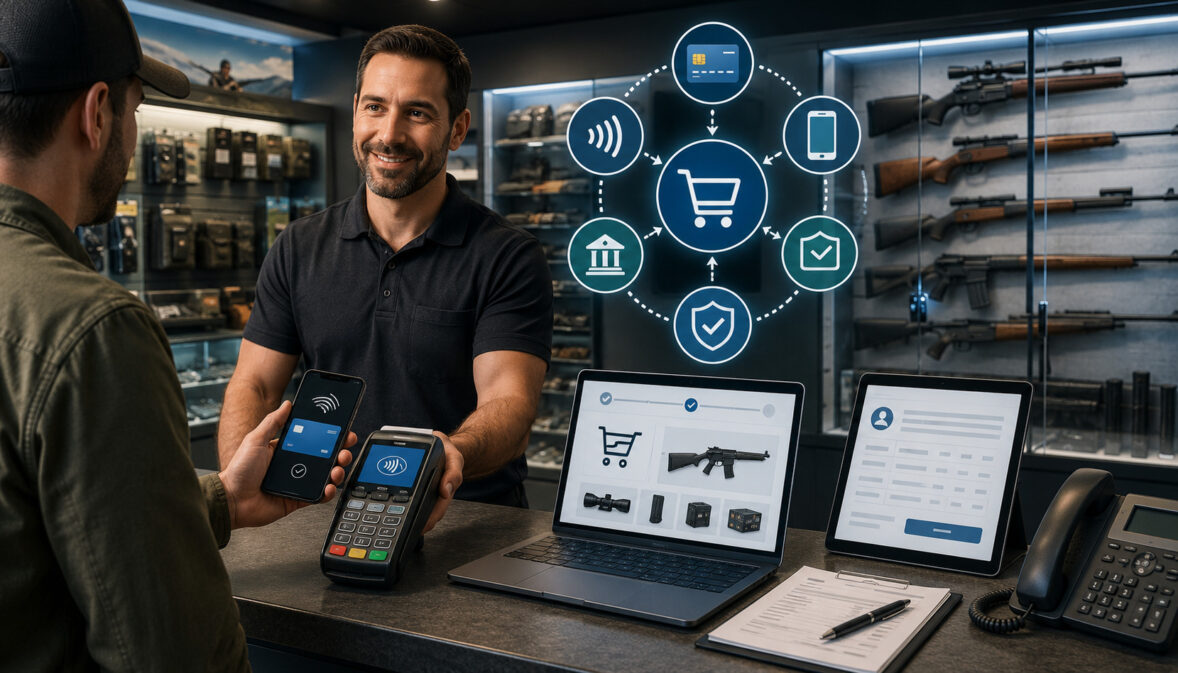
Multi-channel payment processing for firearm businesses is no longer just a convenience feature. For many firearm retailers, FFL dealers, gun shops, shooting ranges, firearm accessory sellers, outdoor sporting goods stores, and online firearm-related sellers, customers may interact with the business in several different ways before a payment is completed.
A customer may browse accessories online, visit a retail counter, call about a custom order, pay an invoice for gunsmithing work, register for a training class, renew a range membership, or complete a purchase at an event.
Each of these situations may require a different payment method, different fraud controls, different records, and different approval from the payment processor.
That is why multi-channel payments should be planned carefully. A firearm business cannot simply add every available payment tool without thinking about underwriting, product rules, payment security, website compliance, chargebacks, settlement reporting, and processor-approved activity.
Firearm payment processing is often reviewed more closely than ordinary retail processing because the products, licensing requirements, customer verification concerns, and card-not-present risks may be different.
A strong payment setup helps the business accept card-present payments, card-not-present payments, online checkout, mobile transactions, invoices, payment links, virtual terminal payments, ACH payments, and recurring billing where appropriate.
However, the most important goal is not just accepting more payments. The goal is accepting payments in a secure, organized, and clearly disclosed way.
Multi-channel merchant services for firearm businesses should support customer convenience while also protecting account stability. That means clear documentation, accurate underwriting information, secure tools, trained staff, organized receipts, consistent refund practices, strong fraud prevention, and regular reconciliation.
What Is Multi-Channel Payment Processing for Firearm Businesses?
Multi-channel payment processing for firearm businesses means accepting payments through more than one approved sales channel. Instead of relying only on a retail countertop terminal, the business may also use an online checkout, payment gateway, mobile card reader, virtual terminal, invoice tool, payment link, ACH option, or recurring billing platform.
The idea is simple: customers do not always buy in the same way. A retail customer may pay with a chip card at the counter. A range member may pay recurring fees. A training student may register online.
A customer placing a custom order may pay a deposit through an invoice. A buyer at an event may use a mobile card reader. A customer calling about accessories or services may complete payment through a virtual terminal.
For firearm businesses, every payment channel should be connected to the actual business model. A retail gun shop may need in-store firearm payment processing and online firearm payment processing for accessories.
A shooting range may need retail POS tools, membership billing, mobile checkout, and event registration payments. An FFL transfer business may need invoice payments, deposits, and service-fee processing. An outdoor sporting goods retailer may need both retail checkout and eCommerce payment tools.
Multi-channel payment solutions for gun shops are useful because they help centralize customer payment activity. But they also require discipline. Each channel creates different risk. In-store card-present payments usually have different fraud exposure than card-not-present payments.
Online firearm eCommerce payments require website policies, product review, shipping disclosures, and gateway approval. Mobile payments for firearm businesses may require confirmation that off-site or event-based use is permitted.
A firearm merchant account should reflect the real way the business accepts payments. Processors may review licensing information, ownership details, product catalog, expected sales volume, average ticket size, website content, refund policy, chargeback history, and the payment channels being used. Firearm businesses that want stable processing should keep those details accurate and current.
Multi-Channel Payments vs Single-Channel Payments
Single-channel payment processing means the business accepts payments through one main method. For example, a small shop may only accept in-store card payments through a countertop terminal.
That setup may be easier to manage because most transactions happen in one place, under one workflow, with one set of receipts and one settlement report.
Multi-channel payments are different. A business may accept credit card processing at the counter, debit card payments through a POS system, digital wallets through tap-to-pay, online payments through a payment gateway, phone payments through a virtual terminal, invoices through email, mobile payments at events, and ACH payments for certain invoices or recurring arrangements.
The benefit is flexibility. Customers can pay in the setting that fits the transaction. Staff can collect deposits, take payments for repairs, support online accessory orders, and process range membership fees without forcing every customer to stand at a retail counter.
The challenge is organization. Every payment channel has its own records, security expectations, refund process, and dispute risk. A phone order may need stronger customer verification.
An online checkout may need fraud screening and clear shipping rules. A mobile card reader may need device controls. A recurring billing setup may need written consent and cancellation terms.
Multi-channel payment processing for firearm businesses works best when each channel has a defined purpose. The business should know which channel is used for retail sales, which channel is used for online checkout, which channel is used for deposits, which channel is used for invoices, and which channel is used for events.
Why Firearm Businesses Need Approved Payment Channels
Firearm-related businesses should use only payment channels that have been reviewed and approved for their business activity. This matters because payment processors, acquiring banks, gateways, and card network rules may evaluate firearm businesses based on product type, sales channel, licensing status, website content, transaction behavior, and risk exposure.
A merchant account is usually approved based on the information submitted during underwriting. If the application describes only in-store sales but the business later begins accepting online firearm eCommerce payments, phone orders, mobile event payments, or payment links for regulated products, the account profile may no longer match actual activity.
That mismatch can create risk. Processors may question why new channels were added, whether the product catalog was reviewed, whether the website policies are complete, whether the business is processing for itself only, and whether customer verification procedures are adequate.
In some cases, undisclosed activity may lead to funding holds, additional reserves, processing limits, account review, suspension, or termination.
Approved payment channels also help with transaction monitoring. If a processor expects retail card-present payments but suddenly sees a high volume of card-not-present payments, remote transactions, or larger-ticket online orders, the activity may appear unusual. When channels are disclosed up front, the processor can better understand expected transaction patterns.
Firearm businesses should also consider licensing and documentation. The federal licensing agency explains that those engaged in certain firearm business activities must apply for a federal firearms license, and payment reviewers may ask for relevant FFL documentation where applicable.
Why Firearm Businesses Use Multiple Payment Channels
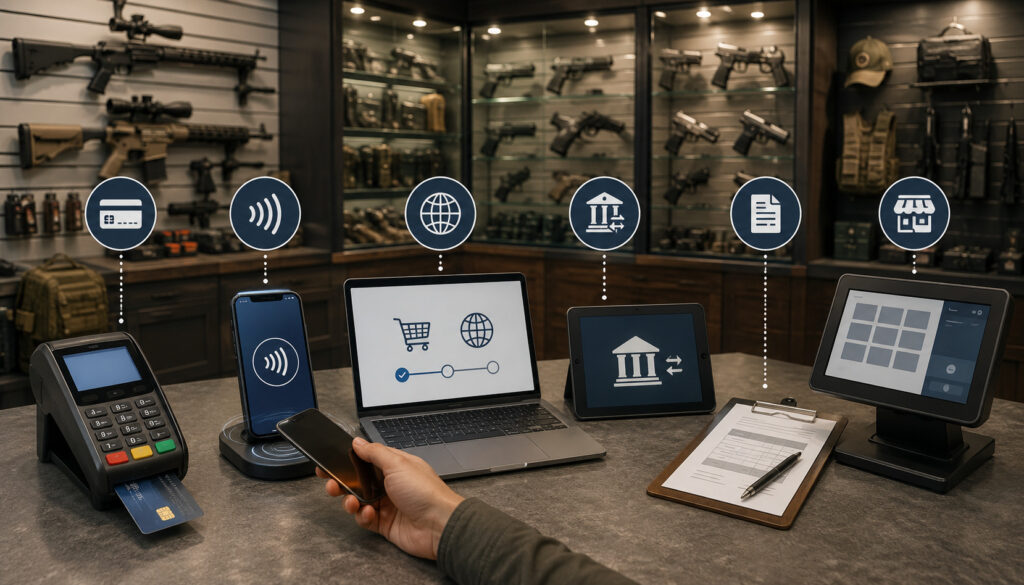
Firearm businesses use multiple payment channels because their revenue does not always come from one type of sale. A retail shop may sell firearms, accessories, optics, safes, apparel, cleaning supplies, and outdoor gear.
A shooting range may collect lane fees, membership dues, class registrations, rentals, retail purchases, and event payments. An FFL dealer may process transfers, custom orders, deposits, service fees, and special-order payments.
A single terminal at the counter may not support all of those needs. In-store firearm payment processing may be ideal for walk-in customers, but it may not help when a customer wants to pay an invoice from home.
Online checkout may support accessory sales, but it may not be appropriate for every regulated product or every fulfillment workflow. A virtual terminal may help with phone orders, but it requires careful card-not-present controls.
Multi-channel payment solutions for gun shops can make operations smoother when they are planned around the customer journey.
A customer might first ask about a product by phone, receive an invoice for a deposit, visit the store for required steps, and later buy accessories online. A range member might pay monthly dues automatically, purchase ammunition at the counter, and register for training through an online form.
Multiple channels can also support cash flow. Payment links may help collect balances faster. Mobile payments may support off-site events where approved. ACH payments may be useful for certain invoices or recurring payments when properly authorized. Reporting tools can help owners see which channels produce revenue and which channels require closer review.
However, more channels also mean more responsibility. Firearm business payment solutions should include fraud prevention, chargeback prevention, PCI compliance, tokenization, encryption, website compliance, staff training, and consistent settlement reporting. Flexibility should never come at the cost of unclear records or unapproved processing.
In-Store, Online, and Mobile Customer Expectations
Customers increasingly expect payment options that match the buying environment. In a retail store, they may expect chip cards, debit card payments, tap-to-pay, and digital wallets.
For online accessory orders, they may expect secure checkout, clear shipping information, and order confirmation. For classes or range events, they may expect registration links or invoice-based payments.
Payment flexibility can improve the customer experience. A customer who can pay a deposit through a secure invoice may be less likely to delay a custom order. A range member who can use recurring billing may find membership easier to maintain. A shopper buying accessories online may appreciate a checkout process that is secure, clear, and easy to complete.
For firearm businesses, convenience must be balanced with compliance awareness. Customer expectations do not override processor terms, product restrictions, licensing obligations, age-restricted product concerns, shipping rules, or documentation requirements.
A payment channel should support the transaction only when the business has confirmed that the channel is appropriate for the product and sale type.
Mobile payments for firearm businesses are a good example. A mobile card reader may be useful for an event, outdoor sporting sale, or range activity, but the business should confirm whether off-site use is allowed.
Staff should also know how to secure the device, issue receipts, document the transaction, and follow the same product and customer verification procedures used in the main location.
Supporting Different Firearm Business Models
Not every firearm-related business needs the same payment setup. A retail gun shop may prioritize firearm POS payment processing, inventory integration, chip card acceptance, customer receipts, refund controls, and end-of-day reconciliation. Its main risk may be managing high-ticket purchases, staff permissions, and accurate product records.
An FFL transfer business may need invoice tools, deposits, service-fee payments, and clear documentation tied to each transfer. It may not need the same eCommerce setup as an online accessory seller, but it may need strong records that connect customer communication, payment authorization, and service completion.
A shooting range may need lane-fee payments, recurring memberships, class registrations, waivers, rentals, retail purchases, and event payments. Recurring billing and payment links may be more important for this model than for a simple retail counter.
An online firearm-related business may need a payment gateway for firearm businesses, website review, product catalog review, customer verification, clear fulfillment disclosures, fraud screening, and strong card-not-present controls. Online firearm payment processing often receives more review because the customer is not physically present at checkout.
An outdoor sporting goods retailer may have a mixed catalog. Some items may be ordinary retail goods, while other items may be age-restricted or subject to additional policy review. The payment setup should clearly identify the business model, product categories, and sales channels.
Common Payment Channels for Firearm Businesses
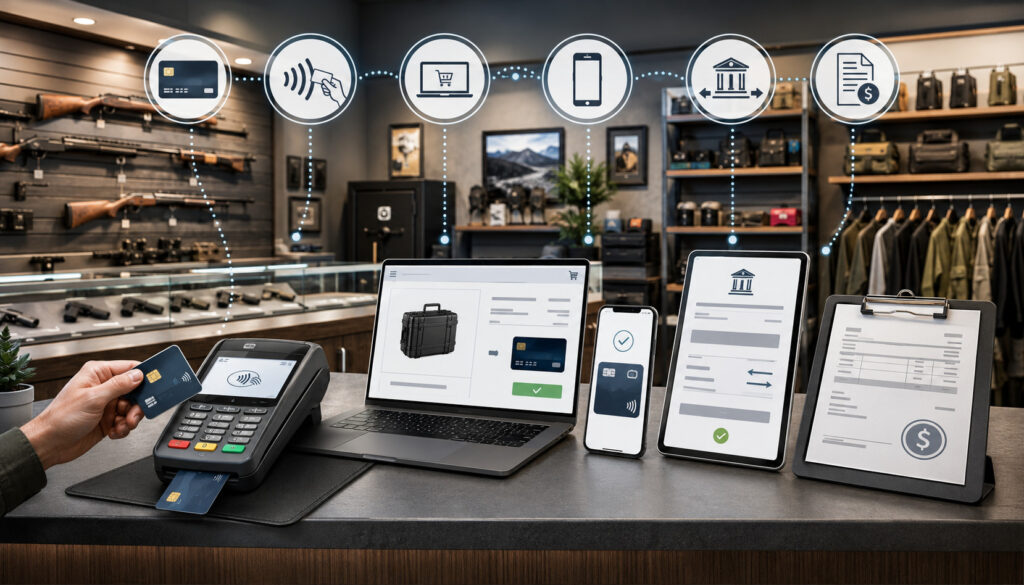
Firearm businesses may use several payment channels depending on their approved business model. The most common include retail POS terminals, online checkout, payment gateways, virtual terminals, payment links, invoices, mobile card readers, ACH payments, and recurring billing.
A retail POS terminal is typically used for card-present payments at the counter. A customer inserts a chip card, taps a contactless card, swipes when needed, or uses a digital wallet. The POS system may also connect sales, receipts, refunds, staff permissions, and inventory records.
Online checkout is used for eCommerce transactions. For firearm-related businesses, this channel requires careful review because website content, product descriptions, shipping policies, restrictions, refund terms, customer service details, and gateway approval may all affect processing.
A virtual terminal allows staff to enter payment details manually, often for phone orders or custom invoices. This can be useful, but it carries card-not-present risk. Staff should follow strict procedures and avoid storing card details insecurely.
Payment links and invoices can help collect deposits, balances, class payments, service fees, and remote payment requests. The customer receives a secure link or invoice and completes payment through an approved payment page. These tools can reduce manual entry if configured correctly.
Mobile card readers allow portable payment acceptance at ranges, events, shows, classes, or temporary checkout points when approved. ACH payments may be used for certain invoices or recurring arrangements with proper authorization and return handling.
Recurring billing may support range memberships, training subscriptions, or service plans where appropriate and clearly disclosed.
The best setup is not always the setup with the most features. It is the setup where each channel is approved, secure, documented, and connected to reliable reporting.
Retail POS and Card-Present Payments
Retail POS and card-present payments are often the foundation of gun store payment processing. In this setup, the customer is physically present and pays through a terminal or integrated POS system. Common payment methods include chip cards, contactless cards, debit card payments, and digital wallets.
A strong POS setup should support fast checkout, accurate receipts, refund controls, staff logins, manager permissions, and end-of-day reconciliation. When the POS system connects with inventory and sales records, staff can more easily match transactions to products, returns, and deposits.
For firearm POS payment processing, staff permissions are especially important. Not every employee should have access to refunds, voids, manual discounts, settlement settings, or reporting exports. Role-based access can reduce mistakes and help owners identify who processed a transaction, refund, or adjustment.
Card-present payments may have lower fraud exposure than remote payments, but they still require security. Terminals should be secure, updated, and protected from tampering. Receipts should be clear. Refunds should follow written policy. Staff should know how to handle declined transactions, partial approvals, duplicate charges, and customer disputes.
Online Checkout and Card-Not-Present Payments
Online checkout allows customers to pay through a website or hosted checkout page. For firearm-related businesses, online firearm payment processing requires more than simply adding a payment button. The website, product catalog, sales policies, shipping details, customer service information, and payment gateway must be aligned with processor approval.
Card-not-present transactions carry higher fraud and chargeback risk because the cardholder is not physically at the terminal. Businesses should use fraud tools such as address verification, CVV checks, velocity controls, order review, customer verification, and transaction monitoring. Higher-risk orders may require additional review before fulfillment.
A payment gateway for firearm businesses should support secure checkout, encryption, tokenization where available, fraud screening, reporting, refunds, and integration with the online store. The gateway should also be approved for the product types and sales channels being used.
Website compliance matters. Product pages should be accurate, policies should be visible, and the checkout process should make customer obligations clear. Refund policy, shipping policy, privacy policy, terms and conditions, contact information, and customer service details all help reduce confusion and disputes.
Online firearm eCommerce payments should also be connected to fulfillment procedures. If an item requires special handling, transfer steps, shipping restrictions, or customer verification, those expectations should be stated before payment. Clear communication can reduce cancellations, chargebacks, and customer complaints.
Multi-Channel Payment Solutions for Gun Shops Compared
The table below compares common payment channels used in multi-channel payment processing for firearm businesses. It is not a recommendation to use every channel. Instead, it helps owners, managers, payment teams, and compliance staff think through which tools fit their approved sales activity.
| Payment Channel | Best For | Benefits | What to Review |
| Retail POS | In-store firearm and accessory sales | Fast checkout and clear receipts | Terminal compatibility and staff permissions |
| Online checkout | eCommerce firearm-related sales | Supports remote purchases | Website policies and gateway approval |
| Virtual terminal | Phone or manual orders | Useful for custom orders | Card-not-present risk and authorization |
| Payment links | Invoices and remote payment requests | Convenient for follow-up payments | Link security and confirmation |
| Mobile card readers | Events, ranges, and off-site sales | Portable payment acceptance | Approved use and device security |
| ACH payments | Certain invoices or recurring payments | Alternative payment option | Authorization and return handling |
| Recurring billing | Range memberships or subscriptions | Predictable revenue | Clear consent and cancellation terms |
| Reporting tools | All sales channels | Better reconciliation | Batch, refund, and chargeback reports |
A firearm business should choose channels based on actual customer needs, approved product categories, risk controls, staff capability, and reporting requirements. Adding more channels can improve flexibility, but it can also increase operational complexity.
The business should be able to explain why each channel is used, which products it supports, who manages it, and how records are stored.
Multi-channel payment solutions for gun shops are strongest when the channels work together. For example, retail POS payments, eCommerce transactions, invoices, and mobile payments should all feed into reporting that helps the business track sales, refunds, chargebacks, fees, and deposits.
How to Use the Table Before Choosing Payment Channels
The table should be used as a planning tool. A firearm business can start by listing each type of sale it accepts. Then it can match each sale type to the most appropriate payment channel. Walk-in retail purchases may belong at the POS terminal.
Range memberships may fit recurring billing. Repair deposits may work through invoices. Approved event sales may require mobile card readers.
The next step is reviewing risk. In-store payments may need strong staff permissions and refund controls. Online payments may need website policies and fraud screening. Phone payments may need manual authorization procedures and clear records. ACH payments may need written authorization, return procedures, and customer communication.
Businesses should also compare documentation needs. Some channels create automatic receipts and order confirmations. Others require staff to manually attach notes, invoices, shipping records, or customer communication. A channel that is convenient but poorly documented can create problems during disputes or account reviews.
Funding speed and reporting should also be considered. Card-present payments, card-not-present payments, ACH payments, and recurring payments may settle differently. Fees may also vary by channel. A good decision includes both customer convenience and back-office clarity.
Why Every Channel Should Be Reviewed During Underwriting
Underwriting is the process payment providers use to evaluate a merchant before approving processing.
For firearm businesses, underwriting may include business verification, FFL documentation where applicable, product review, website review, ownership information, bank statements, processing history, chargeback history, expected monthly volume, average ticket size, and sales channel disclosure.
Every payment channel matters because each one changes the risk profile. In-store card-present payments show one type of risk. Online checkout introduces card-not-present fraud, website policy review, fulfillment issues, and product catalog concerns.
Phone orders create manual-entry risk. Mobile card readers may raise location and device-security questions. Recurring billing requires consent and cancellation clarity.
Processors may ask whether the business accepts in-store payments, online payments, phone payments, invoices, payment links, event payments, mobile payments, or recurring payments. They may also ask which products are sold through each channel. This helps them understand whether the merchant account is structured correctly.
If a business adds a channel later, the payment provider may need to update the account profile. This is not only a paperwork issue. It can affect transaction monitoring, reserves, funding timelines, gateway permissions, and chargeback expectations.
A transparent underwriting process helps reduce surprises. Firearm businesses should be ready to explain how payments flow from customer order to authorization, settlement, fulfillment, refund, and reporting.
Merchant Account Requirements for Multi-Channel Firearm Payments
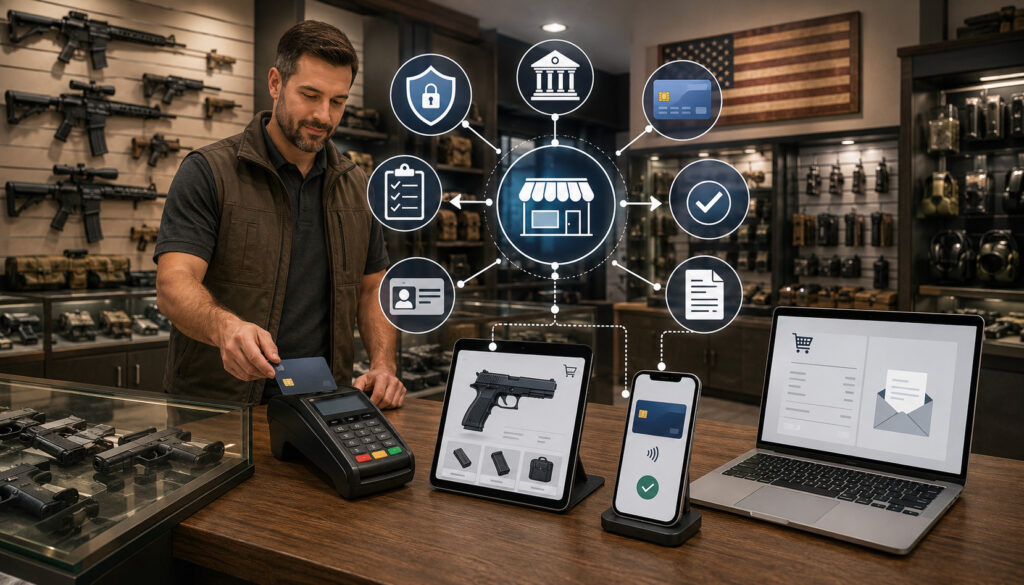
A firearm merchant account used for multi-channel payments may require more documentation than a standard retail account. The goal of underwriting is to understand who owns the business, what the business sells, where it sells, how it accepts payments, how much volume it expects, and whether its risk controls are adequate.
Common documentation may include business registration details, ownership information, responsible party details, banking information, recent bank statements, processing statements, chargeback history, product lists, website URL, refund policy, shipping policy, privacy policy, terms and conditions, and FFL documentation where applicable.
The federal licensing agency notes that license applications involve review of required materials and background checks for responsible persons, which helps explain why accurate ownership and licensing records may matter in regulated firearm activity.
Underwriters may also review the business model. A retail-only shop, range, gunsmith, FFL transfer dealer, online accessory seller, and outdoor sporting goods retailer may have different risk profiles. Expected volume, average ticket size, high-ticket transactions, recurring billing, card-not-present sales, and event activity may all affect the review.
Multi-channel merchant services for firearm businesses should be built around disclosed sales activity. If the account is approved for retail POS only, the business should not assume that online checkout, phone orders, payment links, ACH payments, or mobile event sales are automatically included.
Disclosing All Sales Channels During Application
Firearm businesses should disclose every payment channel they plan to use during the merchant account application. This includes in-store payments, online checkout, phone orders, virtual terminal use, invoices, payment links, mobile readers, event payments, ACH payments, and recurring billing.
Honest disclosure helps the processor understand actual business activity. It also gives the business a chance to confirm which channels are approved before accepting transactions. If a business expects to add eCommerce in the near future, it is better to mention that plan early instead of waiting until after the website begins processing payments.
Hidden or undisclosed channels may create problems later. A processor may see transaction patterns that do not match the account profile. For example, a retail-only account may suddenly show a large number of keyed transactions, remote payments, or online gateway transactions. That can trigger a risk review.
Disclosure is also important for product categories. A business may sell firearms, ammunition, accessories, optics, apparel, safes, training classes, range memberships, repairs, or outdoor sporting goods. Each category may have different review considerations.
Keeping Documentation Current
Documentation is not only needed during application. Firearm businesses should keep records current throughout the life of the merchant account. This includes licenses, ownership information, business address, bank details, website policies, product details, transaction records, refund records, chargeback documentation, and processor communications.
If the business changes ownership, moves locations, adds a website, expands product categories, opens a range, starts classes, adds recurring billing, or begins event-based sales, payment documentation may need to be updated. Processor notices should be saved, and important communications should be easy to find.
Current documentation can help during account reviews. If the processor asks for proof of licensing, product information, fulfillment records, or chargeback evidence, the business should be able to respond quickly. Delayed or incomplete responses can make reviews more difficult.
Website documentation should also stay updated. Old refund policies, missing shipping information, outdated contact details, or unclear terms can create customer confusion and underwriting concerns. Online checkout pages should reflect the actual sales process.
Organized documentation also helps internal operations. Managers can train staff more easily, accounting teams can reconcile deposits more accurately, and owners can identify which channels need improvement.
Website and Checkout Requirements for Online Firearm Payments
Website compliance is especially important for online firearm payment processing. A website is often reviewed before gateway approval, and it may be reviewed again if chargebacks, suspicious activity, customer complaints, or product changes occur.
A firearm-related website should clearly show what is being sold, who is selling it, how customers can contact the business, what policies apply, and what restrictions or requirements may affect fulfillment. Product pages should be accurate. Checkout should be secure. Policies should be visible before payment.
Important pages may include refund policy, shipping policy, privacy policy, terms and conditions, contact page, customer service details, and any product-specific purchase or fulfillment disclosures. These pages help customers understand the transaction and help payment reviewers understand the business.
A secure checkout should use encryption and should avoid exposing payment data to unnecessary systems. Tokenization can reduce the need to store card details. Hosted payment pages or secure gateway integrations may help reduce payment data handling, depending on the setup.
For age-restricted products or regulated items, customer verification and fulfillment procedures should be carefully documented. This article is not legal advice, so businesses should consult qualified professionals for specific legal, regulatory, or contract questions.
Clear Product Listings and Sales Policies
Clear product listings help both customers and payment reviewers understand what is being sold. Product pages should use accurate titles, descriptions, categories, prices, availability details, and relevant restrictions. Confusing product pages can lead to customer complaints, disputes, and underwriting questions.
Firearm-related catalogs may include a mix of products. Some products may be regulated, while others may be accessories, apparel, outdoor gear, safes, optics, cleaning supplies, or training services. Clear categories help separate product types and reduce confusion during review.
Sales policies should explain how orders are handled. If certain items require special fulfillment steps, transfer procedures, shipping limitations, customer verification, or in-person completion, those details should be stated before checkout. Customers should not discover important restrictions only after payment.
Policies should also explain cancellations, deposits, backorders, special orders, substitutions, service fees, and refund timing where relevant. These details help reduce chargebacks because customers have a clearer understanding of what they agreed to.
Product catalog review may be part of underwriting. If a processor or gateway asks for clarification, a well-organized website can make the review easier and more credible.
Refund, Shipping, Privacy, and Terms Pages
Refund, shipping, privacy, and terms pages are essential for firearm eCommerce payments. They create customer-facing clarity and support account stability. Payment reviewers often look for these pages because unclear policies can increase disputes and chargeback risk.
A refund policy should explain when refunds are available, how they are requested, how long they may take, and whether special orders, deposits, classes, memberships, or certain product categories have different rules. The policy should be fair, clear, and consistent with actual business practice.
A shipping policy should explain fulfillment timing, shipping methods, restrictions, delivery expectations, and any special procedures that apply to regulated or restricted items. If fulfillment depends on customer action or third-party steps, that should be stated clearly.
A privacy policy should explain how customer information is collected, used, and protected. A terms and conditions page should explain the general rules for using the website and purchasing from the business.
These pages do not eliminate disputes, but they reduce confusion. They also provide documentation if a customer later claims they were not informed about refund limits, shipping timing, or order requirements.
Payment Security Across Multiple Channels
Secure payment processing for firearm businesses becomes more complex when payments are accepted across several channels. In-store terminals, online checkout, virtual terminals, payment links, invoices, mobile card readers, ACH tools, and recurring billing systems all require secure handling.
PCI compliance is central to payment security. The PCI Data Security Standard was developed to support consistent technical and operational requirements for protecting payment account data. Firearm businesses should work with payment tools and procedures that reduce exposure to card data and avoid insecure storage.
Tokenization and encryption can help protect payment information. Tokenization replaces sensitive card details with a token that can be used for future transactions without storing the actual card number in ordinary business systems. Encryption helps protect data while it is transmitted or stored by approved systems.
Staff permissions also matter. Employees should use unique logins, not shared passwords. Refunds, voids, manual entry, settlement changes, reporting exports, and recurring billing access should be limited to appropriate roles. Audit logs can help identify who performed sensitive actions.
Mobile devices and terminals should be protected from loss, theft, tampering, and unauthorized use. Online checkout credentials should use strong passwords and multi-factor authentication where available. Staff should never write down full card numbers, store card details in spreadsheets, or send payment information through insecure messages.
Protecting Payment Data in Every Channel
Each payment channel creates a different payment data environment. In-store terminals should be secure, updated, and checked for tampering. Online checkout should use a secure gateway and avoid unnecessary exposure to card data. Virtual terminals should be used only by trained staff through approved systems.
Payment links and invoices should direct customers to secure payment pages, not request card numbers by email or message. Mobile card readers should be paired only with approved devices and protected by passwords or device management controls. Recurring billing should use tokenized credentials when available rather than stored card numbers.
ACH payments also require secure handling of bank account information and clear authorization records. Return handling should be documented, and customer communication should be consistent.
Firearm businesses should map where payment data enters, where it is transmitted, where it is stored, who can access it, and how it is deleted or protected. This process helps identify weak points. For example, a business may have secure terminals but poor procedures for phone payments. Or it may have a secure gateway but too many staff members with refund access.
Staff Access Controls and Device Security
Staff access controls are a practical part of secure payment processing. Every employee should have access only to the tools needed for their role. A cashier may need to process sales but not issue large refunds. A manager may need refund authority but not gateway administration access. An accounting employee may need reports but not transaction entry rights.
Unique logins are important because they create accountability. Shared passwords make it difficult to determine who processed a refund, changed a setting, exported a report, or entered a manual transaction. Passwords should be strong, changed when needed, and removed immediately when an employee leaves.
Device security is equally important. POS terminals, tablets, phones, mobile card readers, and back-office computers should be protected from unauthorized access. Devices should not be left unattended in public areas. Software updates should be installed as recommended by providers. Suspicious device behavior should be reported.
Audit logs can help identify unusual activity, such as refunds outside normal hours, repeated failed login attempts, or manual transactions by unauthorized users. Managers should review these logs periodically.
Security training should be practical. Staff should know what to do if a customer reads card details over the phone, if a device is lost, if a payment link seems suspicious, or if a transaction appears fraudulent.
Fraud and Chargeback Prevention for Multi-Channel Payments
Multi-channel payments can increase fraud and chargeback exposure if controls are weak. Card-not-present transactions are especially important because the customer is not physically present with the card. Online checkout, phone orders, payment links, invoices, and recurring billing all need appropriate verification and documentation.
Fraud may appear as suspicious order patterns, mismatched billing and shipping information, unusually large orders, repeated failed attempts, rush shipping requests, multiple cards from the same customer, or inconsistent customer details. Businesses should define procedures for reviewing and escalating suspicious transactions.
Chargebacks may result from fraud, unclear policies, delayed shipping, duplicate billing, poor communication, refund delays, unclear billing descriptors, product misunderstandings, or weak records. Multi-channel businesses should track chargebacks by channel. If most disputes come from online orders or phone payments, controls for those channels may need improvement.
Chargeback prevention starts before the sale. Product pages should be accurate. Policies should be clear. Receipts should be easy to understand. Customer communication should be timely. Shipping and fulfillment expectations should be documented. Refunds should follow written policy.
For high-risk payment processing, chargeback ratios and dispute history may affect account stability. A firearm business should not wait until disputes become serious before reviewing its process.
Fraud Controls for Online and Phone Payments
Online and phone payments need stronger controls than ordinary in-store payments. Address verification, CVV checks, customer verification, order review, and velocity monitoring can help identify suspicious activity.
Businesses should also watch for repeated orders from the same IP address, multiple cards used for one order, unusual shipping destinations, or order details that do not match customer history.
For phone orders, staff should use approved virtual terminal procedures. They should not write down card details, store card numbers, or process transactions outside approved systems. If a customer asks to use a different card after several declines, staff should follow escalation procedures.
Online checkout should include fraud-screening rules that fit the business model. Very strict rules may block legitimate customers, while weak rules may allow suspicious transactions. The goal is balanced risk management.
Customer verification may be especially important for age-restricted products or regulated items. The payment process should support the business’s broader compliance procedures, not replace them.
Chargeback Prevention Through Clear Records
Clear records are one of the strongest chargeback prevention tools. When a dispute occurs, the business may need to provide receipts, invoices, order confirmations, customer communication, shipping records, delivery confirmation, refund records, and payment authorization details.
For in-store transactions, records may include signed receipts where applicable, itemized receipts, refund receipts, and POS logs. For online transactions, records may include order details, customer account information, payment authorization, fraud-screening results, shipping confirmation, and customer messages.
For invoices and payment links, records should show what the customer was paying for, when the invoice was sent, when payment was completed, and what terms applied. For recurring billing, the business should keep consent records, billing schedule, cancellation terms, and customer communications.
Chargeback records should be organized by channel. If disputes repeatedly occur from one channel, the business can identify the cause more easily. For example, unclear shipping language may affect online sales, while staff errors may affect phone payments.
A clear refund process also reduces chargebacks. Customers often file disputes when they cannot reach the business, do not understand policy, or believe a refund is delayed. Fast communication can prevent some disputes before they reach the payment network.
Reporting and Reconciliation Across Payment Channels
Reporting becomes more important as payment channels increase. A single retail terminal may produce a simple daily batch report. A multi-channel setup may include POS reports, gateway reports, online order reports, mobile reader reports, virtual terminal payments, ACH records, recurring billing reports, refunds, chargebacks, fees, and bank deposits.
Reconciliation means matching transactions to orders, batches, deposits, refunds, fees, and accounting records. Without regular reconciliation, a business may not notice missing deposits, duplicate payments, unsettled batches, refund errors, or chargeback deductions.
Settlement timing may differ by channel. Card-present payments, card-not-present payments, ACH payments, and recurring billing may not all deposit on the same schedule. Fees may be deducted daily, monthly, or from batches depending on the processing arrangement. Reserves or holds may also affect deposits.
Multi-channel reporting should help the business answer basic questions. How much came from in-store sales? How much came from online checkout? How many refunds were issued by channel? Which channels had chargebacks? Which deposits matched which batch reports? Were there any transactions above normal ticket size?
Strong reporting supports accounting, tax preparation, fraud review, customer service, and processor communication. It also helps owners make better decisions about staffing, promotions, inventory, and payment channel expansion.
Matching Transactions to Orders and Deposits
Matching transactions to orders and deposits is essential for financial clarity. Each payment should connect to a sale, invoice, membership, class registration, service order, or customer account. Each batch should connect to a deposit. Each deposit should connect to accounting records.
A common problem in multi-channel payments is fragmented reporting. The POS system may show one total, the payment gateway may show another, the bank deposit may reflect fees or reserves, and the eCommerce platform may show refunds separately. Without a process, staff may struggle to explain differences.
Businesses should reconcile daily or on a consistent schedule. Start with gross sales by channel. Then subtract refunds, chargebacks, fees, reserves, and adjustments. Compare the result to deposits. Investigate differences promptly.
Virtual terminal payments and payment links should be labeled clearly so accounting teams know what each payment represents. Mobile transactions should be tied to the event, staff member, or location where they occurred.
Tracking Channel-Level Performance
Channel-level reporting helps firearm businesses understand where revenue is coming from and where problems are developing. A business may discover that in-store sales have low dispute rates, while online orders create more manual review. Or it may find that mobile event payments are convenient but require better device procedures.
Tracking performance by channel can include sales volume, average ticket size, refund rate, chargeback rate, decline rate, fraud alerts, settlement timing, fees, and customer complaints. These numbers help owners make informed decisions.
If online checkout produces strong revenue but higher disputes, the solution may not be to remove online payments. The better answer may be clearer product pages, stronger fraud screening, improved shipping communication, or better customer service response times.
If mobile payments are used rarely but create reconciliation problems, the business may need better event procedures or fewer staff with mobile access. If phone orders have repeated errors, staff training may need improvement.
Channel-level analysis also helps with processor communication. If volume increases because of a range event, seasonal promotion, or online campaign, the business can better explain the source of the activity.
Funding Timelines, Reserves, and Processing Limits
Multi-channel merchant services for firearm businesses may include funding timelines, reserves, holds, processing limits, average ticket limits, and risk monitoring. These terms should be reviewed before the business relies on a payment setup for major sales activity.
Funding timeline refers to when processed funds are deposited into the business bank account. Card-present payments, card-not-present payments, ACH payments, and recurring billing may settle differently. Weekends, banking holidays, batch times, risk reviews, and gateway settings may affect timing.
A reserve is an amount held back to help cover potential chargebacks, refunds, or risk exposure. Reserves may be rolling, fixed, or triggered by certain risk conditions. Holds may apply to specific transactions or batches during review.
Processing limits may include monthly volume limits, transaction limits, average ticket expectations, or maximum ticket thresholds. If a business suddenly processes more than expected, especially through a new channel, the processor may ask questions.
These tools are not always negative. They are often part of risk management in high-risk payment processing. The key is clarity. Firearm businesses should understand what limits apply, what may trigger review, how long holds may last, and what documentation may be requested.
Why Funding May Vary by Payment Channel
Funding may vary by payment channel because each channel carries different risk and settlement rules. In-store card-present payments may have one funding pattern. Online card-not-present payments may have another.
ACH payments may take longer because bank account transfers can return after authorization. Recurring billing may have different review settings depending on customer consent and history.
Mobile payments may also be reviewed differently if they occur outside the main business location. Virtual terminal payments may carry higher risk because card details are manually entered. Payment links and invoices may depend on gateway settings, fraud filters, and settlement configuration.
Fees may also vary. Card-present transactions, keyed transactions, eCommerce payments, ACH payments, and international cards may have different cost structures. The business should review statements carefully instead of assuming all payment channels cost the same.
Funding differences can affect cash flow. A business that relies on quick deposits should understand when each channel settles and whether refunds, chargebacks, reserves, or batch delays can reduce expected deposits.
Understanding Reserves and Volume Limits
Reserves, holds, monthly limits, and ticket limits are common risk management tools. A reserve means a portion of processing funds may be held for a period of time. A hold may delay a specific transaction or batch while it is reviewed. A monthly limit may cap expected processing volume. A ticket limit may flag transactions above a certain amount.
These controls may be based on underwriting, processing history, chargebacks, product type, sales channel, average ticket size, or sudden changes in activity. Firearm businesses may encounter additional review if they process unexpected online volume, unusually large orders, or new mobile/event transactions that were not part of the approved profile.
The best way to manage limits is to understand them before they become a problem. Ask what monthly volume was approved, what average ticket size was expected, whether high-ticket transactions require notice, and whether channel-specific limits apply.
Good communication can help. If the business expects a temporary sales spike, a major event, a new online campaign, or a large custom order, it may be wise to notify the payment provider in advance when appropriate.
Reserves and limits should also be reviewed in contract terms. Businesses should understand how reserves are calculated, how long funds may be held, and what conditions may lead to changes.
Best Practices for Multi-Channel Payment Processing for Firearm Businesses
Multi-channel payment processing for firearm businesses works best when the business treats payment acceptance as a controlled operating system, not just a set of tools. The following best practices can help improve organization, security, and account stability:
- Disclose every payment channel during underwriting.
- Use only processor-approved sales channels.
- Keep FFL and business documents current where applicable.
- Maintain clear website policies.
- Use secure payment gateways and terminals.
- Train staff on channel-specific payment procedures.
- Use fraud tools for online and phone orders.
- Keep receipts, invoices, and shipping records organized.
- Monitor chargebacks by channel.
- Reconcile deposits regularly.
- Review processing limits before major sales events.
- Communicate expected sales spikes when appropriate.
- Avoid processing for another business.
- Protect payment data with PCI-aware practices.
- Review payment reports and processor notices consistently.
These practices are useful because multi-channel payments create more moving parts. A business may have retail payments, online payments, keyed payments, mobile payments, and recurring payments happening in the same week. Without procedures, staff may improvise. Improvisation can create inconsistent records, customer confusion, and payment risk.
Firearm business payment solutions should be documented in a way staff can follow. Policies should explain which channels are allowed, who can use them, how refunds are handled, how suspicious orders are escalated, and how records are saved.
Creating a Channel-Specific Payment Policy
A channel-specific payment policy explains how each payment method should be used. It should cover in-store payments, online checkout, phone orders, mobile payments, invoices, refunds, ACH payments, and recurring billing where applicable.
For in-store payments, the policy may explain accepted payment methods, receipt requirements, refund approval levels, void procedures, and end-of-day batching. For online checkout, it may explain order review, fraud tools, shipping confirmation, product restrictions, and customer communication.
For phone orders and virtual terminal payments, the policy should explain when manual entry is allowed, what customer verification is required, how authorization is documented, and what information must never be stored. For invoices and payment links, it should explain invoice descriptions, due dates, confirmation procedures, and recordkeeping.
For mobile payments, the policy should explain where devices can be used, who can use them, how devices are secured, how receipts are issued, and how transactions are reconciled after events. For recurring billing, it should explain consent, billing schedule, cancellation, failed payments, and customer notices.
Training Staff Across Payment Channels
Staff training is critical because payment mistakes often happen at the point of action. Employees should know which payment methods are allowed, which products can be sold through which channels, how to issue refunds, how to document customer communication, and how to escalate suspicious activity.
Training should be channel-specific. A cashier processing in-store card payments needs different instructions than a staff member handling online orders or phone payments. A range employee using a mobile reader at an event needs device-security training. An office employee sending invoices needs to know how to describe charges clearly and confirm payment.
Staff should also understand card-not-present risk. Phone payments, invoices, and online orders require more verification than ordinary card-present checkout. Employees should know how to spot suspicious behavior, such as rushed orders, mismatched information, repeated declines, or unusual shipping requests.
Refund training is equally important. Inconsistent refunds can create customer frustration and chargebacks. Staff should know when they can issue a refund, when manager approval is required, and how to document the reason.
Regular refreshers help. Payment tools, policies, and processor requirements can change. A short quarterly review may prevent costly mistakes.
Common Mistakes to Avoid With Multi-Channel Firearm Payments
Common mistakes in multi-channel firearm payments usually come from moving too quickly. A business may add a website, virtual terminal, mobile reader, invoice tool, or recurring billing feature without confirming whether the merchant account allows it. The tool may work technically, but technical access does not always mean approved use.
Another mistake is weak website policy. Online checkout without clear refund, shipping, privacy, terms, product, and customer service information can lead to disputes and underwriting concerns. Customers should know what they are buying, how fulfillment works, and what happens if they cancel or request a refund.
Manual card storage is a serious mistake. Staff should not write down full card numbers, store card details in spreadsheets, keep card information in emails, or save payment details in unapproved systems. Approved tools should be used for card storage, tokenization, and recurring billing.
Poor reconciliation is also common. If the business does not match POS totals, gateway reports, mobile transactions, refunds, chargebacks, fees, and deposits, financial records can become confusing. Problems may go unnoticed until accounting, tax preparation, or account review.
Other mistakes include ignoring chargebacks, selling unapproved products, processing payments for another business, using misleading descriptors, failing to respond to processor requests, and treating all channels as if they carry the same risk.
Adding Online or Mobile Payments Without Review
Adding online or mobile payments without review can create significant account risk. A merchant account approved for in-store firearm payment processing may not automatically support online firearm payment processing, firearm eCommerce payments, mobile event payments, phone orders, or payment links.
Online payments require website review, gateway approval, product catalog review, fraud screening, and policy review. Mobile payments may require confirmation that off-site use is allowed. Phone orders may require virtual terminal approval. Recurring billing may require clear customer consent and cancellation terms.
If new channels are added without disclosure, transaction monitoring may flag the account. A sudden shift from card-present payments to card-not-present payments can appear unusual. A spike in keyed transactions, online orders, or event payments may prompt questions.
Possible outcomes can include funding holds, reserves, processing limits, additional documentation requests, suspension, or account termination. These risks can often be reduced by communicating before the channel goes live.
Treating Every Payment Channel the Same
Every payment channel has different risk, documentation needs, security requirements, fees, and customer-service expectations. Treating them the same is a common operational mistake.
In-store payments are usually card-present. They rely on secure terminals, staff permissions, receipts, and batch reconciliation. Online payments are card-not-present. They require fraud screening, website policies, customer verification, order review, and shipping documentation.
Phone orders through a virtual terminal require careful manual-entry procedures. Payment links and invoices require clear descriptions and secure link handling. Mobile payments require device security and approved location use. Recurring billing requires consent, billing schedule clarity, and cancellation procedures.
Fees and settlement timing may also differ. A business that prices products or plans cash flow based only on retail card-present assumptions may be surprised by online payment fees, ACH return timing, or reserve requirements.
The solution is to create channel-specific procedures. Each channel should have its own approval status, use case, staff training, refund process, fraud controls, and reporting steps.
How to Choose Multi-Channel Merchant Services for Firearm Businesses
Choosing multi-channel merchant services for firearm businesses requires more than comparing transaction rates. Rates matter, but account stability, policy fit, supported channels, security tools, reporting, chargeback support, and customer service may matter just as much.
A firearm-related business should review whether the provider understands firearm payment processing, gun shop merchant services, FFL merchant services, online checkout needs, POS integrations, virtual terminal use, mobile payments, payment links, ACH payments, recurring billing, fraud controls, chargeback reporting, and settlement timing.
The business should also review underwriting requirements. A provider that asks detailed questions may be doing important work to match the account to the business model. That can be better than quick approval followed by later account review because activity was misunderstood.
Compatibility is important. The payment gateway should work with the website. The POS system should support retail workflow. Mobile tools should work for approved off-site use. Reporting should be clear enough for accounting teams to reconcile deposits across channels.
Contract terms should be reviewed carefully. Businesses should understand fees, reserves, termination terms, funding timelines, chargeback thresholds, equipment terms, gateway fees, PCI-related requirements, and processing limits. For specific legal, regulatory, or contract interpretation, professional review is recommended.
Questions to Ask Before Choosing a Payment Provider
Before choosing a payment provider, firearm businesses should ask practical questions that match their real operations:
- Do you support firearm-related businesses and FFL merchant services?
- Which product categories are allowed or prohibited?
- Which sales channels are approved: in-store, online, phone, mobile, invoices, ACH, and recurring billing?
- What FFL documentation or business records are required?
- Is online firearm payment processing available for my product mix?
- What website policies must be visible before gateway approval?
- Are mobile card readers approved for events or off-site sales?
- What payment gateway integrations are supported?
- What fraud tools are available for online and phone orders?
- How are chargebacks monitored, reported, and supported?
- Are reserves, holds, monthly limits, or ticket limits likely?
- What funding timelines apply by channel?
- What reports are available for reconciliation?
- How are processor notices and policy updates communicated?
These questions help the business compare more than marketing claims. They also encourage accurate disclosure. A provider should understand the actual mix of products, channels, average tickets, expected volume, and customer payment behavior.
Comparing More Than Transaction Rates
Choosing payment solutions based only on advertised rates can be risky. A low rate may not help if the account does not support the business’s actual sales channels, product categories, or risk profile. For firearm businesses, policy fit and stability are essential.
A business should compare account approval quality, underwriting clarity, gateway compatibility, POS support, mobile use rules, chargeback assistance, reporting quality, security tools, and customer support. The cheapest option may become expensive if it leads to frozen funds, unclear reserves, poor reporting, or unsupported online payments.
Transaction rates should still be reviewed. Businesses should understand card-present pricing, card-not-present pricing, keyed transaction costs, gateway fees, ACH costs, chargeback fees, monthly fees, PCI-related fees, equipment terms, and early termination terms where applicable.
Support quality matters because payment issues can affect daily operations. If a batch does not settle, a gateway declines legitimate orders, a mobile reader fails during an event, or a chargeback arrives, the business needs timely help.
Good multi-channel payment solutions for gun shops balance cost, approval fit, security, reporting, and operational support.
Multi-Channel Payment Processing Checklist
The following checklist can help firearm businesses review readiness before expanding payment channels or evaluating firearm business payment solutions.
| Review Area | What to Check | Why It Matters |
| Sales channels | In-store, online, phone, mobile, invoices | Supports accurate underwriting |
| Documentation | FFL, business records, bank details | Helps approval and reviews |
| Website policies | Refund, shipping, privacy, terms | Reduces disputes and risk |
| Payment security | PCI, tokenization, encryption | Protects card data |
| Fraud controls | AVS, CVV, order review | Reduces suspicious transactions |
| Chargebacks | Dispute tracking by channel | Protects account stability |
| Reporting | POS, gateway, deposits, refunds | Supports reconciliation |
| Staff training | Channel-specific procedures | Reduces mistakes |
| Processing limits | Volume and ticket thresholds | Helps avoid risk reviews |
| Processor communication | Notices, policy updates, requests | Keeps account informed |
This checklist should be used before launching new online checkout, adding mobile payments, sending payment links, accepting phone orders, starting recurring billing, or expanding product categories. It is also useful after chargebacks, funding delays, or processor requests.
Firearm businesses should not treat the checklist as a one-time task. Payment operations change as the business grows. A channel that worked well at low volume may need stronger controls at higher volume. A website that was complete at launch may become outdated after new product categories are added.
How Often to Review the Checklist
A firearm business should review its payment checklist regularly and whenever operations change. A practical schedule may include monthly reconciliation review, quarterly policy review, and a deeper review before launching a new sales channel or major promotion.
The checklist should also be reviewed before adding a website, mobile card reader, virtual terminal, payment links, ACH payments, recurring billing, new product categories, new locations, event sales, or expanded range services. These changes can affect underwriting, fraud controls, reporting, and settlement expectations.
Chargebacks should trigger review as well. If disputes increase, the business should identify which channel is responsible and why. Online orders may need better shipping communication. Phone payments may need stronger authorization procedures. In-store refunds may need manager approval.
Processor notices should also trigger review. If the payment provider requests updated documentation, changes terms, flags transactions, or asks about activity, the business should respond promptly and update internal records.
Documentation to Maintain for Account Stability
Good documentation supports account stability, customer service, accounting, and dispute response. Firearm businesses should maintain licenses where applicable, merchant statements, bank records, processing statements, website policies, product catalogs, refund records, chargeback records, shipping records, processor notices, staff procedures, and transaction reports.
For online sales, keep order confirmations, customer communication, fraud-screening results, shipping records, delivery confirmation, and refund notes.
For invoices and payment links, keep invoice descriptions, payment confirmations, and customer acknowledgments. For recurring billing, keep consent records, cancellation requests, billing schedules, and failed-payment communication.
For in-store payments, keep batch reports, receipts, refund approvals, terminal records, and POS reports. For mobile payments, keep event records, staff assignments, device logs, and reconciliation reports.
Documentation should be easy to access. If only one employee knows where records are stored, the business may struggle during a review or dispute. Use organized folders, consistent naming, and secure access controls.
The goal is not to create unnecessary paperwork. The goal is to preserve the evidence needed to explain transactions, support customers, respond to disputes, and maintain trust with payment partners.
FAQs
What is multi-channel payment processing for firearm businesses?
Multi-channel payment processing for firearm businesses means accepting payments through more than one approved channel. These channels may include retail POS terminals, online checkout, payment gateways, virtual terminals, invoices, payment links, mobile card readers, ACH payments, and recurring billing.
The purpose is to support different customer interactions. A customer may pay in-store, online, by invoice, over the phone, at a range event, or through a membership billing arrangement. Each channel should be approved, secure, and documented.
For firearm-related businesses, multi-channel payments require careful review because the business model, product categories, licensing records, website policies, and fraud controls may affect underwriting and account stability.
Why do gun shops need multi-channel payment solutions?
Gun shops may need multi-channel payment solutions because customers often buy in different ways. Some customers visit the retail counter. Others register for classes, pay deposits, request custom orders, buy accessories online, or complete payments at approved events.
A single countertop terminal may not support all of these transactions efficiently. Multi-channel payment solutions for gun shops can help collect payments through POS systems, invoices, payment links, online checkout, and mobile tools.
However, each channel should be reviewed before use. The business should confirm that the merchant account supports the sales activity and that staff know how to process, document, refund, and reconcile each transaction type.
Can firearm businesses accept both in-store and online payments?
Yes, firearm businesses may be able to accept both in-store and online payments when the merchant account, payment gateway, website, product categories, and sales process are properly reviewed and approved. In-store payments and online payments are different from a risk perspective.
In-store payments are typically card-present transactions. Online payments are card-not-present transactions and may require stronger fraud prevention, website policies, customer verification, product catalog review, and shipping disclosures.
A business should not assume that approval for retail POS processing automatically includes online firearm payment processing. The online channel should be disclosed and approved before launch.
Why does underwriting review each payment channel?
Underwriting reviews each payment channel because every channel affects risk. Retail POS payments, online checkout, phone orders, virtual terminals, mobile card readers, invoices, ACH payments, and recurring billing all have different fraud exposure, documentation requirements, and settlement behavior.
For firearm businesses, underwriters may also review licensing documentation where applicable, product categories, website content, chargeback history, processing volume, average ticket size, and refund policies.
Clear disclosure helps the payment provider understand the business accurately. It also helps reduce the chance of account reviews caused by unexpected transaction patterns.
What payment channels are common for firearm-related businesses?
Common payment channels include retail POS terminals, online checkout, payment gateways, virtual terminals, payment links, invoices, mobile card readers, ACH payments, and recurring billing. The right mix depends on the business model.
A retail gun shop may focus on POS and online accessory sales. A shooting range may need recurring memberships and class registration payments. An FFL transfer business may need invoices and deposits. An online firearm-related seller may need gateway approval and strong fraud tools.
The business should choose channels based on approved activity, product type, customer needs, risk controls, staff workflow, and reporting quality.
How can firearm businesses reduce chargebacks across payment channels?
Firearm businesses can reduce chargebacks by keeping product descriptions accurate, making refund and shipping policies easy to find, confirming customer expectations before payment, sending clear receipts, responding quickly to customer concerns, and keeping detailed records.
For online and phone payments, fraud controls such as address verification, CVV checks, order review, customer verification, and transaction monitoring can help reduce suspicious transactions. For invoices and payment links, clear descriptions and confirmation records are important.
Chargebacks should be tracked by channel. If disputes are concentrated in one area, such as online checkout or phone orders, the business should review that workflow and improve controls.
What security controls are important for multi-channel payments?
Important security controls include PCI-aware practices, secure terminals, approved payment gateways, encryption, tokenization, unique staff logins, role-based permissions, strong passwords, device security, audit logs, and secure refund procedures.
Businesses should avoid storing card details manually. Card numbers should not be kept in spreadsheets, emails, paper notes, or unapproved systems. Payment links, hosted checkout pages, and tokenized recurring billing tools can help reduce exposure.
Security should apply to every channel, including POS terminals, online checkout, virtual terminals, mobile devices, invoices, payment links, ACH tools, and recurring billing.
How can a firearm business choose the right multi-channel merchant services?
A firearm business should choose multi-channel merchant services by reviewing policy fit, supported channels, underwriting clarity, POS compatibility, gateway support, mobile payment rules, virtual terminal access, payment links, ACH options, recurring billing, fraud tools, reporting, funding timelines, reserves, contract terms, and support quality.
The business should ask whether firearm-related sales are supported, which products are allowed, which payment channels are approved, what documentation is required, and how chargebacks are handled.
Rates are important, but they should not be the only factor. Account stability, clear approval, secure tools, good reporting, and knowledgeable support can be just as important for long-term operations.
Conclusion
Multi-channel payment processing for firearm businesses can support customer convenience, organized operations, and stronger payment flexibility when it is handled responsibly.
Firearm retailers, FFL dealers, gun shops, shooting ranges, firearm accessory sellers, outdoor sporting goods stores, online sellers, payment teams, and compliance managers may all benefit from a payment setup that supports in-store, online, mobile, phone, invoice, event-based, ACH, and recurring payment needs.
The key is control. More payment channels should not mean more confusion. Each channel should be disclosed during underwriting, approved for actual use, protected with secure payment tools, supported by clear policies, and connected to reliable reporting.
Firearm businesses should maintain current documentation, keep website policies clear, use fraud prevention tools, monitor chargebacks by channel, reconcile transactions regularly, train staff, and communicate with payment partners before expanding into new sales channels.
Multi-channel payments are most valuable when they make the business easier to run and easier for customers to use without weakening security, documentation, or account stability.
With the right planning, secure procedures, and consistent review, firearm businesses can build a payment system that supports daily sales, customer trust, and long-term operational confidence.
Meta Description –
Secure multi-channel payment processing for firearm businesses with tips for POS, online, mobile, invoice payments, fraud control, and compliance.
Leave a Reply