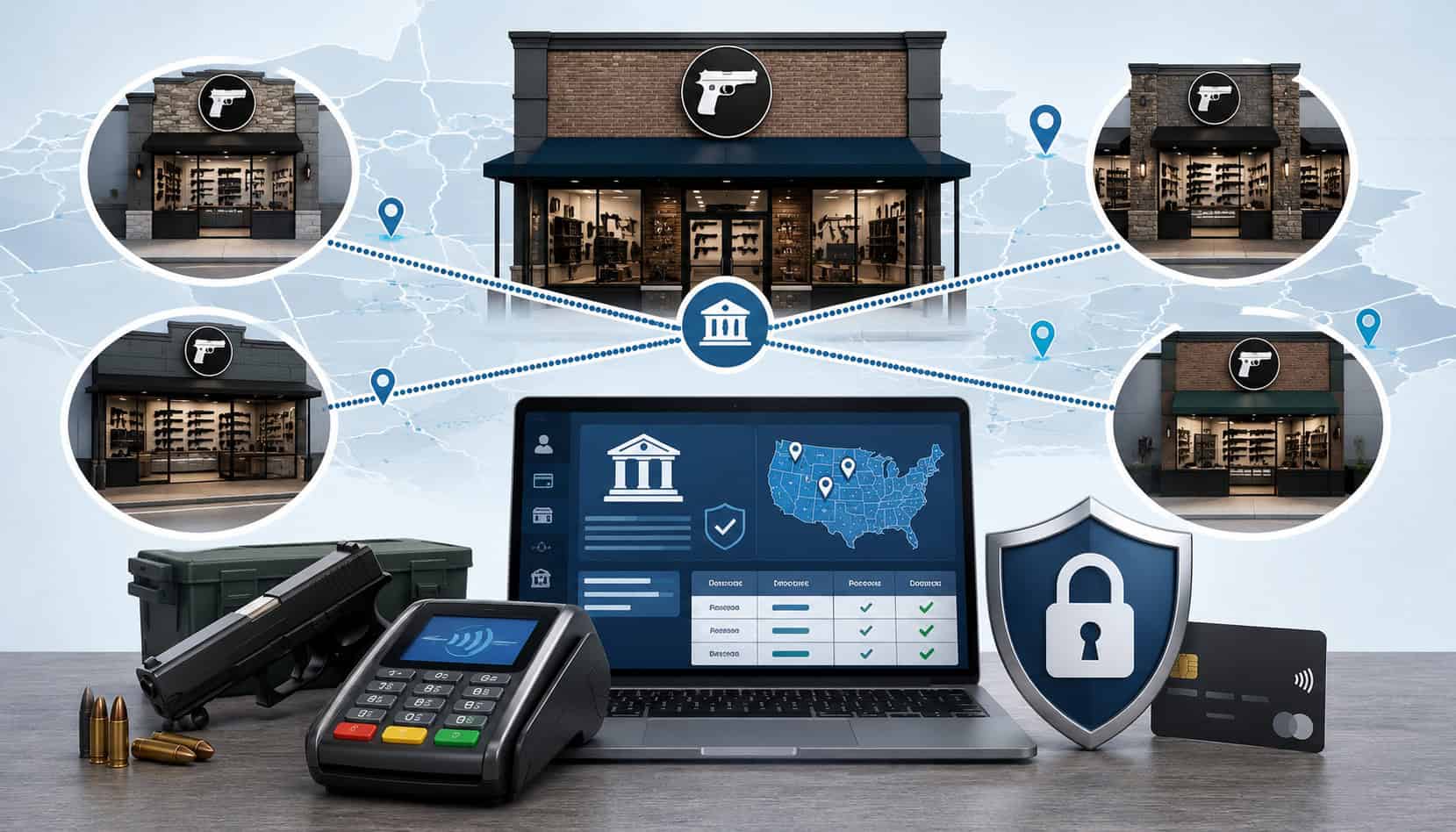
Multi-location firearm retailers need more than basic card acceptance. They need merchant accounts that support in-store sales, ecommerce payments, inventory coordination, FFL documentation, secure firearms payments, centralized payment reporting, and chargeback management across every store.
For expanding retailers, merchant accounts for multi-location gun shops help create a consistent payment structure. Instead of every branch operating with disconnected terminals, inconsistent reporting, and unclear risk controls, the business can manage payments through a coordinated setup that supports compliance-minded operations and better financial visibility.
A reliable setup can help owners track sales by store, reconcile deposits, manage refunds, monitor disputes, and maintain clearer documentation for underwriting reviews. It can also support modern gun-friendly payment processing needs, including POS terminals, ecommerce gateways, fraud controls, and location-level reporting.
What Are Merchant Accounts for Multi-Location Gun Shops?
Merchant accounts for multi-location gun shops are payment accounts designed to let firearm retailers accept debit card, credit card, and approved digital payment transactions across more than one storefront, sales channel, or POS environment.
They connect the business, payment processor, acquiring bank, payment gateway, and POS system so transactions can be authorized, settled, reported, and monitored.
For a single-store retailer, one merchant account may be enough. For a chain, franchise-style operation, or ownership group with several FFL locations, the structure often needs more planning.
Each store may have different transaction volume, staff, inventory, refunds, deposits, and risk patterns. Without the right setup, it becomes difficult to know which location generated a sale, where a refund occurred, or which branch caused a chargeback.
Multi-location firearm merchant accounts may be organized under one ownership profile with separate location identifiers, separate merchant IDs, or linked accounts. The best structure depends on underwriting requirements, ownership, licensing records, sales channels, and reporting needs.
These accounts can support:
- Card-present transactions at retail counters
- Ecommerce checkout for approved products and workflows
- Deposits or special-order payments
- Refunds and voids
- Batch settlement
- Store-level sales reporting
- Chargeback alerts and dispute response
- POS and payment gateway integrations
Because firearm businesses are often classified as high-risk merchant accounts, underwriting is usually more detailed. Providers may review FFL documentation, product categories, ownership records, processing history, website policies, refund terms, and chargeback controls.
A properly structured account helps the processor understand how each location operates, reducing confusion during reviews.
Why Multi-Location Firearm Businesses Need Specialized Payment Processing
Multi-store firearm retailers operate with more complexity than ordinary retail chains. Each location may process different sales volumes, serve different customer patterns, manage different inventory levels, and experience different refund or dispute behavior.
That makes generic payment processing risky, especially when the processor does not clearly support firearms-related transactions.
Specialized gun store payment processing for multiple locations helps align payment operations with underwriting expectations. Firearm-friendly payment processors typically want to understand the business model before approval.
They may ask which locations sell firearms, accessories, range services, training, parts, or online products. They may also review whether ecommerce transactions are routed through a secure gateway and whether the checkout experience includes clear policies.
This matters because account stability depends on transparency. If a processor approves one location but later discovers additional stores, online sales, or higher-risk product categories, it may trigger holds, reserves, or account review.
A better approach is to disclose the full operating model from the beginning and set up multi-store firearm payment processing in a way that reflects reality.
The ATF explains that businesses engaged in dealing, manufacturing, or importing firearms, or manufacturing or importing ammunition, must apply for the appropriate federal firearms license. That licensing context is one reason processors often review documentation carefully before supporting payment acceptance. Federal firearms licensing guidance
| Payment Need | Multi-Location Challenge | Best Solution |
| Store-level sales tracking | Revenue gets mixed across branches | Location-specific reporting |
| Deposits and settlements | Bank deposits may be hard to reconcile | Separate batch reports by location |
| Refund control | Staff may issue inconsistent refunds | Role-based POS permissions |
| Chargeback management | Disputes may not identify the right store | Location-level merchant IDs or descriptors |
| Ecommerce payments | Online orders carry higher fraud risk | Secure gateway with AVS, CVV, and monitoring |
| Underwriting clarity | Processor may not understand all locations | Complete documentation for every branch |
| POS consistency | Different terminals create staff errors | Standardized firearms POS systems |
| Fee review | Costs may vary without visibility | Centralized payment reporting |
Centralized Payment Reporting
Centralized payment reporting gives owners and operators a clear view of sales, refunds, chargebacks, deposits, and fees across every location. Without it, multi-store firearm retailers may spend hours comparing bank deposits, POS exports, gateway reports, and accounting records.
For firearm retailers, reporting is not only about convenience. It supports better operational control. Owners can identify which store has the highest approval rate, which location generates the most refunds, and whether chargebacks are tied to a specific employee, product category, or checkout process.
Centralized reporting also helps with cash flow planning. If settlements are delayed, fees increase, or reserves are applied, owners need to understand whether the issue affects one branch or the entire business. A unified dashboard can make that easier.
Location-Specific Merchant IDs
Location-specific merchant IDs can help multi-location gun shops separate activity by branch while still allowing ownership-level oversight. This structure can be useful when each location has its own FFL documentation, staff, sales patterns, or bank deposit needs.
Separate tracking can improve reconciliation because each store’s batches, deposits, fees, and chargebacks are easier to match. It also helps underwriting teams understand how the business operates. A high-volume location, a new store, and a small rural branch may not carry the same risk profile.
This setup may also help with chargeback management. When a dispute arrives, the business can quickly identify where the transaction occurred, which receipt applies, and which staff member handled the sale. That makes evidence gathering faster and more accurate.
Not every business needs separate merchant accounts for every store, but every multi-store operator should ask how location-level tracking will work before signing an agreement.
Secure POS Systems Across Stores
Consistent firearms POS systems help reduce payment errors, staff confusion, and security gaps. When every store uses a different terminal setup or refund process, it becomes harder to train employees, enforce permissions, and investigate transaction issues.
A standardized POS environment can support secure firearms payments by applying the same controls across locations. These controls may include EMV terminals, encrypted card data, tokenized stored payment details, staff login permissions, refund limits, receipt customization, and transaction notes.
POS consistency also improves the customer experience. Receipts look the same, policies are presented clearly, and staff follow the same steps for deposits, voids, refunds, and special orders.
For growing retailers, POS standardization should happen before expansion becomes difficult to manage. Adding one store at a time without a unified system can create reporting problems that become expensive to fix later.
Gun Store Payment Processing for Multiple Locations
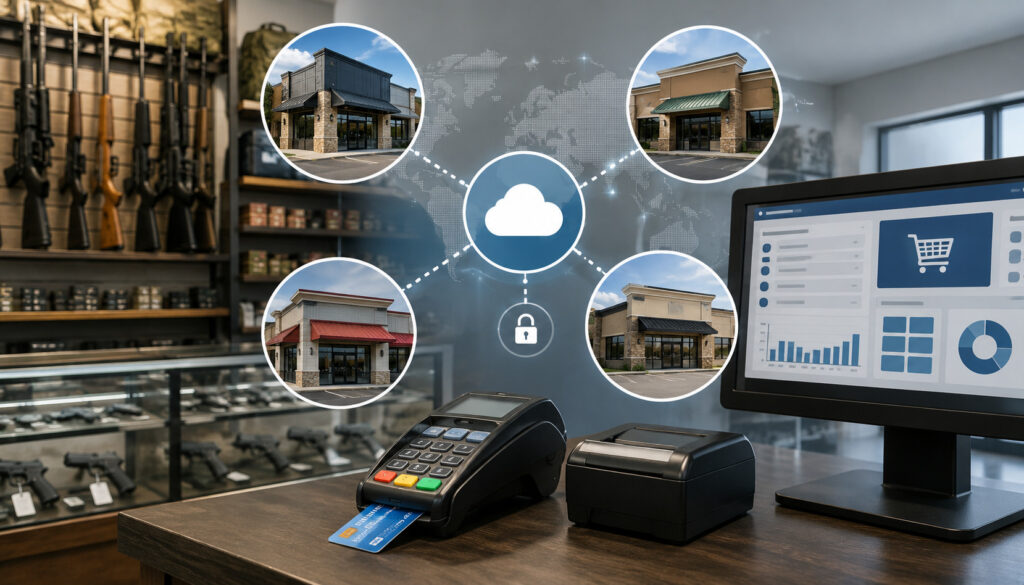
Gun store payment processing for multiple locations involves more than running cards at the counter. It includes authorization, settlement, refund handling, chargeback response, ecommerce support, batch reporting, and reconciliation across all stores.
When a customer pays in person, the POS terminal sends transaction data securely for authorization. After approval, the transaction is included in a batch and later deposited according to the settlement schedule. In a multi-location setup, each store’s batch should be easy to identify so accounting teams can match deposits to daily sales.
For ecommerce, payments usually flow through a gateway. Online transactions may require additional fraud controls because the card is not physically present. Address verification, CVV checks, velocity rules, fraud scoring, and manual review settings can reduce risk.
Refunds also need careful control. A refund issued at the wrong location, under the wrong employee profile, or without documentation can create reconciliation problems. Strong POS permissions and refund policies help prevent mistakes.
Multi-store reconciliation should answer five basic questions:
- Which location made the sale?
- Which account received the deposit?
- What fees were deducted?
- Were any refunds or voids issued?
- Are there open disputes or chargebacks?
A useful guide to high-risk merchant accounts for firearms businesses explains that firearm businesses may face added scrutiny around sales methods, refund practices, licensing, ticket size, and fraud exposure. Those same concerns become more important as the number of stores grows.
FFL Merchant Services for Chain Stores

FFL merchant services for chain stores should be built around documentation, transparency, and store-level organization. Payment providers commonly review business formation records, ownership details, banking information, processing history, website content, refund policies, and licensing documentation.
For multi-location operators, documentation should be organized by location. If different branches operate under different licenses, addresses, or managers, the processor should understand that structure. Clear records reduce underwriting delays and help prevent confusion during future reviews.
Website review is also important. If the business accepts online payments, the site should clearly show product categories, contact information, refund terms, shipping or transfer procedures where applicable, privacy policies, and secure checkout practices.
Processors do not want vague websites that make it difficult to understand what is being sold or how orders are fulfilled.
Chain stores should also define store-level payment policies. Staff should know how to handle deposits, canceled orders, refunds, customer identification workflows where applicable, and transaction notes. Payment policies should be consistent enough to support centralized control but flexible enough to account for local store operations.
Strong FFL payment processing is not only about approval. It is about staying approved. That requires accurate onboarding, ongoing monitoring, chargeback prevention, and communication with the processor when the business adds stores, changes product categories, expands online sales, or increases monthly volume.
Common Challenges Multi-Store Firearm Retailers Face
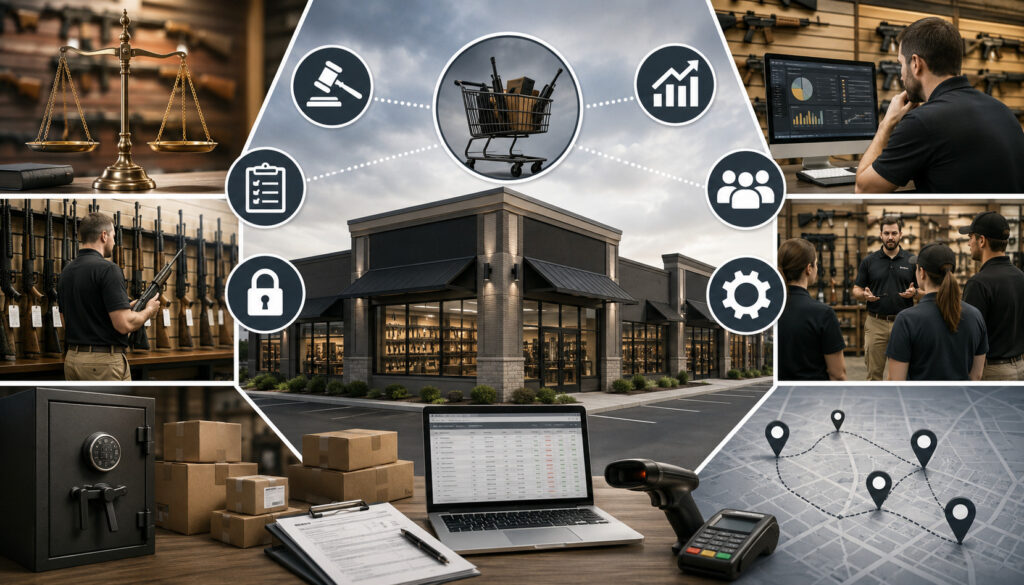
Multi-store firearm retailers often run into payment issues because their operations grow faster than their processing structure. A setup that worked for one store may not support five locations, ecommerce checkout, special orders, and centralized accounting.
Account holds are one common challenge. Holds may occur when transaction volume rises suddenly, chargebacks increase, documentation is incomplete, or the processor sees activity that does not match the original application. For a multi-location business, this can affect cash flow across the entire operation.
Reserves are another concern. Some high-risk merchant accounts include rolling reserves, where a percentage of sales is held temporarily to protect against chargebacks or losses. Reserves are not always avoidable, but owners should understand how they are calculated, when funds are released, and whether they apply to all locations or only specific accounts.
Inconsistent reporting also creates problems. If one store uses a standalone terminal, another uses integrated POS, and ecommerce uses a separate gateway, accounting becomes messy. Disputes may be harder to investigate, fees may be harder to compare, and deposits may not match expected totals.
Other common challenges include:
- Processor restrictions on certain product categories
- Staff training gaps
- Weak refund documentation
- Chargebacks tied to unclear policies
- Inconsistent receipts
- Manual keyed transactions without controls
- Poor ecommerce fraud screening
- Lack of centralized reporting
Chargebacks deserve special attention. A firearm chargeback prevention resource notes that clear policies, strong communication, fraud controls, and documentation all play a role in reducing disputes. For multi-store retailers, those controls must be applied consistently across every location.
Payment Security Best Practices
Payment security best practices protect customers, employees, and the business. For multi-location firearm retailers, security must be consistent across stores, ecommerce channels, and back-office systems.
Encryption helps protect card data while it moves through the payment environment. Tokenization replaces sensitive card details with tokens that are less useful if exposed. EMV chip acceptance can reduce certain card-present fraud risks. Secure gateways help protect online checkout and support fraud screening.
Role-based permissions are equally important. Not every employee should be able to issue refunds, manually key transactions, change prices, or access payment reports. Store managers may need broader access, while counter staff may only need standard checkout permissions.
Refund controls should be documented. Require manager approval for large refunds, refunds after a certain time window, or refunds without matching receipt records. This reduces internal errors and helps create better evidence if a dispute occurs.
Fraud monitoring should include:
- AVS checks
- CVV verification
- Velocity limits
- Suspicious order review
- Mismatched billing and shipping alerts
- Unusual ticket-size monitoring
- Chargeback alerts
- Manual review for high-risk online orders
A secure payment program also depends on training. Staff should know how to recognize suspicious transactions, protect customer data, follow refund rules, and document customer communication.
How to Choose Firearm-Friendly Payment Processors
Choosing firearm-friendly payment processors requires more than comparing rates. The lowest quote may not be the best option if the provider lacks high-risk experience, does not support firearm-related businesses, or cannot handle multi-location reporting.
Start with industry fit. The provider should understand gun-friendly merchant services, FFL payment processing, ecommerce review, chargeback management, and high-risk merchant accounts. Ask directly whether the processor supports your product categories, sales channels, and number of locations.
Next, review pricing. Firearm businesses may pay higher processing costs than lower-risk merchants, but pricing should still be transparent. Look for clear information about transaction rates, monthly fees, gateway fees, chargeback fees, PCI-related fees, reserves, early termination terms, and equipment costs.
POS compatibility matters too. The processor should support the terminals, gateways, ecommerce platforms, and firearms POS systems your stores use. If you are planning to expand, ask whether new locations can be added smoothly.
Evaluate these factors before choosing:
- Firearm and high-risk experience
- Clear underwriting requirements
- Support for multiple store locations
- Location-level reporting
- Ecommerce gateway support
- Chargeback tools
- Fraud prevention features
- Settlement timing
- Reserve terms
- Contract flexibility
- Support availability
- POS integration options
A helpful payment processor selection guide emphasizes the importance of processor fit, stable underwriting, transparent pricing, and support for firearm-specific operations.
Common Mistakes to Avoid
One of the biggest mistakes multi-location firearm retailers make is using unsupported processors. Some providers appear easy to start with but prohibit firearm-related transactions in their terms. That can lead to frozen funds, sudden closure, or withheld deposits.
Another mistake is mixing unrelated business types under one merchant setup. If one ownership group operates firearm retail, training, range services, ecommerce, and unrelated retail categories, the processor needs a clear explanation. Blending activity without disclosure can create underwriting issues.
Weak documentation is also risky. Missing FFL records, outdated addresses, unclear ownership details, incomplete bank records, or inconsistent website policies can delay approval or create problems during account review.
Inconsistent POS setups create operational friction. If each store handles refunds, receipts, deposits, and permissions differently, errors become harder to catch. A consistent setup improves training and supports better chargeback management.
Avoid these mistakes:
- Applying through a processor that does not support firearms
- Hiding product categories or sales channels
- Using one descriptor that confuses customers
- Ignoring chargeback trends
- Letting every employee issue refunds
- Failing to document special-order terms
- Using weak ecommerce fraud filters
- Opening new stores without updating the processor
- Not reviewing monthly statements
- Choosing equipment before confirming processor compatibility
A secure online firearms payment setup guide highlights the importance of secure checkout, fraud controls, and clear online policies for card-not-present transactions. These practices are especially important when online sales connect to a multi-store operation.
What are merchant accounts for multi-location gun shops?
Merchant accounts for multi-location gun shops are payment accounts that help firearm retailers accept card payments across multiple stores, POS systems, and approved online sales channels. They allow transactions to be authorized, settled, reported, and monitored.
For multi-store operators, these accounts should provide location-level visibility. Owners need to see which branch made each sale, where refunds occurred, how deposits were batched, and whether chargebacks are tied to a specific store.
Do multi-location gun stores need separate merchant accounts?
Not always. Some businesses use one master relationship with separate location identifiers, while others use separate merchant IDs for each store. The right structure depends on ownership, licensing records, bank accounts, reporting needs, sales volume, and underwriting requirements.
Separate location tracking is often helpful because it improves reconciliation and risk management. It also gives processors a clearer picture of how each branch operates.
Why are firearm businesses considered high risk?
Firearm businesses are commonly treated as high risk because processors may consider industry sensitivity, licensing requirements, higher-ticket transactions, ecommerce risk, chargeback exposure, and policy restrictions. This does not mean the business is doing anything wrong.
High-risk classification usually means the processor wants more documentation, stronger fraud controls, clearer policies, and closer monitoring before and after approval.
Can gun shops accept online payments?
Yes, lawful firearm retailers can accept online payments when their processor supports the business model and the payment flow follows applicable rules, card-network requirements, and processor policies. Online payments typically require stronger fraud controls than in-store transactions.
A secure gateway, clear checkout terms, AVS, CVV, fraud filters, order review, and transparent customer communication can reduce risk.
What documents are needed for approval?
Common documentation may include business formation records, ownership information, bank verification, processing history, FFL documentation where applicable, website policies, refund terms, product details, expected monthly volume, and average ticket size.
Multi-location businesses may also need store addresses, location-level sales estimates, separate licensing records, and details about POS or ecommerce systems.
How can multi-store gun shops reduce chargebacks?
Multi-store gun shops can reduce chargebacks by using clear receipts, consistent refund policies, strong customer communication, fraud screening, signed or digital transaction records, delivery or pickup documentation where applicable, and fast dispute response.
Owners should monitor chargebacks by location. If one branch has more disputes than others, the issue may involve training, receipts, policies, or transaction handling.
What payment security features matter most?
Important payment security features include encryption, tokenization, EMV terminals, secure gateways, AVS, CVV, fraud scoring, velocity checks, role-based permissions, refund controls, and chargeback alerts.
For multi-location operations, consistency matters. Every store should follow the same basic security standards.
How should owners compare firearm-friendly processors?
Owners should compare processors based on firearm industry experience, underwriting clarity, pricing, reserve terms, contract flexibility, POS compatibility, ecommerce support, settlement timing, reporting tools, chargeback support, and customer service.
The best processor is not always the cheapest. It is the one that supports the business model, understands the risk profile, and can scale with additional locations.
Conclusion
Merchant accounts for multi-location gun shops help lawful firearm retailers manage payments with more structure, visibility, and stability. A strong setup supports secure firearms payments, centralized payment reporting, location-level tracking, chargeback management, ecommerce controls, and smoother reconciliation across every store.
As a firearm business grows, payment processing should grow with it. Multi-location firearm merchant accounts, firearms POS systems, secure gateways, fraud tools, and clear reporting can help owners reduce confusion and make better operational decisions.
The goal is not just accepting cards. It is building a payment environment that supports compliant operations, protects revenue, strengthens customer trust, and gives owners the visibility they need to manage every location with confidence.
Leave a Reply