Firearm industry merchant account approval requirements are more detailed than standard retail approvals because firearm businesses operate in a regulated, closely reviewed category. Underwriters usually want to confirm that the business is properly licensed, transparent about what it sells, prepared to manage chargeback risk, and using secure payment systems.
For firearm retailers, FFL dealers, online sellers, ranges, gunsmiths, and accessory merchants, approval is rarely just a basic form submission. The process may include FFL verification, business documentation, owner identification, website review, processing history analysis, bank statement review, product category screening, and payment security checks.
This does not mean lawful firearm businesses cannot accept cards. It means they often need firearm payment processing that is structured for the industry from the start. A well-prepared application can make firearm merchant account approval smoother, reduce underwriting questions, and help prevent avoidable delays.
What Are Firearm Industry Merchant Account Approval Requirements?
Firearm industry merchant account approval requirements are the documents, business details, compliance information, and risk controls a payment processor reviews before allowing a firearm-related business to accept card payments.
These requirements help the underwriter understand who owns the business, what products are sold, how transactions are handled, and whether the business fits the processor’s policy.
A typical review starts with basic business verification. This may include the legal business name, business address, ownership structure, tax identification details, bank account information, and contact information.
The processor may compare this information against the website, application, bank records, and licensing documents to make sure everything is consistent.
For FFL merchant account requirements, licensing is especially important. Underwriters may request a copy of the FFL, business license, owner identification, and operating details.
If the business sells online, the website may be reviewed for product descriptions, restricted product categories, refund policies, shipping terms, transfer procedures, and secure checkout pages.
Financial records also matter. Prior processing statements, bank statements, average ticket size, expected monthly volume, refund history, and chargeback records can all influence the approval decision.
A merchant with organized records and low dispute activity may be viewed as lower risk than one with inconsistent documentation or unclear sales practices.
Payment security is another core expectation. Firearm businesses are often expected to use secure checkout tools, fraud controls, tokenization, encryption, access controls, and PCI-aware workflows. These practices support safer firearm payment processing and help reduce fraud, disputes, and card data exposure.
Why Firearm Businesses Need Specialized Merchant Account Approval
Firearm businesses often need specialized merchant account approval because many standard processors do not support firearm-related transactions.
Some providers prohibit firearm sales, ammunition sales, regulated accessories, online firearm transactions, or certain high-ticket categories. Others may approve a business at first but later restrict, freeze, or terminate the account when firearm activity is detected.
Specialized approval helps prevent that mismatch. Gun-friendly merchant services are designed to review firearm businesses directly instead of forcing them into a generic retail category. The goal is not to bypass underwriting.
The goal is to place the business with a processor and acquiring relationship that understands the category, reviews the documentation properly, and supports eligible transactions under clear terms.
This matters for both retail and ecommerce sales. A physical gun store may need countertop terminals, point-of-sale integration, contactless payments, and chargeback monitoring.
An online FFL dealer may need a secure gateway, website review, transfer workflow documentation, product category screening, fraud filters, and clear shipping or pickup procedures. These details can affect gun store payment processing approval and FFL dealer payment processing approval.
Specialized underwriting also helps the processor evaluate risk more accurately. Instead of viewing every firearm business the same way, underwriters can consider business history, licensing, product mix, transaction size, sales channels, refund practices, and dispute records. That creates a more practical approval process for lawful merchants.
For additional context on getting approved, see this guide on how gun stores can get approved for merchant accounts.
| Approval Requirement | What It Shows | Why It Matters |
| FFL documentation | The business is properly licensed for its activity | Supports compliance review and category validation |
| Business registration | The legal business exists and matches the application | Reduces identity and ownership risk |
| Owner identification | Responsible parties can be verified | Required for underwriting and risk review |
| Bank statements | The business has operating history and cash flow | Helps assess stability and funding risk |
| Processing statements | Prior volume, refunds, and chargebacks | Helps price and approve the account appropriately |
| Website policies | Customers can understand terms before purchase | Reduces disputes and underwriting concerns |
| Product list | The processor knows what is being sold | Confirms products fit policy requirements |
| Payment security controls | Card data and transactions are handled safely | Reduces fraud, breach, and chargeback risk |
FFL Documentation and Business Licensing
FFL documentation and business licensing are usually central to firearm merchant account underwriting requirements. The underwriter wants to confirm that the business is authorized to operate in the category it selected on the application.
If the merchant sells firearms, manufactures firearm-related products, imports regulated items, or operates as a dealer, licensing details may be reviewed closely.
A processor may request a copy of the FFL, business registration, owner information, operating address, and details about how sales are completed. The information should match across the application, website, bank account, license, and public-facing business materials. If the legal name differs from the trade name, explain that clearly.
The ATF provides official information on Federal Firearms Licenses, which can help merchants understand the licensing framework. Underwriters are not replacing legal compliance review, but they do need confidence that the payment account is being opened for a legitimate and properly documented business.
Website and Product Category Review
Website review is especially important for ecommerce firearm businesses. Underwriters often check whether the website clearly explains what is sold, how orders are handled, what products are restricted, how transfers work, and what customers should expect after checkout. A website with vague policies or incomplete product details can slow approval.
Product category review helps the processor determine whether the business fits its policy. Firearms, ammunition, accessories, parts, optics, tactical gear, training services, gunsmithing, and range memberships may be treated differently depending on the provider. Be direct about the full product mix.
Useful website elements include clear product descriptions, refund and return policies, shipping terms, transfer language, customer support contact details, privacy policy, terms of service, and secure checkout. For online payment readiness, this guide on secure online payments for firearms offers helpful context.
Processing History and Chargeback Records
Processing history helps underwriters understand how the business has handled payments in the past. Prior merchant statements may show monthly volume, average ticket size, refund activity, chargeback ratios, card-present versus ecommerce activity, and seasonal sales trends. These details can affect approval, pricing, reserves, and volume limits.
Chargeback risk is especially important because firearm transactions may involve high-ticket purchases, special orders, transfer timing, shipping expectations, or policy misunderstandings. Even a lawful sale can become a dispute if the customer does not understand delivery timelines, refund limits, or transfer requirements.
Merchants with strong documentation are in a better position. Keep receipts, order confirmations, customer acknowledgments, delivery records, refund notes, and communication logs. For prevention strategies, see this guide on how to prevent chargebacks in firearm sales.
Common Documents Needed for Firearm Merchant Account Approval
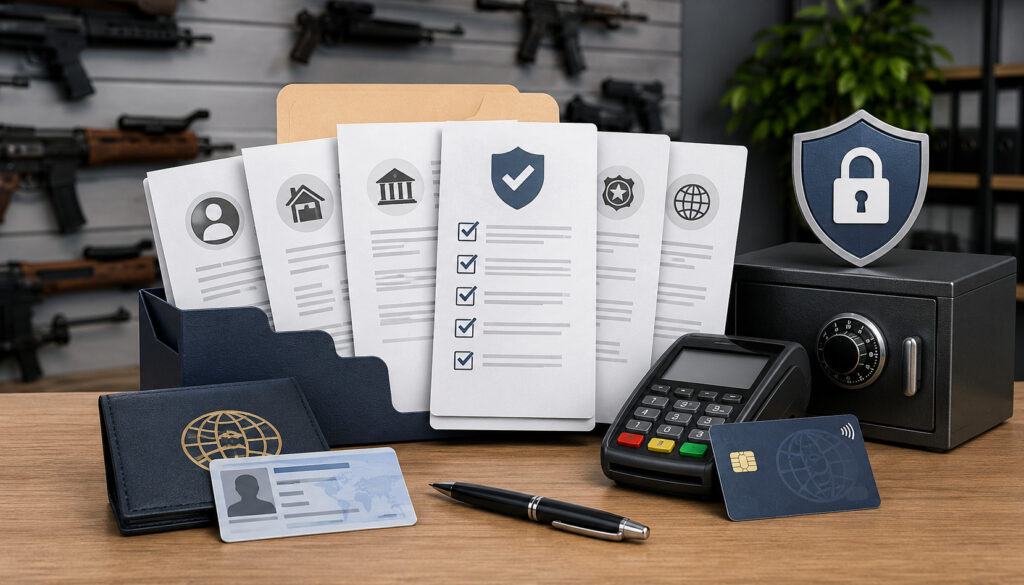
Common FFL payment processing documents usually include business, ownership, banking, licensing, website, and processing history records. The exact list varies by processor, but firearm businesses should expect a more detailed review than a standard retail merchant account.
Most applications begin with the merchant account application, business license, owner identification, bank account verification, and tax-related business details. The processor may ask for a voided check or bank letter to confirm where deposits should be sent.
If the business has multiple owners, each owner above the processor’s threshold may need to provide identifying information.
Firearm-specific documents may include the FFL, business operating details, product list, website URL, transfer procedures, and compliance policies.
Ecommerce merchants should be ready to provide refund terms, shipping terms, privacy policy, terms of service, checkout screenshots, and explanation of how orders are routed through licensed transfer channels when required.
Financial documents are also common. Underwriters may request recent bank statements and prior processing statements. These records help evaluate expected volume, average transaction size, refund activity, chargeback risk, and business stability.
New businesses may not have processing history, but they can still improve the application with complete documentation and realistic volume projections.
A strong approval packet may include:
- Completed merchant application
- FFL copy, when applicable
- Business license or registration
- Owner identification
- Voided check or bank letter
- Recent bank statements
- Prior processing statements
- Website URL
- Product list or catalog
- Refund and return policy
- Shipping and transfer procedures
- Payment security overview
- Chargeback prevention procedures
Firearm Merchant Account Underwriting Requirements
Firearm merchant account underwriting requirements are designed to evaluate business legitimacy, operational risk, payment risk, compliance posture, and processor policy fit. Underwriting is not just a yes-or-no document check. It is a structured review of how the business operates and whether the account can be supported responsibly.
The process usually begins with identity and business verification. The processor checks ownership, business registration, banking details, physical or online presence, and licensing information. Inconsistent information can create delays. For example, a different business name on the website, bank account, and application may require explanation.
Next, the underwriter reviews the business model. A storefront, ecommerce seller, gunsmith, range, training provider, ammunition retailer, and accessory merchant may each have different risk factors. Sales channels matter because card-present transactions are usually evaluated differently from online, keyed, or phone orders.
Transaction profile is another major factor. Average ticket size, expected monthly volume, seasonal spikes, refund frequency, and chargeback history help determine approval terms. High ticket amounts do not automatically prevent approval, but they may lead to more questions about fulfillment, delivery, customer communication, and dispute prevention.
Processor policy checks are also essential. Some providers support only certain firearm-related categories. Others may restrict specific product types, online sales models, or fulfillment methods. A transparent product list helps avoid future account issues.
Underwriting may also evaluate payment security. Secure checkout, fraud filters, user permissions, refund controls, and PCI-aware practices all help show that the merchant takes payment security seriously. A well-organized merchant appears lower risk because the business can explain how it protects customers, prevents fraud, and handles disputes.
Gun Store Payment Processing Approval Steps
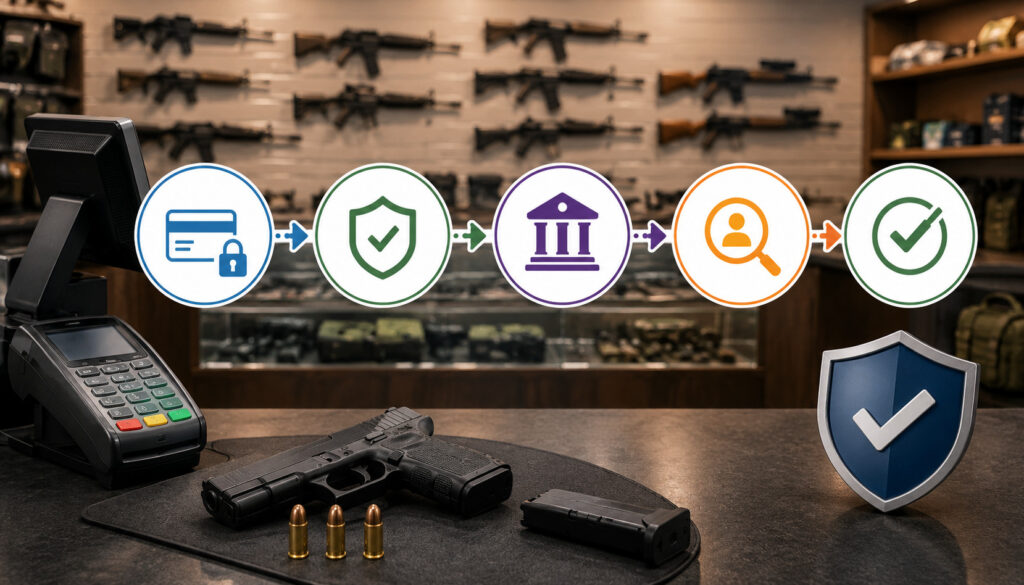
Gun store payment processing approval usually follows a sequence: application submission, document collection, underwriting review, pricing offer, reserve review, account setup, gateway or POS configuration, and test transactions. The exact workflow may vary, but most firearm businesses should expect several steps before processing begins.
The application stage gathers business basics. This includes the legal name, trade name, ownership details, address, contact information, business type, expected monthly volume, average ticket, sales channels, and product categories.
Accuracy matters. If the application understates firearm-related activity or leaves out ecommerce sales, the account may face problems later.
The document review stage confirms the information. Underwriters may request FFL documentation, business registration, owner identification, bank statements, processing statements, website policies, and product details. If documents are missing or inconsistent, approval may pause until the issue is resolved.
The underwriting stage evaluates risk. The processor reviews licensing, website readiness, processing history, chargeback risk, refund policies, product categories, and payment security. If the business is approved, the processor may provide pricing, volume limits, reserve terms, settlement timing, and gateway or POS options.
Some firearm merchants may be subject to reserve review. A reserve is not always required, but it may be considered when the merchant has high ticket sales, limited processing history, elevated chargebacks, or unusual fulfillment timelines. Merchants should review reserve terms carefully before signing.
After approval, technical setup begins. This may include a payment gateway, virtual terminal, countertop terminal, mobile reader, ecommerce integration, fraud filters, user permissions, and test transactions. For merchants setting up a full account securely, this guide on secure firearm merchant account setup may be useful.
Factors That Can Delay Approval
Several factors can delay firearm business payment approval. The most common is incomplete paperwork. Missing FFL documentation, unsigned applications, outdated bank statements, unclear ownership details, or mismatched business names can all slow underwriting.
Website issues are another major cause. If the website lacks refund terms, shipping rules, transfer information, privacy policy, terms of service, customer support details, or secure checkout, the underwriter may request updates before approval. Ecommerce firearm businesses should make policies visible before applying.
Unsupported products can also create delays or denials. Some processors may support certain firearm-related merchants but not all categories. If the business sells restricted accessories, custom parts, ammunition, kits, or other products that require additional review, the processor may need more detail.
High chargebacks can trigger deeper review. Underwriters may ask why disputes occurred, what corrective steps were taken, and whether refund policies or fulfillment practices have changed. Merchants with prior chargeback issues should prepare a short explanation and supporting records.
Weak payment security may also delay approval. A non-secure checkout page, poor fraud controls, shared logins, unclear refund authority, or unsafe card data handling can raise concerns. Underwriters want to see that payment security is not an afterthought.
Common delay triggers include:
- Missing or expired FFL documentation
- Inconsistent business details
- Incomplete owner information
- Unclear website policies
- Unsupported product categories
- High chargeback ratios
- Limited processing history
- Unrealistic volume projections
- Weak payment security controls
- Poor customer communication practices
Payment Security Expectations for Firearm Businesses
Payment security is a major part of firearm merchant account approval because processors want to reduce fraud, data exposure, unauthorized refunds, and chargeback risk. Firearm businesses often handle high-value transactions, which can attract fraud attempts and increase the importance of secure payment workflows.
At a minimum, merchants should use secure checkout pages, encrypted payment transmission, tokenization where available, and PCI-aware card data handling. Card numbers should not be stored in spreadsheets, emails, handwritten notes, or unsecured systems. Staff should understand that sensitive card data must be handled only through approved payment tools.
Fraud controls are also important. Ecommerce merchants may use AVS, CVV checks, velocity filters, IP review, order review rules, and manual verification for unusual orders. Retail locations may use EMV-capable terminals, receipt controls, refund permissions, and manager approval for high-risk adjustments.
User permissions matter. Not every employee needs access to refunds, transaction reports, settlement settings, or gateway administration. Limiting access reduces internal risk and creates a cleaner audit trail. Businesses should also remove access when employees leave or change roles.
Refund controls help prevent disputes and internal errors. Refund policies should be written, visible, and consistently followed. Staff should document why a refund was issued, who approved it, and how the customer was notified.
Payment security also supports customer trust. A secure checkout experience, professional receipts, consistent billing descriptor, and clear customer communication can reduce confusion. Confusion often turns into disputes, and disputes can affect account stability.
Strong security habits include:
- Secure checkout pages
- Tokenized card storage where supported
- Encryption for payment data
- EMV-capable terminals
- AVS and CVV checks
- Fraud filters and velocity rules
- Role-based user permissions
- Refund approval workflows
- Clear customer receipts
- Consistent billing descriptors
Common Mistakes Firearm Businesses Should Avoid
One of the biggest mistakes firearm businesses make is applying with a processor that does not support firearm transactions. A standard processor may appear easy to use, but if firearm sales violate its policy, the business may face frozen funds, account termination, or delayed deposits.
Another mistake is hiding product categories. Underwriting is based on accurate disclosure. If the application says “sporting goods” while the website clearly sells firearms or ammunition, the inconsistency can damage trust. It is better to be direct from the start.
Incomplete documentation is also common. Missing FFL records, owner identification, bank verification, processing statements, or website policies can create unnecessary delays. A complete application shows the business is organized and serious.
Weak refund policies can increase chargeback risk. If customers do not understand cancellation rules, special order timelines, restocking fees, transfer procedures, or shipping limitations, they may dispute the transaction. Clear policies should be visible before payment.
Some merchants also ignore contract terms. Pricing, reserves, settlement timing, chargeback fees, cancellation terms, volume limits, and prohibited products should be reviewed before signing. A merchant account is not just a way to accept cards; it is a risk agreement with operating rules.
Poor chargeback prevention is another avoidable issue. Firearm businesses should document customer authorization, order details, delivery information, transfer steps, refund communications, and support interactions. Good records can help defend valid sales and reduce losses.
Best Practices to Improve Approval Chances
The best way to improve approval chances is to make the underwriter’s job easier. Organized records, clear policies, consistent business information, and strong payment security all help the processor understand the business and evaluate risk accurately.
Start by organizing documents early. Keep the FFL, business registration, owner identification, bank records, processing statements, product list, website URL, refund policy, shipping policy, and compliance procedures in one folder. Make sure documents are current and legible.
Review the website before applying. Product pages should be clear. Policies should be visible. Contact information should be easy to find. Checkout should be secure. Transfer, shipping, refund, and cancellation terms should be understandable before the customer pays.
Be realistic about volume. If projected monthly volume is much higher than current sales, explain why. Underwriters may ask about marketing plans, seasonal demand, new locations, ecommerce launch plans, or distributor relationships. Clear explanations help avoid concern.
Reduce disputes before applying. Review refund patterns, customer complaints, delayed orders, unclear terms, and recurring support issues. A lower chargeback profile can improve the underwriting conversation and may support better approval terms.
Respond quickly to underwriting requests. Delays often occur because the processor is waiting for one missing document or clarification. Fast, complete responses show professionalism.
Practical approval tips include:
- Disclose all product categories accurately
- Keep FFL and business documents current
- Match business names across records
- Maintain clear website policies
- Use secure checkout and fraud tools
- Keep chargebacks low
- Document refunds and special orders
- Review contract terms carefully
- Monitor processing after approval
- Update the processor before major business changes
What are firearm industry merchant account approval requirements?
Firearm industry merchant account approval requirements are the documents, business details, security practices, and underwriting checks used to evaluate a firearm-related merchant account application.
They typically include business verification, ownership details, FFL documentation when applicable, bank records, prior processing statements, website review, product category review, refund policies, and chargeback history.
These requirements help the processor confirm that the business is legitimate, properly documented, transparent about what it sells, and prepared to manage payment risk. They also help determine pricing, reserve terms, processing limits, gateway setup, and ongoing monitoring expectations.
Why do firearm businesses need special merchant approval?
Firearm businesses often need special merchant approval because many standard processors restrict or prohibit firearm-related transactions. Even lawful merchants can face account closures if the processor’s policy does not support the category.
Specialized approval places the business through underwriting designed for firearm payment processing. The review considers licensing, product mix, sales channels, chargeback risk, payment security, and website readiness.
This helps create a more stable account structure than using a generic processor that may not understand the business.
What documents are needed for FFL merchant account approval?
Typical documents include the merchant application, FFL copy, business license or registration, owner identification, voided check or bank letter, bank statements, prior processing statements, website URL, product list, refund policy, shipping policy, and compliance procedures.
New businesses may not have processing statements, but they should still provide complete business documentation and realistic projections. Ecommerce merchants should also prepare website policies and checkout details because online sales usually receive closer review.
Why do processors review firearm websites?
Processors review firearm websites to understand what the business sells, how customers order, how transfers are handled, and whether policies are clear. A website review also helps confirm that product categories match the application.
Underwriters may look for secure checkout, clear refund terms, shipping information, privacy policy, terms of service, contact information, product descriptions, and transfer procedures. A complete website can reduce questions and make approval smoother.
Can gun stores accept credit cards?
Yes, eligible gun stores can accept credit cards when they have a merchant account that supports firearm-related transactions. The key is using a processor that allows the category and properly underwrites the account.
A firearm merchant should avoid processors that prohibit firearm sales. The account should be set up transparently with accurate product categories, licensing documentation, secure payment tools, and clear operating policies.
What can delay firearm payment processing approval?
Approval can be delayed by incomplete paperwork, missing FFL documentation, inconsistent business names, unclear website policies, unsupported products, weak payment security, high chargebacks, or unrealistic volume estimates.
Delays can also happen when the underwriter needs more detail about ecommerce sales, transfer procedures, refund rules, or prior disputes. Preparing a complete application package before applying is the best way to reduce delays.
Are reserves common for firearm merchant accounts?
Reserves can be common in high-risk merchant accounts for firearms, but they are not always required. A reserve may be considered when the merchant has high average tickets, limited processing history, elevated chargebacks, long fulfillment timelines, or higher perceived risk.
Merchants should review reserve terms carefully. Important details include the reserve percentage, hold period, release schedule, and conditions for reducing or removing the reserve later.
How can firearm businesses improve approval chances?
Firearm businesses can improve approval chances by organizing documents early, keeping licensing current, making website policies clear, reducing chargebacks, using secure checkout tools, and responding quickly to underwriting questions.
Transparency is also important. The application should accurately describe the business, product categories, sales channels, expected volume, and fulfillment process. A clear, complete, and consistent application gives underwriters more confidence.
Conclusion
Firearm industry merchant account approval requirements usually include licensing verification, business documentation, ownership review, website analysis, underwriting, payment security checks, and chargeback risk assessment. These requirements are more detailed because firearm businesses operate in a regulated and closely reviewed payment category.
Approval is easier when the business is organized before applying. Current FFL records, accurate business details, clear website policies, realistic processing projections, secure payment systems, and strong dispute prevention practices can all help.
The goal is not just to get approved. The goal is to build a stable firearm merchant account that supports lawful sales, protects customer data, reduces chargeback risk, and keeps payment operations running smoothly.
Leave a Reply