
Firearm-related businesses need reliable ways to accept card payments, but approval is rarely as simple as filling out a short online form.
Gun shops, FFL dealers, shooting ranges, firearm accessory sellers, outdoor sporting goods retailers, and online firearm-related businesses often go through a more detailed review because processors must understand what is being sold, how transactions are handled, how customers are verified, and whether the business fits the processor’s risk policies.
That review process is known as underwriting. It helps payment processors, acquiring banks, and risk teams decide whether a business can be approved for card acceptance and what conditions may apply.
Underwriting requirements for firearms merchant accounts may include business verification, FFL documentation where applicable, ownership details, tax information, bank statements, processing history, website policies, product catalog review, fraud controls, and chargeback history.
The process can feel demanding, especially for newer firearm businesses that have not applied for a specialized merchant account before. However, strong preparation can make the review smoother.
When documents are current, website policies are clear, sales channels are accurately disclosed, and payment practices are organized, underwriters can better understand the business and assess risk fairly.
This article explains how firearm merchant account underwriting works, why firearm businesses face additional review, what documents may be requested, and how businesses can prepare for merchant account approval for firearms without treating the process as guesswork.
What Are Underwriting Requirements for Firearms Merchant Accounts?
Underwriting requirements for firearms merchant accounts are the documents, business details, policies, and risk controls a payment provider may review before approving a merchant account. The goal is to determine whether the business can process card payments safely, predictably, and within the provider’s acceptable-use rules.
For firearm-related businesses, underwriting may review more than basic business identity. A processor may ask about business formation, ownership, beneficial ownership, tax ID, physical address, website URL, FFL documentation where applicable, products sold, sales channels, expected monthly volume, average ticket size, refund policy, shipping policy, chargeback history, and prior processing statements.
This process protects multiple parties. It helps the processor understand financial exposure. It helps the acquiring bank determine whether the account fits its risk appetite. It helps the business begin the relationship with clearer expectations instead of risking future funding holds, sudden account reviews, or policy conflicts.
Firearms merchant account underwriting requirements are not the same for every business. A retail-only gun shop may be reviewed differently than an eCommerce firearm accessory seller, a shooting range with memberships, or a dealer that accepts online deposits. The more complex the business model, the more important documentation becomes.
Why Firearm Merchant Account Underwriting Is Different
Firearm merchant account underwriting is different because the products, regulations, transaction types, and processor policies create a more complex risk profile than many standard retail categories.
A firearm-related business may be fully licensed and responsibly operated, yet still receive additional scrutiny because processors must consider product restrictions, age-sensitive purchases, card-not-present risk, chargebacks, fraud, and reputational policies.
Underwriters may review whether the business sells firearms, ammunition, parts, accessories, training, range memberships, hunting gear, or other related products. They may also examine how those products are presented online, whether restricted items are clearly handled, and whether website policies explain shipping, returns, cancellations, privacy, and terms of sale.
FFL documentation may be reviewed where applicable because federal firearms licensees are subject to detailed licensing and compliance expectations.
Federal guidance explains that FFLs must follow laws and regulations involving licensing, recordkeeping, and firearm transfers, which is one reason payment underwriters often want to see license-related documentation during review.
Merchant account underwriting for gun stores is also different because many general processors do not support firearm-related sales. As a result, a firearm business may need a gun-friendly payment processing setup that is reviewed intentionally for the industry rather than approved under a generic retail category.
Underwriting vs Merchant Account Approval
Underwriting is the review process. Merchant account approval is the result of that review. A business can complete underwriting and receive approval, conditional approval, a request for additional information, or a decline. Approval does not always mean unrestricted processing.
A firearms merchant account may be approved with conditions such as monthly volume limits, average ticket limits, delayed funding, rolling reserves, transaction monitoring, card-not-present restrictions, or limits on certain product categories. These conditions are usually designed to reduce risk while allowing the business to process payments.
For example, a new gun shop merchant account may be approved for a projected monthly volume based on expected sales. If the business suddenly processes far above that amount, the processor may request more documentation or temporarily review funding. That does not always mean something is wrong; it may simply mean activity exceeded the original risk profile.
Businesses should read the merchant agreement carefully and ask questions about reserves, settlement timing, prohibited products, chargeback thresholds, gateway rules, and account review procedures. For legal, regulatory, or contract-specific questions, professional review is recommended because underwriting terms can affect cash flow and operations.
Why Firearm Businesses Are Considered Higher Risk
Firearm businesses are often categorized within high-risk payment processing because processors evaluate more than whether a business is legitimate. They assess the likelihood of disputes, fraud losses, regulatory complications, policy violations, chargebacks, product restrictions, and reputational concerns.
This does not mean firearm businesses are automatically unsafe or poorly managed. It means the payment ecosystem views the category as requiring additional controls. A regulated product, higher average ticket size, online ordering, special orders, age-restricted products, shipping complexity, and customer verification steps can all increase underwriting attention.
High-risk merchant account underwriting often looks closely at the business model. A retail store with mostly card-present transactions may be easier to assess than an eCommerce firearm sales model with phone orders, deposits, shipping coordination, and delayed fulfillment.
A shooting range may have memberships, recurring billing, classes, lane rentals, and retail sales. An accessory seller may have broader product categories but still face restrictions based on processor policy.
Chargebacks are another major factor. Firearm-related transactions can involve larger purchase amounts, special orders, cancellation disputes, delivery questions, refund confusion, or unauthorized purchase claims. Even a small number of disputes can create concern if the average ticket size is high.
Processor policy also matters. Some providers avoid firearm businesses entirely. Others accept only certain types of firearm-related sales. Some allow in-store transactions but not online sales. Others may support online accessories but not certain restricted categories. This is why firearms merchant services should be evaluated for fit, not only pricing.
Card-Not-Present and eCommerce Firearm Sales Risk
Card-not-present transactions happen when the card is not physically presented to the merchant, such as online, phone, invoice, or keyed payments. These transactions usually receive closer underwriting review because fraud and dispute risk are higher than card-present sales.
For eCommerce firearm sales or firearm-related online orders, underwriters may review the checkout flow, payment gateway, product descriptions, customer verification steps, fraud screening tools, shipping terms, delivery procedures, cancellation language, and customer support details.
The website must help the underwriter understand what is being sold and how the business reduces risk before and after payment.
A payment gateway with address verification, CVV checks, velocity controls, fraud scoring, secure checkout, and transaction monitoring can help reduce concerns. Clear customer communication also matters.
When customers understand order timing, shipping rules, pickup requirements, cancellation terms, and refund procedures before paying, disputes are less likely.
The PCI Security Standards Council provides payment security resources for businesses that accept card payments, and its small merchant guidance explains that payment pages and card-data handling methods affect security responsibility.
Product Type and Policy Restrictions
Underwriters need to know exactly what the business sells. Firearms, ammunition, parts, accessories, optics, safes, apparel, gunsmithing services, training classes, range memberships, and outdoor sporting goods may be viewed differently depending on processor policy.
Some processors may accept a gun store but restrict certain product types. Others may allow accessories and sporting goods but not ammunition or certain regulated items. A provider may also require additional documentation if the business sells through online checkout, events, gun shows, phone orders, or marketplace-style channels.
This is why a clear product catalog is important. Underwriters may review SKUs, product categories, website pages, descriptions, and sales channels to determine whether the business fits the provider’s acceptable-use rules.
Common FFL Merchant Account Requirements
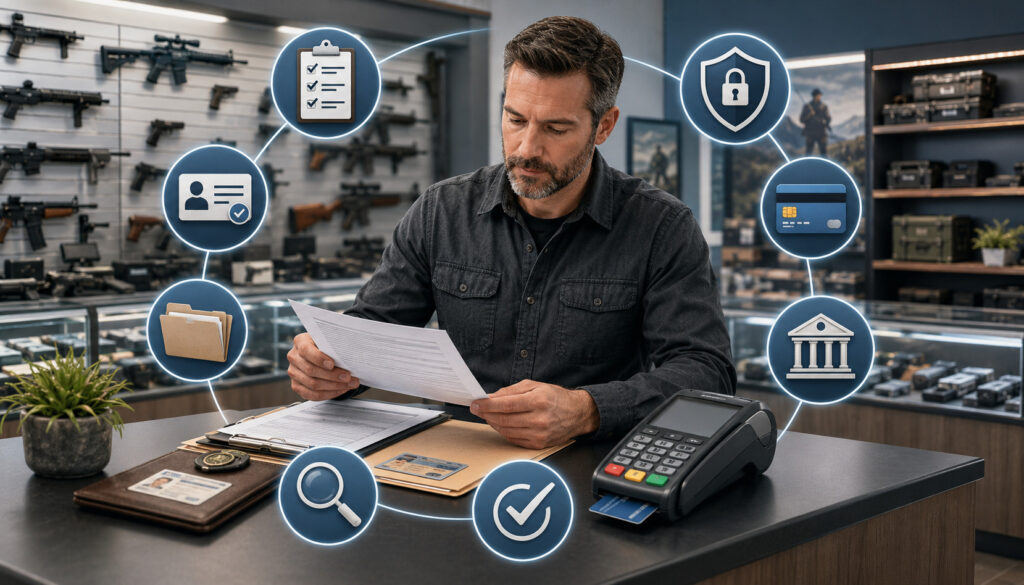
Common FFL merchant account requirements include business identity documents, ownership information, licensing records, financial records, website details, and payment history. The exact list depends on the provider, the acquiring bank, the products sold, and the sales channels used.
A firearm merchant account application may request:
- Business legal name and DBA
- Business address and contact information
- Tax identification information
- Owner and beneficial ownership details
- Business license where applicable
- FFL documentation where applicable
- Product catalog or website URL
- Processing history if available
- Bank statements
- Refund policy
- Shipping policy
- Terms and conditions
- Privacy policy
- Chargeback history
- Expected monthly volume
- Average ticket size
- Sales channel details
- Payment gateway or POS needs
For new businesses, prior processing statements may not exist. In that case, underwriters may ask for projections, bank statements, business plans, inventory details, supplier information, or explanations of expected sales channels. Established businesses should be ready to provide recent merchant statements showing volume, refunds, chargebacks, and average ticket size.
FFL merchant account requirements are often more detailed because licensing and product handling matter. ATF guidance notes that federal firearms licensees are subject to responsibilities involving compliance, recordkeeping, and lawful transfers, so underwriters commonly want to confirm that the payment application aligns with the licensed business model.
A business preparing for an FFL merchant account should make sure every document uses consistent names, addresses, and ownership details. Mismatches are one of the easiest ways to slow down underwriting.
Business Verification Documents
Business verification documents help underwriters confirm that the applicant is a real operating business with identifiable ownership, valid banking details, and consistent records. This review may include legal business name, DBA, tax ID, formation documents, address records, bank account information, owner identification, and beneficial ownership details.
Underwriters compare these details across the application, bank statements, website, licenses, and business records. If the business name on the application differs from the bank account, website footer, tax records, or license documents, the underwriter may pause the file and request clarification.
Address consistency is also important. A retail storefront, mailing address, license address, and bank address may differ for legitimate reasons, but those differences should be easy to explain. The goal is to remove uncertainty before it becomes a delay.
Firearm-Specific Documentation
Firearm-specific documentation helps underwriters understand how the business operates within its category. This may include FFL documentation where applicable, product categories, sales channels, shipping procedures, website disclosures, customer verification practices, transfer-related procedures, and product restrictions.
A retail gun shop may need to show licensing records and describe in-store card-present processing. An online accessory seller may need to provide a product catalog, website policies, and fraud controls. A shooting range may need to explain memberships, training payments, rental policies, waivers, and recurring billing if offered.
Firearm merchant account documentation should be current, readable, and complete. Expired licenses, blurry scans, missing pages, or unclear product descriptions can slow down approval. Underwriters are not only checking whether documents exist; they are checking whether the business model is understandable and fits the processor’s risk guidelines.
Firearms Merchant Account Underwriting Requirements Table
The following table can help firearm-related businesses understand common review areas before applying. It is not a universal checklist because every provider has its own standards, but it reflects many areas commonly reviewed in firearm merchant account underwriting.
| Underwriting Area | What May Be Reviewed | Why It Matters |
| Business identity | Legal name, DBA, address, ownership | Confirms business legitimacy |
| Licensing | FFL and business licenses where applicable | Supports compliance review |
| Product catalog | Firearms, accessories, parts, ammunition, related goods | Helps determine processing fit |
| Website policies | Refund, shipping, privacy, and terms pages | Reduces customer and processor risk |
| Sales channels | In-store, online, phone, events, range payments | Shows transaction risk profile |
| Processing history | Volume, chargebacks, refunds, statements | Helps assess payment behavior |
| Financial records | Bank statements and business stability | Supports underwriting confidence |
| Chargeback history | Dispute frequency and reasons | Indicates account risk |
| Security controls | PCI practices and fraud tools | Protects payment data |
| Expected volume | Monthly sales and average ticket size | Helps set processing limits |
This table is useful because underwriting is easier when the business can explain each area clearly. A processor does not want vague answers. It wants a complete picture of how payments flow through the business, what customers buy, how orders are fulfilled, and what controls reduce risk.
For firearm businesses, the table also highlights the connection between compliance documentation and payment stability. Underwriting is not only about getting approved. It sets the baseline for future monitoring, reserves, funding reviews, and account expectations.
How to Use the Table Before Applying
Use the table as a preparation checklist before submitting a firearms merchant account application. Start with business identity and licensing. Confirm that legal names, DBA names, addresses, owner information, bank details, and license records match across all documents.
Next, review the product catalog and sales channels. Make sure the application clearly explains whether the business sells in-store, online, by phone, at events, through invoices, or through range-related transactions. Underwriters need to know the full transaction environment.
Then review policies and risk controls. Refund, shipping, privacy, and terms pages should be easy to find on the website. Processing statements, bank statements, chargeback records, and security practices should be organized in digital folders so they can be sent quickly when requested.
Why Missing Information Delays Approval
Missing information delays approval because underwriters cannot complete risk assessment without a complete file. If a license is missing, a website policy is unclear, or sales volume estimates do not match bank activity, the application may be paused.
Incomplete documents also create follow-up cycles. One missing page may lead to another request. A mismatched business name may require a written explanation. An unclear product category may trigger a deeper review of the website.
Responding quickly helps, but the best approach is prevention. Submit clean, complete documents from the beginning. If something unusual exists, such as a new DBA, a recently moved address, a new website, or a new sales channel, explain it upfront.
Website Requirements for Firearms Merchant Account Underwriting
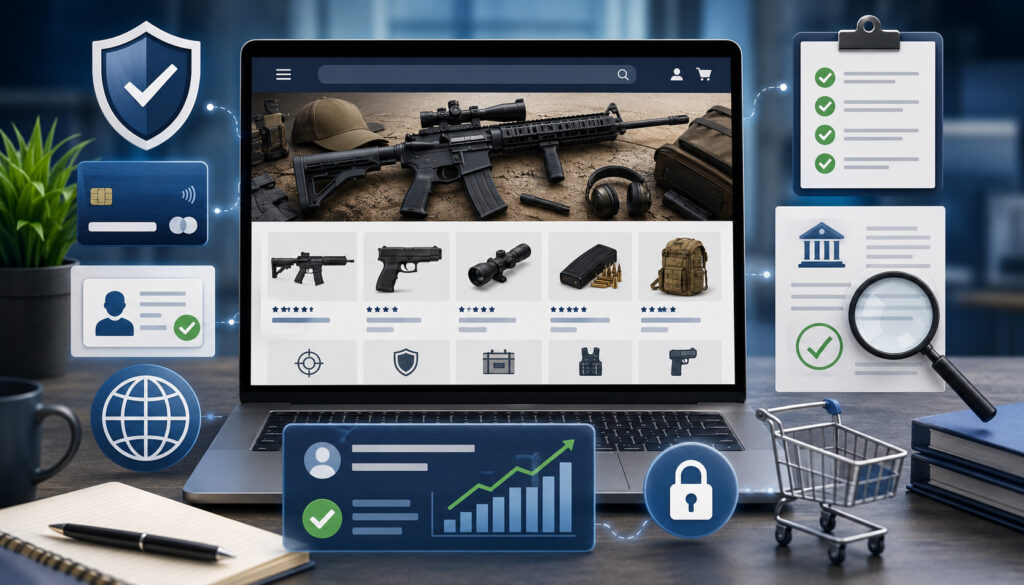
A firearm business website is often reviewed during underwriting, especially when the business accepts online orders, collects deposits, lists products, advertises regulated goods, or uses a payment gateway. The website gives underwriters a public view of how the business presents itself to customers.
Underwriters may review product pages, checkout flow, contact information, refund policy, shipping policy, cancellation terms, privacy policy, terms and conditions, secure checkout indicators, age-related notices where applicable, and prohibited product clarity. If the website is incomplete, confusing, or inconsistent with the application, approval may be delayed.
A website should clearly show the business name, contact information, customer service process, and policy pages. Product descriptions should be accurate and should not misrepresent availability, delivery timing, restrictions, or customer responsibilities. Policies should explain how refunds, cancellations, special orders, shipping limits, and customer data are handled.
For online firearm-related businesses, secure checkout is especially important. A strong gateway setup and fraud controls support both customer trust and underwriting confidence. Businesses reviewing firearm payment processing options should pay close attention to how online checkout, fraud screening, and payment data security work together.
Product Pages and Business Transparency
Product pages help underwriters understand exactly what the business sells. Clear categories, accurate descriptions, visible pricing, availability details, and understandable product terms make the business easier to review.
Avoid vague product labels or incomplete descriptions. If a business sells accessories, parts, optics, safes, training, memberships, or related items, those categories should be organized clearly. If the business sells products that may have shipping restrictions, pickup requirements, or transfer-related steps, customer-facing language should be easy to understand.
Transparency reduces underwriting uncertainty. It also helps customers make informed decisions, which can reduce disputes. When customers know what they are buying, when it will be available, and what restrictions apply, they are less likely to file complaints or chargebacks.
Refund, Shipping, Privacy, and Terms Pages
Refund, shipping, privacy, and terms pages show underwriters that the business has organized procedures. These pages also reduce customer confusion, which can lower dispute risk.
A refund policy should explain when refunds are available, how long they may take, and whether special orders, deposits, memberships, classes, or customized items have different rules. A shipping policy should explain delivery limits, timelines, fulfillment expectations, and customer responsibilities where applicable.
A privacy policy should explain how customer information is handled. Terms and conditions should address order acceptance, cancellations, pricing errors, restricted products, customer obligations, and dispute procedures. These pages should be accessible from the website footer and should match how the business actually operates.
Financial and Processing History Review
Financial and processing history review helps underwriters evaluate whether the business is stable, predictable, and capable of managing card transactions responsibly. This review may include bank statements, prior merchant statements, chargeback ratios, refund levels, sales volume, average ticket size, transaction spikes, and account history.
For established businesses, processing statements are especially valuable. They show real transaction behavior rather than projections. Underwriters can see monthly volume, average ticket size, refund patterns, chargeback activity, fees, funding history, and whether sales are consistent or volatile.
For new businesses, underwriters may rely on bank statements, projected monthly volume, expected average ticket size, business plans, inventory records, website review, and owner experience. Projections should be realistic. Overstating volume may create future problems if actual processing does not match the approved profile.
Financial review is not only about how much money the business has. It is about whether transaction activity makes sense. A sudden jump in volume, unusual refund pattern, high dispute count, or mismatch between expected and actual sales can raise questions.
Why Processing Statements Matter
Processing statements matter because they provide evidence of payment behavior. They show how much the business processed, how often customers requested refunds, how many disputes occurred, what the average ticket size looked like, and whether the account had unusual activity.
A business with steady volume, low chargebacks, and clear refund patterns may be easier to underwrite than a business with unclear history. Even if chargebacks occurred, statements help the business explain what happened and what controls have been added.
New businesses may not have processing statements. In that case, projections should be supported by reasonable assumptions, such as inventory, expected foot traffic, online strategy, range memberships, training schedules, or prior owner experience.
Chargebacks and Refund Patterns
Chargebacks and refunds are major underwriting concerns because they affect financial risk. A chargeback can lead to lost revenue, fees, product loss, processor scrutiny, and higher monitoring. Frequent chargebacks may suggest unclear billing, weak customer service, fraud exposure, or product fulfillment problems.
Refunds are not always negative. A reasonable refund level can show that the business resolves issues before they become disputes. However, frequent or unusually large refunds may raise questions, especially if customers are confused about cancellation terms or order timing.
Good refund documentation helps. Keep records of customer communication, receipts, order confirmations, shipping details, cancellation approvals, and refund confirmations. These records can support chargeback prevention and help during future account reviews.
For deeper dispute prevention practices, businesses can review chargeback prevention for firearm sales in the context of customer communication and documentation.
Product Catalog and Sales Channel Review
Underwriters review the product catalog and sales channels to understand what is being sold and how payments are accepted. This is a core part of merchant account underwriting for gun stores because the risk profile changes depending on whether sales happen in-store, online, by phone, at events, through invoices, or through recurring memberships.
A product catalog may include firearms, ammunition, accessories, optics, parts, apparel, safes, cleaning supplies, gunsmithing services, training classes, memberships, rentals, or outdoor sporting goods. Each category may be evaluated differently depending on the processor’s policies.
Sales channels also matter. Card-present retail transactions are usually viewed differently from eCommerce orders or manually keyed payments. Event sales may require mobile terminals. Phone orders may require stronger verification. Online deposits may require clear cancellation terms. Range memberships may require recurring billing disclosures.
Underwriters want to see that the business understands its own payment flow. A clear explanation of sales channels can improve the review process and reduce the chance of future account restrictions.
In-Store vs Online Firearm-Related Sales
In-store transactions are generally easier to evaluate because the card is present, the customer interacts with staff, and the business may have stronger evidence if a dispute occurs. EMV terminals, clear receipts, signed documentation where applicable, and in-person service can help reduce fraud exposure.
Online transactions require closer review because the card is not physically present. Underwriters may ask about fraud tools, customer verification, shipping procedures, product restrictions, gateway settings, and customer support. Card-not-present risk can affect pricing, reserve requirements, and monitoring.
A business that handles both in-store and online payments should disclose both channels honestly. Hiding online sales during underwriting can create serious account problems later because the processor approved the account under incomplete assumptions.
Changes in Product Mix After Approval
Product mix changes can trigger risk reviews after approval. If a business adds new product categories, expands online sales, starts taking phone orders, launches memberships, or begins processing larger tickets, the processor may want to reassess the account.
This does not mean growth is a problem. It means the account should match the current business model. Unexpected changes are more concerning than planned, disclosed changes.
Before adding higher-risk items or new sales channels, review processor policies and merchant agreement terms. When in doubt, contact the processor before launching the change. Proactive communication is often better than explaining the change after a funding hold or account review begins.
Risk Controls Underwriters May Expect
Risk controls help underwriters see that the business is prepared to manage fraud, chargebacks, customer confusion, and payment security. These controls may not guarantee approval, but they can strengthen the application and support long-term account stability.
Common risk controls include fraud screening, customer verification, secure checkout, PCI compliance, clear receipts, refund documentation, shipping records, chargeback monitoring, staff training, access controls, and transaction review procedures.
For online transactions, tools such as AVS, CVV checks, velocity filters, suspicious order review, and gateway fraud settings are especially important.
For in-store transactions, secure terminals, EMV acceptance, receipt clarity, staff training, and consistent refund procedures matter. For phone orders, written procedures for verifying billing details and confirming customer authorization can reduce dispute risk.
PCI compliance is also central to payment security. The PCI Security Standards Council develops and maintains standards and resources to help protect payment data across the card payment ecosystem.
Fraud Prevention and Customer Verification
Fraud prevention and customer verification are important because firearm-related transactions may involve high-ticket items, card-not-present orders, special orders, and shipping restrictions. A single fraudulent transaction can create product loss, chargebacks, fees, and processor scrutiny.
Online businesses should use address verification, CVV validation, fraud scoring, order velocity checks, suspicious IP or device review, and manual review for unusual orders. Staff should know how to recognize mismatched billing and shipping details, rushed orders, repeated declined cards, or unusual purchase patterns.
Customer verification should be documented and consistent. The goal is not to create unnecessary friction for legitimate buyers. It is to identify risky transactions before fulfillment and maintain records that can support the business if a dispute occurs.
PCI Compliance and Payment Security
PCI compliance and payment security matter because every business that accepts card payments has responsibilities related to cardholder data. Underwriters may not perform a full security audit during application review, but they may ask about payment gateways, terminals, card data handling, and security practices.
Secure terminals, encrypted payment transmission, tokenization, strong passwords, user permissions, software updates, and avoiding insecure card storage can all support a stronger payment environment. Staff should never write card numbers on paper, store card data in spreadsheets, or send card details through insecure messages.
For online payments, a hosted payment page or properly secured gateway can reduce direct exposure to card data. PCI guidance for small merchants explains that how a payment page is managed affects security responsibilities, and outsourcing payment handling to validated providers can often reduce risk.
Reserves, Funding Holds, and Processing Limits
Some firearm merchant accounts may be approved with conditions such as reserves, funding holds, delayed settlement, volume limits, ticket limits, or review periods. These conditions are common in high-risk payment processing and are usually used to manage exposure from chargebacks, refunds, fraud, or unusual transaction activity.
A rolling reserve means the processor holds a percentage of processed funds for a set period before releasing them on a rolling schedule. A funding hold may temporarily delay payouts while a processor reviews transactions, chargebacks, documentation, or unusual activity. Processing limits may cap monthly volume or average ticket size based on the approved application.
These conditions should be reviewed before signing a merchant agreement. Businesses should ask how reserves are calculated, when funds are released, what triggers holds, whether limits can be increased, and how account reviews are handled.
Reserves and limits are not always permanent. A business with stable processing, low chargebacks, and consistent volume may be able to request review later. However, terms vary, so businesses should get details in writing.
Why Reserves May Be Required
Reserves may be required when the processor wants a financial buffer against future losses. In firearm business payment processing, reserves may be considered because of higher ticket sizes, delayed fulfillment, card-not-present sales, chargeback exposure, new business history, or limited processing records.
A reserve does not necessarily mean the business has done anything wrong. It is a risk management tool. The processor may use it to cover potential chargebacks, refunds, fraud claims, or fees if transaction problems arise after funds have already been paid out.
Businesses should understand the reserve percentage, hold period, release schedule, and conditions for review. This information matters for cash flow planning, especially for inventory-heavy businesses.
How Processing Limits Affect Growth
Processing limits affect growth because they define the transaction profile the processor approved. If a merchant is approved for a certain monthly volume and then processes far above that level, the processor may request updated financials, bank statements, invoices, or explanations.
Average ticket limits also matter. If a business usually processes smaller accessory orders and suddenly runs several high-ticket transactions, the processor may review the activity. Transaction caps may apply to certain sales channels, especially keyed or online payments.
Growth should be communicated. If a business expects seasonal spikes, a new product launch, or expanded online sales, it should ask the processor how to raise limits before activity changes.
Best Practices Before Applying for a Firearms Merchant Account
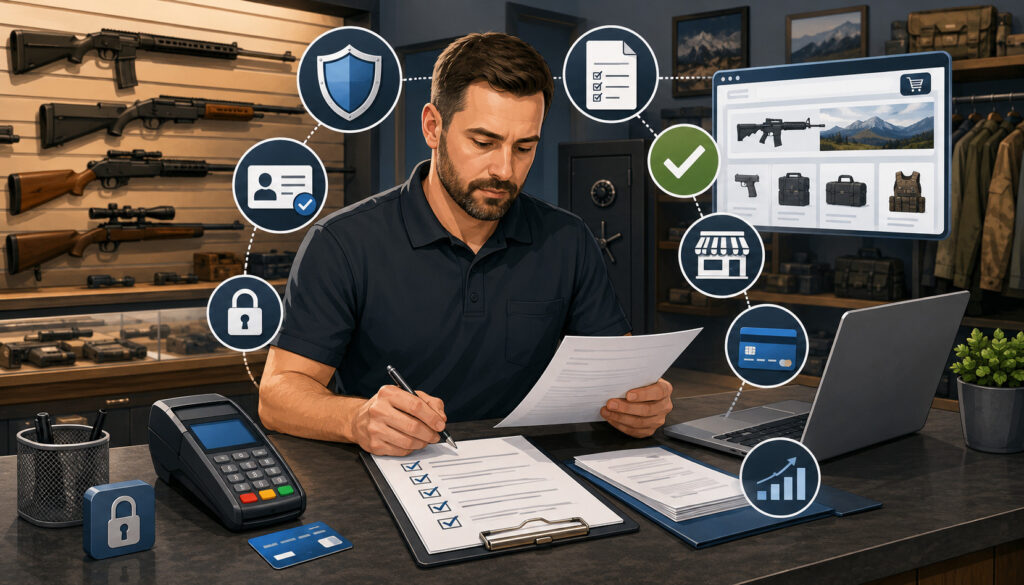
Preparation is one of the best ways to improve underwriting readiness. A well-prepared application helps underwriters review the file faster and reduces the chance of repeated document requests.
Before applying, firearm-related businesses should:
- Gather business documents before applying.
- Keep FFL documentation current where applicable.
- Make sure business details are consistent.
- Prepare recent bank statements.
- Provide prior processing statements if available.
- Review website policies before underwriting.
- Clearly describe products and sales channels.
- Disclose online, phone, and event sales honestly.
- Estimate monthly volume and average ticket size realistically.
- Monitor chargebacks before applying.
- Document refund and shipping procedures.
- Use secure checkout and payment tools.
- Avoid selling products outside processor approval.
- Respond quickly to underwriting requests.
- Keep copies of all submitted documents.
Businesses should also prepare a short explanation of how they accept payments. Include whether transactions are in-store, online, keyed, invoiced, event-based, membership-based, or mixed. Underwriters appreciate clear operational descriptions.
For businesses comparing gun store payment processing, the best preparation is not only about approval. It is about building an account profile that matches real operations from the beginning.
Be Accurate and Transparent in the Application
Accuracy and transparency are essential. Do not understate monthly volume, hide online sales, omit product categories, or describe firearm-related activity as a generic retail category. Incomplete disclosure may create approval delays and future account instability.
Underwriters need to know what they are approving. If an account is approved for in-store retail but later shows significant online card-not-present volume, the processor may review or restrict the account. If product categories were omitted, the account may be considered outside the approved risk profile.
Clear disclosure does not weaken a strong application. It helps place the business with the right underwriting path and reduces unpleasant surprises later.
Prepare for Follow-Up Questions
Follow-up questions are normal in firearm merchant account underwriting. An underwriter may ask for clarification about licenses, ownership, website policies, product categories, chargeback history, bank statements, shipping procedures, or expected transaction volume.
Respond calmly, completely, and quickly. If a question seems repetitive, it may be because the underwriter needs a specific format or clearer documentation. Provide direct answers and attach supporting documents when needed.
Keep a copy of every response. These records can help if the business changes processors later, requests a limit increase, or goes through a future risk review.
Common Mistakes That Delay or Prevent Approval
Common mistakes in firearm merchant account underwriting include missing FFL documents, outdated business records, unclear website policies, high chargebacks, inconsistent application details, unsupported volume estimates, incomplete product descriptions, and undisclosed eCommerce activity.
A rushed application often creates avoidable delays. For example, a business may submit bank statements under one name, a license under another, and a website using a different DBA. Even if all names are connected legitimately, the underwriter may need clarification before proceeding.
Another common mistake is launching a website before policy pages are complete. If refund, shipping, privacy, and terms pages are missing or generic, underwriters may view the website as higher risk. Product pages should also be clear enough for someone outside the business to understand what is sold.
High chargebacks can also hurt approval readiness. Businesses should review dispute causes before applying and prepare explanations for any unusual activity.
Incomplete or Inconsistent Documentation
Incomplete or inconsistent documentation is one of the most common causes of delays. Mismatched names, addresses, ownership details, bank information, tax information, or website details can create uncertainty.
For example, if the business application lists one address but the license lists another, the underwriter may request proof of address or a written explanation. If the bank account name does not match the legal business name, additional documentation may be required.
The best solution is to review all documents before submission. If a mismatch is legitimate, explain it upfront. Do not wait for the underwriter to discover it.
Unclear Website or Product Information
Unclear website or product information can make underwriters hesitant because they cannot easily determine what is being sold or how customers are protected. Missing contact details, vague categories, incomplete policy pages, or confusing checkout terms can create underwriting concerns.
The website should make the business model understandable. Product categories should be organized. Policies should be visible. Customer service contact information should be easy to find. Checkout pages should be secure and consistent with the business’s stated sales channels.
If certain products have restrictions, shipping limits, or special handling rules, the website should not leave customers guessing. Clear disclosure supports both customer trust and processor review.
How to Strengthen a Firearm Merchant Account Application
A firearm merchant account application becomes stronger when the business can show organized operations, accurate documents, clear policies, stable financial records, responsible chargeback management, and secure payment practices.
Start by building a documentation folder. Include licenses, business formation records, tax records, owner information, bank statements, merchant statements, website policy pages, chargeback records, refund logs, shipping procedures, processor communication, and product catalog details.
Next, review customer-facing policies. Refund, shipping, privacy, and terms pages should match real operations. If staff handle refunds differently than the website explains, the policy should be corrected.
Then review chargebacks and fraud controls. If disputes have occurred, identify root causes. Were customers confused about shipping? Were refunds delayed? Were descriptors unclear? Were special-order terms not documented? Fixing these issues before applying can improve underwriting readiness.
Finally, make sure the payment setup is secure. Use compliant terminals, trusted gateways, access controls, and staff training. Payment security and documentation work together to support account stability.
Show Stable and Organized Business Operations
Stable and organized business operations help underwriters feel more confident about approval. A business does not need to be large to appear well managed. It needs accurate records, clear processes, consistent customer communication, and responsible payment practices.
Underwriters may look favorably on businesses that can explain their transaction flow, refund handling, shipping process, fraud controls, and dispute prevention steps. This shows that payment risk is being managed intentionally.
Reliable customer service also matters. Many chargebacks begin when customers cannot get timely answers. A visible phone number, email address, order confirmation process, and documented refund procedure can reduce disputes.
Keep Compliance and Payment Records Easy to Access
Keeping compliance and payment records easy to access can save time during underwriting and future reviews. Digital folders are helpful because underwriters often ask for documents quickly.
Organize folders for licenses, business records, bank statements, processing statements, chargeback notices, refund records, shipping documentation, website policies, gateway settings, and processor messages. Label files clearly and keep them updated.
This habit is useful after approval as well. If a processor asks about a transaction spike, new product line, or chargeback, the business can respond with organized evidence instead of scrambling.
What Happens After Underwriting Approval
Approval is not the end of risk review. Firearms merchant services are often monitored after the account goes live. Processors may review sales volume, chargebacks, refunds, fraud alerts, ticket size, website changes, new products, and sales channel changes.
This ongoing monitoring is normal in high-risk payment processing. The processor is checking whether account activity continues to match the approved profile. If volume grows gradually and disputes remain low, monitoring may be uneventful. If activity changes suddenly, the processor may request additional details.
Businesses should keep the processor informed about meaningful changes. These may include launching online sales, adding new product categories, changing ownership, opening a new location, increasing monthly volume, adding recurring billing, or expanding event sales.
Good communication can reduce surprises. It also helps the processor update the account profile before activity triggers a review.
Ongoing Monitoring and Account Reviews
Ongoing monitoring may include chargeback ratios, refund activity, transaction volume, average ticket size, fraud alerts, settlement patterns, and website review. A processor may also review activity if customers complain, a card network alert occurs, or sales patterns change.
Account reviews can feel stressful, but they are easier when records are organized. If a processor asks about a spike in volume, the business can provide invoices, seasonal explanations, inventory changes, or promotional context.
If chargebacks rise, the business should be ready to explain causes and prevention steps. Underwriters and risk teams generally prefer businesses that identify problems early and take corrective action.
Keeping the Merchant Account in Good Standing
Keeping a merchant account in good standing requires ongoing attention. Businesses should maintain accurate records, monitor chargebacks, update website policies, protect payment data, train staff, and respond quickly to processor requests.
Stay within approved processing limits or request increases before exceeding them. Do not add new product categories or sales channels without reviewing processor policies. Keep FFL documentation current where applicable and update business records when names, addresses, ownership, or bank accounts change.
A strong payment relationship depends on consistency. When the business processes in the way it was approved, maintains low disputes, and communicates changes clearly, account stability is easier to maintain.
How to Choose Merchant Services for Firearm Businesses
Choosing merchant services for firearm businesses requires more than comparing advertised rates. Firearm businesses should evaluate underwriting transparency, firearm industry familiarity, eCommerce support, POS and gateway options, chargeback support, funding terms, reserve clarity, contract terms, payment security, and customer support.
The right provider should be able to explain firearm merchant account requirements before the application begins. It should clearly state what documents may be needed, whether online sales are supported, what product categories are restricted, how reserves work, how chargebacks are monitored, and what funding timelines apply.
Businesses should also evaluate technology fit. A retail gun shop may need EMV terminals, contactless payments, POS integration, and clear receipts. An online business may need a secure gateway, fraud tools, hosted checkout, and card-not-present controls. A shooting range may need membership billing, invoicing, and in-person payments.
Contract terms matter as much as technical features. Review termination clauses, reserve terms, chargeback fees, monthly minimums, gateway costs, PCI fees, funding schedules, and volume limits. For contract-specific questions, professional review is recommended.
Questions to Ask Before Applying
Before applying, firearm-related businesses should ask direct questions about underwriting and account rules. Useful questions include:
- Do you support firearm-related businesses under your current policies?
- What firearm merchant account documentation is required?
- Do you review FFL documentation where applicable?
- Are online firearm-related sales supported?
- Are phone orders, invoices, event sales, or range payments allowed?
- Which product categories are prohibited or restricted?
- Are reserves required, and how are they released?
- What are the funding timelines?
- What chargeback thresholds apply?
- Which payment gateways and POS systems are compatible?
- Are monthly volume limits or ticket limits applied?
- What events can trigger an account review?
These questions help the business identify whether the provider is a good fit before submitting sensitive documents or moving payment operations.
Comparing More Than Processing Rates
The lowest advertised rate is not always the best choice for payment processing for gun stores. A low rate is not helpful if the account is later restricted, funds are held unexpectedly, or the provider does not actually support the business model.
Compare underwriting fit, account stability, policy clarity, support quality, funding terms, reserve terms, fraud tools, gateway compatibility, and contract flexibility. A provider that understands firearm business payment processing may offer more practical value than a cheaper option with unclear policies.
Businesses should also compare communication quality. If a provider cannot explain underwriting requirements before approval, it may be difficult to get support during a risk review or chargeback issue.
FAQs
What are underwriting requirements for firearms merchant accounts?
Underwriting requirements for firearms merchant accounts are the documents, business details, policies, and risk controls reviewed before a firearm-related business is approved for card processing.
These may include business identity, ownership information, tax details, bank statements, FFL documentation where applicable, website policies, product catalog, processing history, chargeback records, and expected transaction volume.
The goal is to help the processor understand the business, confirm legitimacy, assess risk, and determine whether the account fits its policies. Approval may include conditions such as volume limits, ticket limits, reserves, or additional monitoring.
Why do firearm merchant accounts require more detailed underwriting?
Firearm merchant accounts often require more detailed underwriting because the industry involves regulated products, age-sensitive sales, policy restrictions, card-not-present risk, higher ticket sizes, shipping complexity, and chargeback exposure.
Processors also vary in their willingness to support firearm-related businesses. Some do not accept the category at all. Others accept it only when the business provides strong documentation and uses appropriate risk controls.
What documents are needed for an FFL merchant account?
Documents commonly requested for an FFL merchant account may include business legal name, DBA, tax ID, ownership details, business address, bank account information, FFL documentation where applicable, business license where applicable, product catalog, website URL, bank statements, processing statements, refund policy, shipping policy, privacy policy, terms and conditions, and chargeback history.
New businesses may not have processing statements, so underwriters may ask for projections, bank statements, inventory information, or a written explanation of expected sales channels.
Can online firearm-related businesses get merchant accounts?
Online firearm-related businesses may be able to get merchant accounts, but underwriting is usually more detailed than for in-store-only sales. Underwriters may review the website, checkout process, product categories, shipping procedures, fraud controls, customer verification practices, refund policy, and terms of sale.
Online sales create card-not-present risk, so businesses should use secure checkout, fraud screening, clear policies, and accurate product descriptions. The business should also confirm that its processor supports the exact online sales model before accepting payments.
Why do underwriters review a firearm business website?
Underwriters review a firearm business website to understand what is being sold, how customers are charged, what policies apply, and whether the business matches the application. Product pages, contact information, refund policy, shipping policy, privacy policy, terms and conditions, secure checkout, and restricted product disclosures may all be reviewed.
A clear website helps reduce uncertainty. A confusing or incomplete website can delay approval because underwriters may need more information before deciding whether the account fits processor rules.
What causes a firearms merchant account application to be delayed?
Common causes of delays include missing documents, expired FFL documentation, mismatched business names, inconsistent addresses, unclear ownership information, incomplete website policies, vague product descriptions, unsupported sales volume estimates, high chargebacks, and undisclosed online sales.
Delays can often be reduced by preparing documents before applying, reviewing website policies, explaining unusual details upfront, and responding quickly to follow-up requests.
What are reserves in firearm merchant account underwriting?
Reserves are funds held by the processor for a period of time to reduce risk from chargebacks, refunds, fraud, or account losses. A rolling reserve usually holds a percentage of each batch and releases it later according to the agreement.
Reserves may be required for new businesses, higher-risk sales channels, high-ticket transactions, limited processing history, or elevated dispute risk. Businesses should ask how reserves are calculated, how long they are held, and when they may be reviewed.
How can gun stores improve merchant account approval readiness?
Gun stores can improve approval readiness by organizing business documents, keeping FFL documentation current where applicable, preparing bank and processing statements, creating clear website policies, documenting refund and shipping procedures, using secure payment tools, monitoring chargebacks, and accurately disclosing all sales channels.
The strongest applications are complete, consistent, and transparent. Underwriters should be able to understand who owns the business, what it sells, how customers pay, how orders are fulfilled, and how payment risk is managed.
Conclusion
Underwriting requirements for firearms merchant accounts matter because they shape payment approval, account stability, funding expectations, and long-term processing health.
Firearm-related businesses often face added review because processors must evaluate regulated products, sales channels, card-not-present risk, chargebacks, documentation quality, website policies, fraud controls, and payment security.
A smoother underwriting process begins before the application is submitted. Businesses should prepare accurate records, maintain current licensing where applicable, organize ownership and tax information, review website policies, disclose sales channels honestly, provide realistic volume estimates, monitor chargebacks, and protect payment data.
Approval is not only about getting a merchant account open. It is about creating a payment relationship that matches the way the business actually operates. A well-prepared application gives underwriters a clearer risk picture, reduces avoidable delays, and helps the business avoid future account problems caused by incomplete disclosure or poor documentation.
Firearm businesses should treat underwriting as an ongoing part of payment operations. Keep records updated, respond quickly to requests, review processor policies before changing products or sales channels, and maintain strong customer service and security practices.
With accurate documentation and organized risk controls, underwriting can become a manageable step toward more stable firearm payment processing.
Leave a Reply