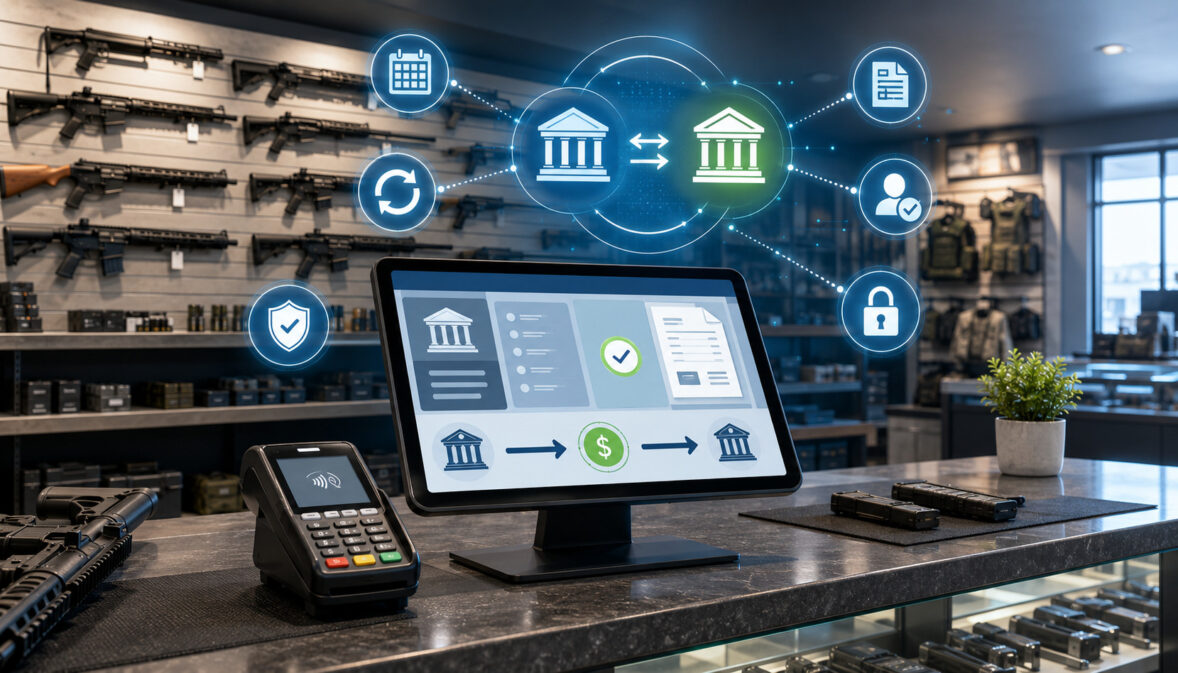
ACH payments for firearms businesses can be a useful part of a well-organized payment setup when they are approved, documented, secure, and matched to the right transaction types.
Firearm retailers, FFL dealers, gun shops, shooting ranges, firearm accessory sellers, outdoor sporting goods stores, and online firearm-related sellers often need more than one way to accept and manage payments.
Cards may work well at the counter, payment links may help with remote invoices, and ACH may fit recurring memberships, larger invoices, deposits, vendor payments, or business account billing.
ACH is not a shortcut around processor rules. It is a bank-to-bank payment method that requires proper authorization, customer consent, secure handling of bank information, and careful monitoring of returns.
For firearm-related businesses, that matters even more because payment providers and banks may review licensing, product categories, websites, refund terms, shipping policies, transaction sizes, and sales channels before approving any form of firearm payment processing.
Used responsibly, ACH payment processing for firearms can support smoother billing and better payment tracking. However, it also comes with return risk, settlement timing, authorization requirements, account verification needs, and fraud prevention responsibilities.
Businesses should treat ACH as one payment option within a broader strategy that may include cards, digital wallets, retail POS, invoices, and approved online checkout.
What Are ACH Payments for Firearms Businesses?
ACH payments for firearms businesses are electronic bank-to-bank payments that move funds between a customer’s bank account and a business bank account through the ACH network. Instead of relying on a card number, ACH uses bank account information, authorization, and electronic funds transfer rules to debit or credit money between accounts.
For gun shops, FFL dealers, shooting ranges, firearm training businesses, and outdoor sporting goods stores, ACH may be used for selected workflows such as invoice payments, recurring range memberships, training fees, business-to-business billing, special-order deposits, gunsmithing invoices, or approved online account payments.
It is usually not a complete replacement for card processing because many customers still prefer cards at checkout, especially for retail transactions.
ACH payment solutions for firearm businesses should be planned carefully. The business must know when funds are expected to settle, how returns are handled, what authorization is required, how bank account details are verified, and how customer communication will work.
A customer should never be confused about when their bank account will be debited, what amount will be collected, or how to cancel a recurring payment.
ACH payments may sit alongside other approved payment channels. For example, a store may use a retail POS for in-store card payments, an online gateway for approved eCommerce transactions, invoice links for custom orders, and ACH for memberships or larger account payments.
The ACH network has rules covering authorization, recordkeeping, return handling, data security, and risk management responsibilities. Nacha notes that ACH transaction authorization and related record retention obligations continue to apply even when open banking data is used in payment workflows.
ACH Debit vs ACH Credit
ACH debit and ACH credit both move money through bank accounts, but the direction and control of the transaction are different. An ACH debit happens when the business pulls money from the customer’s bank account after receiving proper authorization. This is common for recurring ACH payments, memberships, invoice payments, and scheduled billing arrangements.
ACH credit works differently. In an ACH credit, the payer pushes funds to the business. For example, a business customer may use its bank portal to send payment to a firearm retailer for an invoice. Payroll deposits and vendor payments often use a similar push-payment structure.
For firearm ACH payment processing, the difference matters because authorization, risk, and customer expectations are not the same. With ACH debit, the business must be able to prove that the customer authorized the payment.
With ACH credit, the payer initiates the payment, but the business still needs strong reconciliation so the payment can be matched to the right invoice, customer account, or order.
ACH debit may be useful when the business manages the billing schedule. ACH credit may be useful for business accounts that prefer to send funds from their own banking system. Both require clean records, secure bank details, and clear payment instructions.
ACH Payments vs Card Payments
ACH payments and card payments may both support electronic payments for gun stores, but they operate differently. Card payments usually rely on card networks, authorization at checkout, card-present or card-not-present rules, and chargeback processes. ACH payments rely on bank account authorization, account verification, settlement timing, and ACH return rules.
Cards are often faster from the customer’s point of view. A customer taps, swipes, inserts, or enters card details, and the transaction response is usually immediate.
ACH may feel less instant because the payment can take time to settle, and the business may still need to watch for returns such as insufficient funds, closed accounts, incorrect account details, or unauthorized payment claims.
ACH can be useful for invoices, recurring billing, or larger payments where bank account payments fit the workflow. Card payments often work better for fast retail checkout, same-day in-store purchases, and customers who want rewards, card protections, or quick confirmation.
Disputes are also different. Cards have formal chargeback processes, while ACH returns follow bank and ACH network rules. This does not mean ACH is risk-free. A returned or unauthorized ACH transaction can still create operational problems, collection delays, and customer service issues.
Why Firearm Businesses May Consider ACH Payments
Firearm businesses may consider ACH payment processing for firearms because their payment needs are often more varied than simple over-the-counter sales.
A gun shop may sell retail accessories, process transfer-related fees, collect range memberships, take deposits for custom orders, invoice business customers, and manage training class registrations. One payment method rarely fits all of those needs.
ACH payments for gun stores may be especially useful when the customer already expects invoice-style or account-based billing.
For example, a shooting range with monthly memberships may prefer recurring ACH payments because billing can be scheduled and tracked. A gunsmith may use ACH for invoice balances after work is completed. A training business may collect class fees through approved payment links or bank account payments.
Larger-ticket orders are another reason businesses review ACH. Some card payments can trigger higher fees, closer fraud review, or customer card limits. ACH may provide a bank-based payment option for certain invoices or deposits, provided the business follows authorization and risk controls.
ACH can also support business-to-business payments. Outdoor sporting goods stores, corporate accounts, instructors, clubs, or wholesale buyers may prefer bank payments for invoices. In those cases, ACH can reduce manual check handling and improve reporting when the payment system is integrated with invoices or accounting tools.
Firearm businesses should still avoid treating ACH as a universal fix. Provider approval, underwriting fit, sales channel rules, customer verification, refund policies, and documentation all matter. Businesses that need broader account stability may benefit from reviewing firearm merchant account considerations before adding new payment channels.
Benefits of ACH Payments for Gun Stores
The benefits of ACH payments for gun stores usually come from flexibility, organization, and suitability for certain billing workflows. ACH gives customers a bank-based payment option, which may be useful for memberships, invoices, larger balances, recurring billing, business accounts, and approved online account payments.
ACH can also help reduce some card-related friction in specific workflows. For example, a recurring range membership paid through ACH may avoid card expiration issues that interrupt billing.
A business invoice paid through ACH may be easier to match to an invoice than a mailed check. A training class deposit paid electronically may be easier to track than a phone payment note.
ACH payment solutions for firearm businesses may also support better reconciliation when payments are tied to invoices, customer IDs, membership accounts, or order numbers. That can help payment teams match deposits, returns, refunds, and failed payments more accurately.
Another benefit is that ACH can support recurring billing when properly authorized. Range dues, club memberships, storage fees where allowed, and approved service plans may be easier to manage when payment dates, receipts, cancellation terms, and failed payment procedures are built into the workflow.
When ACH May Not Be the Best Fit
ACH may not be the best fit for every firearm-related transaction. In-store retail purchases often need immediate confirmation, and customers may prefer cards, cash, or digital wallets at the counter. ACH can involve settlement delays, return windows, and additional verification steps that may not match a quick checkout experience.
ACH is also not ideal when the business cannot confidently verify the customer, account details, authorization, or order information. Incorrect routing or account numbers can cause failed payments. Fraudulent account use can create returns. Unclear authorization can lead to unauthorized payment claims.
Customer preference matters too. Some customers are comfortable using bank account payments for memberships or invoices, while others may not want to share bank account information. Businesses should explain ACH clearly and offer approved alternatives where appropriate.
ACH may also be inappropriate if the provider has not approved the transaction type, product category, or sales channel. For example, a provider may approve ACH for membership billing but not for certain online product sales. Firearm businesses should confirm the exact approved use cases before launching ACH at checkout or through payment links.
Common Use Cases for ACH Payments in Firearm Businesses

Common use cases for ACH payments in firearm businesses include recurring memberships, training fees, invoice balances, custom work, business accounts, vendor payments, and certain online payment workflows where approved. The best use cases are usually those where the customer has time to review terms, provide authorization, and understand the payment timeline.
Shooting ranges may use recurring ACH payments for memberships, club dues, training subscriptions, or service plans. Firearm safety instructors may use ACH for scheduled class payments or organizational invoices.
Gunsmiths may accept ACH for repair invoices, custom work deposits, or final balances. Retailers may use ACH for special orders, larger accessory orders, or business-account billing.
ACH processing for gun shops may also support wholesale or vendor payments. A business may pay suppliers, landlords, contractors, trainers, or service providers through ACH credit or debit arrangements. These transactions are not customer checkout payments, but they still need authorization, records, and reconciliation.
Online firearm payment processing can be more sensitive because providers often review websites, product categories, fulfillment steps, refund terms, shipping policies, and compliance language. If ACH appears online, the checkout must clearly show payment timing, authorization language, refund expectations, and customer contact options.
ACH should be used only for approved transactions. A firearm business should not use ACH to process sales that another provider or agreement has restricted. Payment processing for gun stores depends on transparency with providers, accurate underwriting, and policies that match the business model.
Recurring ACH Payments for Range Memberships
Recurring ACH payments can be useful for range memberships, club dues, training subscriptions, or approved service plans. The main advantage is predictability. The business can bill on a set schedule, and the customer can keep the membership active without re-entering payment information each time.
Recurring ACH payments require clear recurring authorization. The authorization should explain the amount, billing frequency, start date, billing date, cancellation process, and how the customer can update bank account information. If the amount may vary, the business should explain how customers will be notified before debits occur.
Receipts and confirmations are important. Customers should receive a copy of the authorization or confirmation after enrolling. They should also receive receipts or account updates when payments are processed, especially when a payment fails or a membership status changes.
Failed payments should follow a written procedure. Staff should know when to notify the customer, whether to retry the payment, when to suspend membership privileges, and how to document the communication. This helps reduce confusion and prevents inconsistent handling.
ACH for Invoices and Larger Orders
ACH may be useful for invoices and larger orders because the payment can be tied directly to a billing record. A firearm retailer, range, gunsmith, or accessory seller may issue an invoice with an ACH payment option for deposits, balances, custom work, special orders, or business accounts.
Clear payment terms matter. The invoice should identify the customer, order, payment amount, due date, refund or cancellation terms, and what happens if the ACH payment is returned. For custom orders or deposits, the business should explain whether the payment is refundable, partially refundable, or applied to future balances.
Recordkeeping is especially important for larger payments. The business should match each ACH payment to the correct invoice, customer account, order number, and bank deposit. If a return occurs, the team should be able to identify the affected order quickly and communicate with the customer.
ACH for larger orders should also include fraud review. A large invoice paid by ACH should not automatically be treated as risk-free. Businesses should check customer identity, order details, account verification, shipping or pickup arrangements, and any mismatch between the payer and the order.
ACH Payment Processing for Firearms Compared With Other Payment Methods
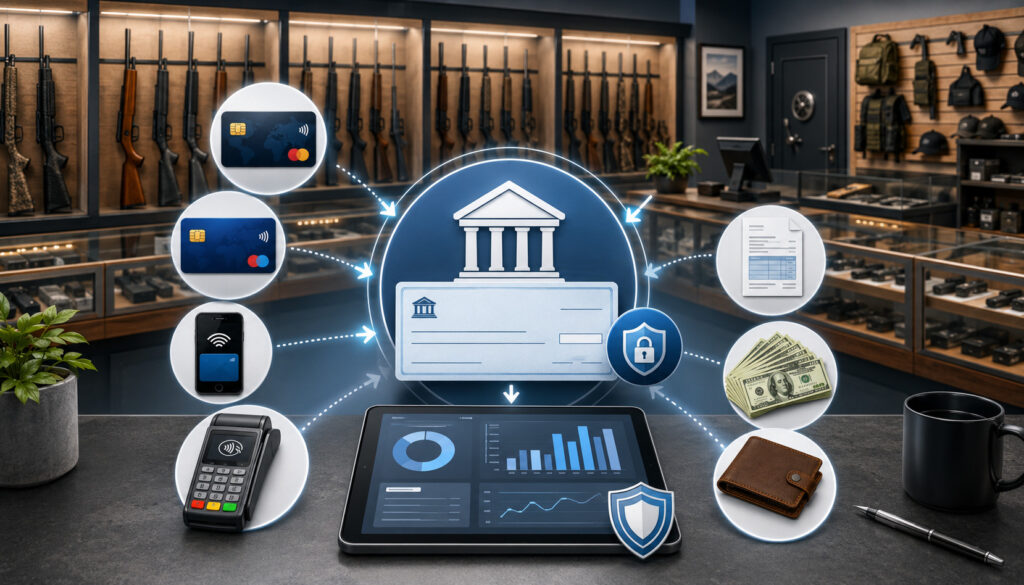
ACH payment processing for firearms works best when it is compared honestly with other approved payment methods. Firearm businesses often need several options because customer behavior, transaction size, risk level, and sales channel can differ from one order to another.
A gun store may rely on retail POS terminals for in-person sales, secure online checkout for approved website orders, payment links for custom invoices, virtual terminals for approved remote payments, and ACH for memberships or larger invoices.
A shooting range may need recurring billing, counter payments, and class registration tools. A gunsmith may need deposits, invoice balances, and card payments for smaller transactions.
The right payment mix should be based on approved channels, not convenience alone. Firearm businesses are often subject to closer underwriting review, and some general payment providers may restrict firearm-related activity. Reviewing gun store payment processing options can help businesses think about fit, risk controls, and long-term account stability.
| Payment Method | Best For | Benefits | What to Review |
| ACH payments | Invoices, memberships, larger payments | Bank-based option and useful for recurring billing | Authorization, returns, and settlement timing |
| Credit/debit cards | Retail checkout and online purchases | Familiar and fast for customers | Fees, chargebacks, and processor rules |
| Digital wallets | Contactless or mobile checkout | Convenient customer experience | Compatibility and approved use |
| Payment links | Remote payment requests | Easy for invoices and custom orders | Link security and confirmation |
| Retail POS | In-store payments | Fast card-present transactions | Terminal setup and reconciliation |
| Virtual terminal | Phone or manual orders | Useful for approved remote payments | Card-not-present risk |
| Cash | Limited in-person situations | Simple for some customers | Tracking and internal controls |
How to Choose the Right Payment Mix
The right payment mix depends on how the firearm business sells, what customers expect, which channels are approved, and how risk is managed.
A retail store with heavy counter traffic may prioritize POS terminals, card-present transactions, contactless payments, and cash controls. A shooting range may need recurring billing, online registration, and membership payment tools.
Transaction size should also influence the decision. Larger invoices may require more verification, clearer terms, and stronger records. Smaller retail purchases may need faster checkout and customer convenience. Online orders may require additional fraud screening and website compliance review.
Settlement timing matters as well. Card payments may appear faster in daily operations, while ACH can take longer and may still be returned after submission. Businesses should avoid releasing goods, activating services, or marking invoices as fully settled before understanding the provider’s funding and return rules.
A good payment mix supports customer convenience without weakening compliance. ACH should be one approved option among several, not an unreviewed substitute for card processing.
Why ACH Should Be Part of an Organized Payment Strategy
ACH should be part of an organized payment strategy because bank payments affect authorization, settlement, security, and reconciliation. If ACH is added casually, staff may collect incomplete authorizations, store bank details insecurely, or misunderstand failed payment procedures.
Firearm businesses should define where ACH fits. For example, ACH may be allowed for range memberships, invoices, gunsmithing balances, and business accounts, but not for certain product categories or immediate checkout scenarios. That decision should be based on provider approval and internal risk review.
ACH also needs documentation. The business should keep authorization records, receipts, payment confirmations, cancellation requests, refund records, return notices, and reconciliation reports. These documents help resolve disputes, answer customer questions, and support internal audits.
ACH should never be used as an undisclosed workaround for processor restrictions. If a provider does not approve firearm ACH payment processing for a specific use case, the business should not route payments through ACH while presenting the transaction differently.
ACH Authorization Requirements and Customer Consent

ACH payment authorization is one of the most important parts of secure ACH payments. Before a firearm business debits a customer’s bank account, the customer must authorize the payment. Authorization may be written or electronic depending on the payment setup, but it should be clear, traceable, and stored in a way the business can retrieve later.
The authorization should identify what the customer agreed to. This includes the payment amount, timing, account to be debited, business receiving payment, and whether the payment is one-time or recurring. If the authorization is for recurring ACH payments, the customer should understand the billing frequency, start date, cancellation terms, and how to revoke authorization.
Customer consent should not be buried or vague. A customer should not have to guess whether submitting bank details means immediate payment, scheduled billing, or future recurring debits. Clear consent reduces disputes and supports customer trust.
Nacha has emphasized that ACH entries require separate transaction authorizations that meet ACH rule standards, and related authorization record retention responsibilities remain important. Firearm businesses should review their specific ACH authorization language with qualified payment, banking, or legal professionals before using it.
What ACH Authorization Should Include
ACH authorization should include enough detail to show that the customer knowingly approved the payment. At a minimum, the business should collect the customer’s name, payment amount or billing schedule, authorization date, bank account authorization language, and a confirmation method.
For a one-time ACH debit, the authorization should state the exact amount or explain how the amount is determined. It should also explain when the debit will occur and which business will appear on the customer’s bank statement, if known.
For recurring ACH payments, the authorization should include frequency, start date, billing date, amount, cancellation terms, customer contact method, and how account changes are handled. If fees may apply after failed payments, those terms should be disclosed before enrollment.
The authorization should also reference related policies where relevant. Refund policy, cancellation policy, membership terms, shipping policy, or invoice terms may affect customer expectations. Keeping these connected helps reduce confusion later.
Recurring ACH Authorization Best Practices
Recurring ACH authorization best practices begin with clarity. Customers should know whether they are authorizing weekly, monthly, quarterly, or another billing schedule. They should also know whether the amount is fixed or variable.
Businesses should send confirmations after enrollment. A confirmation may include the customer name, masked account details, billing amount, billing date, cancellation instructions, and contact information. Masking is important because full bank details should not appear in routine emails or receipts.
Cancellation procedures should be easy to understand. If customers must cancel by a certain date before the next debit, state that clearly. If cancellation affects membership access, range privileges, class registration, or service plans, explain how.
Recurring billing should also be reviewed periodically. Businesses should monitor failed payments, customer complaints, authorization records, and outdated bank account details. A recurring billing program is not a “set it and forget it” system.
ACH Returns, Failed Payments, and Payment Risk
ACH returns happen when an ACH payment cannot be completed or is reversed through the banking system. For firearm businesses, returned ACH payments can affect order status, membership access, deposits, invoices, and cash flow.
A payment may fail because of insufficient funds, closed accounts, invalid account details, stop payment requests, unauthorized claims, frozen accounts, or customer revocation.
ACH returns are different from card declines. A card payment may decline immediately at checkout, while an ACH payment may initially appear submitted and later return. That timing difference is important when deciding whether to release goods, finalize an order, activate a membership, or mark an invoice as paid.
Return handling should be documented before ACH goes live. Staff should know how to identify a returned payment, contact the customer, update the order, collect a replacement payment, apply any permitted fees, and document the outcome.
Payment risk management also requires monitoring return rates. A pattern of repeated returns can create provider concerns, customer service problems, and account stability issues. Firearm businesses should track returns by customer, order type, staff entry method, and reason code where available.
Common ACH Return Reasons
Common ACH return reasons include insufficient funds, incorrect account information, closed accounts, unauthorized payment claims, customer revocation, stop payment requests, frozen accounts, and accounts that do not support the transaction type. Each reason may require a different response.
Insufficient funds means the customer’s account did not have enough available balance when the debit was processed. The business may need to contact the customer, follow any retry rules, and request an updated payment method.
Incorrect routing or account numbers often come from manual entry errors. Account verification methods can reduce this risk, but staff should also confirm that payment forms are easy to use and not copied from handwritten notes.
Unauthorized payment claims are especially serious. They may indicate unclear authorization, customer confusion, fraud, or missing records. The business should be able to retrieve the authorization quickly and review what the customer was told.
How to Reduce ACH Returns
Reducing ACH returns starts with collecting accurate account information. Businesses can use micro-deposits, instant account verification, or secure bank connection tools where available. Manual entry should be minimized when safer options exist.
Clear authorization also reduces returns. Customers should understand the amount, timing, billing frequency, and cancellation process. For recurring billing, sending reminders before debits may help reduce insufficient funds and customer confusion.
Businesses should monitor failed payments promptly. If a payment fails, staff should contact the customer quickly, confirm the issue, and document the next step. Waiting too long can turn a simple payment problem into a dispute or service interruption.
Return data should be reviewed regularly. If many returns come from one payment page, one staff workflow, one membership type, or one invoice process, the business may need to improve instructions, verification, or customer communication.
Fraud Prevention for ACH Payments in Firearm Businesses
Fraud prevention for ACH payments in firearm businesses requires customer verification, account validation, transaction review, secure payment tools, and consistent internal controls.
ACH fraud can include unauthorized use of bank information, mismatched payer details, false invoice payments, refund manipulation, or attempts to use returned payments to obtain goods or services.
Firearm businesses should compare customer identity, order details, payment account information, pickup or shipping instructions, and invoice history. Mismatches do not always mean fraud, but they should trigger review. For example, a large order paid from a bank account under a different name may require additional verification before fulfillment.
Transaction limits can also help. A business may set internal limits for first-time ACH customers, online ACH payments, recurring enrollments, or large invoice payments. Limits should be based on risk tolerance, provider rules, and operational needs.
Refund controls are important. ACH refunds should go through an approved process, not informal staff decisions. Businesses should verify that the original payment settled, confirm refund eligibility, document the reason, and avoid sending refunds to unrelated accounts.
Verifying Bank Account Information
Verifying bank account information helps reduce errors and unauthorized payment claims. Two common methods are micro-deposits and instant account verification.
Micro-deposits involve sending small amounts to the customer’s account and asking the customer to confirm them. Instant account verification may allow the customer to connect securely through a supported verification tool.
Verification does not eliminate all risk, but it can reduce incorrect account details and improve confidence that the customer can access the account. For recurring billing, verification can also reduce failed first payments and account setup errors.
Businesses should avoid collecting routing and account numbers through email, text messages, or unsecured documents. Bank account details should be entered through secure payment forms or approved tools.
Staff should be trained to explain verification steps clearly. Customers may be unfamiliar with micro-deposits or secure bank connections, so a simple explanation can reduce abandonment and support trust.
Monitoring Suspicious ACH Activity
Suspicious ACH activity may include repeated failed payments, mismatched names, sudden large orders, unusual billing patterns, multiple accounts tied to one customer, rapid invoice payments followed by refund requests, or bank account details that do not match customer records.
Firearm businesses should review suspicious activity before fulfilling orders or activating services. The review may include contacting the customer, confirming order details, checking invoice history, verifying identity, and reviewing provider risk alerts.
Monitoring should not rely only on software. Staff experience matters too. A counter employee, billing manager, or range administrator may notice unusual behavior before a system flags it.
Businesses should also keep records of fraud review decisions. If a payment is approved after review, note why. If it is rejected, document the reason. These records support consistent decision-making and help train staff.
ACH Compliance and Payment Rules to Understand
ACH compliance for firearm businesses includes authorization, recordkeeping, return handling, data security, provider rules, and bank expectations. ACH payments are governed by network rules and financial institution requirements, and businesses using ACH are expected to follow the terms of their payment provider or bank relationship.
Firearm businesses face an extra layer of review because the business model may be considered sensitive or high-risk by payment providers.
That does not mean ACH is unavailable, but it does mean the business should be transparent during underwriting. Product categories, sales channels, licensing, website content, refund terms, and order fulfillment procedures may all be reviewed.
Firearm-specific compliance is separate from payment compliance, but the two can overlap during underwriting. Providers may ask for FFL documentation, business licenses, website policies, processing history, bank statements, ownership information, and descriptions of how orders are fulfilled.
ATF materials related to firearm transaction records and licensing obligations are important for operational compliance outside the payment process.
Businesses should avoid treating payment guidance as legal advice. Specific questions about firearm regulations, ACH rules, banking agreements, consumer payment laws, or contract obligations should be reviewed with qualified professionals.
Nacha Rules and ACH Payment Responsibilities
Nacha rules establish important expectations for ACH payments, including proper authorization, record retention, return handling, data security, and risk management. Businesses that originate ACH debits through a provider are usually expected to follow the provider’s ACH terms and maintain proof of customer authorization.
At a high level, firearm businesses should understand that ACH is not simply “enter bank details and collect funds.” The business must know what the customer authorized, how long records should be kept, how returns are handled, and how bank account information is protected.
Authorization records should be retrievable. If a customer claims a debit was unauthorized, the business may need to provide evidence of consent. That evidence may include electronic logs, signed forms, confirmation emails, invoice records, or recurring billing enrollment records.
Return handling also matters. ACH returns are not only accounting events; they can affect compliance, customer communication, and provider risk review. A business should monitor returns and act quickly when issues appear.
Why Firearm Businesses Should Review Provider Policies
Firearm businesses should review provider policies because not every ACH provider supports every business type, product category, or sales channel. Some providers may allow ACH for general invoices but restrict certain firearm-related transactions. Others may require more detailed underwriting before approving gun store ACH payments.
Provider approval should be specific. A business should ask whether ACH is approved for retail invoices, online firearm-related orders, range memberships, training fees, recurring billing, deposits, gunsmithing invoices, and business-to-business payments. Vague approval can create problems later.
Website and checkout rules should also be confirmed. Providers may review product descriptions, restricted items, fulfillment steps, refund policy, shipping policy, privacy policy, terms and conditions, and customer support details before allowing online ACH.
Firearm businesses should also ask about transaction limits, return thresholds, funding timelines, account verification requirements, and reserve policies. ACH payment processing for firearms is most stable when expectations are clear before transactions begin.
Website and Checkout Considerations for ACH Payments
Website and checkout considerations for ACH payments are important because online firearm-related payments may receive close review from providers and customers.
If ACH is available online, the checkout page should clearly explain what the customer is authorizing, when the bank account may be debited, how long processing may take, and what happens if the payment fails.
A compliant-looking website should not rely only on a payment button. Product pages, cart flow, payment confirmation pages, refund policy, shipping policy, privacy policy, and terms and conditions should be consistent. If certain products require special fulfillment steps, transfer procedures, or pickup requirements, the website should explain them accurately.
Online firearm payment processing should also use secure checkout tools. Customers should not be asked to send bank account details by email or text. Bank data should be collected through secure forms, tokenized where available, and protected with access controls.
Provider review may include the website itself. If the business offers ACH payment solutions for firearm businesses online, the provider may want to confirm that the site reflects the approved business model. Inconsistent product descriptions, missing policies, or unclear refund terms can create underwriting issues.
Clear ACH Payment Terms at Checkout
Clear ACH payment terms at checkout help customers understand the transaction before they authorize it. The checkout should state whether the payment is one-time or recurring, the amount, the debit timing, and any expected processing delay.
Customers should also understand what happens if the ACH payment returns. For example, the business may pause order processing, request another payment method, charge a permitted returned-payment fee, or cancel a membership after repeated failures. These procedures should match provider rules and applicable law.
Refund and cancellation language should be visible before payment. If an item, deposit, training fee, or membership has special refund terms, those terms should not appear only after the payment is submitted.
Confirmation messages should be specific. A good confirmation explains that the ACH payment has been submitted or scheduled, not necessarily that funds are final. That distinction helps prevent misunderstandings.
Protecting Bank Account Data Online
Protecting bank account data online is essential because routing and account numbers can be misused if mishandled. Businesses should collect ACH details through secure payment forms or approved payment tools rather than email, text, spreadsheets, screenshots, or paper notes left near the counter.
Encryption, tokenization, and access controls reduce exposure. Tokenization can allow the business to process future approved payments without storing full bank details in local systems. Access controls ensure that only authorized staff can view or manage payment records.
Staff should not download, print, or copy bank account information unless there is a documented business need and approved secure process. The fewer places sensitive data appears, the easier it is to protect.
Businesses that also accept cards should understand PCI DSS obligations for cardholder data. The PCI Security Standards Council describes PCI DSS as a global payment data security standard for organizations that accept or process payment transactions. While PCI DSS is card-focused, the same security mindset helps protect ACH workflows too.
Security Controls for ACH Payments
Security controls for ACH payments should cover technology, staff access, customer data, approvals, audit logs, and fraud monitoring. Firearm businesses often manage sensitive customer information, regulated inventory workflows, and payment data, so weak controls can create financial and operational problems.
Secure ACH payments begin with approved payment tools. A business should use secure forms, payment gateways, hosted payment pages, or integrated billing systems rather than manual collection methods. Systems should support encryption, role-based permissions, activity logs, and secure customer records.
Internal access should be limited. Not every staff member needs the ability to view bank payment details, issue refunds, edit recurring billing, or change customer account information. Permissions should match job duties.
Audit records are also important. The business should be able to see who created a payment, who edited a customer profile, who issued a refund, who changed recurring billing, and when those actions occurred. Audit trails help identify mistakes, investigate disputes, and support accountability.
Protecting Customer Bank Information
Customer bank information should be treated as sensitive financial data. Routing and account numbers should not be stored in unsecured files, notebooks, shared inboxes, or staff devices. If the business does not need full bank details after authorization, it should avoid retaining them.
Tokenization can reduce risk by replacing sensitive account details with a token that can be used for future approved transactions. This helps support recurring ACH payments without exposing full account details to staff or local systems.
Secure storage matters too. If records must be kept, they should be stored in approved systems with access controls, encryption, and retention policies. Old records should not remain indefinitely in unsecured folders.
Customer communication should also be careful. Receipts and confirmations should use masked account details. Staff should never repeat full bank account numbers in routine emails, text messages, or printed receipts.
Staff Permissions and Internal Controls
Staff permissions and internal controls reduce errors, fraud, and unauthorized activity. A firearm business should assign ACH responsibilities based on role. For example, one staff member may create invoices, another may approve refunds, and a manager may review large or unusual ACH transactions.
Unique logins are important. Shared logins make it difficult to know who performed an action. Each employee should have their own credentials, and access should be removed promptly when a staff member changes roles or leaves.
Manager approval may be appropriate for refunds, large ACH debits, recurring billing changes, or customer account updates. These controls do not need to slow every transaction, but they should protect higher-risk actions.
Training is part of security. Staff should understand ACH authorization, customer privacy, suspicious activity, return handling, and escalation steps. A tool is only as secure as the people using it.
ACH Payments, Funding Timelines, and Reconciliation
ACH payments, funding timelines, and reconciliation should be understood before ACH is offered to customers. ACH payments may not settle instantly. Timing can depend on the provider, financial institutions, business days, risk review, transaction type, and return windows.
A firearm business should know the difference between payment submitted, payment pending, payment funded, and payment returned. These statuses affect whether an order is ready for next steps, whether a membership should remain active, or whether an invoice can be marked paid.
Funding timelines should be communicated to staff and customers where relevant. If a large invoice is paid by ACH, the business may wait until funds are confirmed before releasing goods or completing fulfillment steps. If a membership payment fails, staff should know when to notify the customer and how access is affected.
Reconciliation is the process of matching ACH deposits, returns, refunds, and fees to orders, invoices, memberships, and bank statements. Without reconciliation, the business may misstate revenue, miss returned payments, duplicate refunds, or fail to collect balances.
Understanding ACH Settlement Timing
ACH settlement timing can vary. Some ACH payments may process within a short business-day window, while others may take longer because of provider review, bank processing, weekends, holidays, or return monitoring. Same-day options may exist in some setups, but availability depends on provider support and transaction eligibility.
Businesses should avoid promising instant settlement unless their provider specifically supports it for the transaction type. Even when funds appear quickly, return risk may still exist depending on the payment and rules involved.
Settlement timing affects operations. A firearm business may need policies for when to start custom work, reserve inventory, activate memberships, register training seats, or release orders after ACH submission.
Customers should also understand timing. If an ACH debit will appear on their bank account after a delay, the business should explain that clearly. This reduces confusion and helps customers keep funds available.
Reconciling ACH Payments With Orders and Invoices
Reconciling ACH payments with orders and invoices helps firearm businesses keep accurate financial records. Every ACH payment should be connected to a customer, invoice, membership, order number, deposit, refund, or account balance.
The business should review daily or weekly ACH reports, depending on volume. Reports should show payments submitted, payments funded, payments returned, refunds issued, and fees charged. These should be compared with bank deposits and accounting records.
Returned payments need special attention. If a payment is returned after an invoice was marked paid, the invoice must be reopened or updated. If a membership payment fails, the membership record should reflect the status and customer communication.
Good reconciliation also helps with audits and provider reviews. If a processor or bank asks about transaction activity, the business can show organized records rather than scattered notes.
ACH Payments Checklist for Firearm Businesses
An ACH payments checklist helps firearm businesses review readiness before launching bank account payments. ACH affects customer consent, data security, staff procedures, return handling, provider rules, and financial reporting. A checklist gives owners, managers, payment teams, and compliance staff a practical way to identify gaps before customers start using ACH.
The checklist should be reviewed during setup and again after ACH has been active for a while. Early review helps prevent launch mistakes. Later review helps identify issues such as return patterns, unclear customer communication, staff permission problems, or reconciliation gaps.
This checklist is general and educational. It should be adapted to the business model, provider terms, licensing requirements, and professional guidance. Firearm businesses with online sales, recurring billing, or larger ACH payments may need more detailed procedures.
| Review Area | What to Check | Why It Matters |
| ACH approval | Confirm ACH is allowed for business model | Reduces account risk |
| Authorization | Written or electronic customer consent | Supports valid payments |
| Recurring billing | Clear schedule and cancellation terms | Reduces disputes |
| Account verification | Micro-deposits or instant verification | Reduces errors |
| Website policies | Refund, shipping, privacy, terms | Improves transparency |
| Data security | Encryption, access controls, secure forms | Protects bank data |
| Return handling | Process for failed or returned ACH payments | Improves collections |
| Fraud monitoring | Suspicious activity review | Reduces payment risk |
| Reporting | ACH deposits, returns, refunds | Supports reconciliation |
| Documentation | Authorizations and customer communication | Helps resolve disputes |
How to Use the Checklist Before Accepting ACH
Before accepting ACH, firearm businesses should use the checklist as a launch review. Start with provider approval. Confirm that ACH is allowed for the exact business type, product categories, sales channels, and billing models the business plans to use.
Next, review authorization language. Make sure one-time and recurring ACH authorizations are clear, complete, and stored properly. If the business uses online checkout, confirm that authorization appears before payment submission.
Security tools should also be reviewed. ACH data should flow through secure forms or payment tools, not manual messages or unsecured files. Staff permissions should be limited, and managers should approve sensitive actions such as refunds or billing changes.
Finally, test reconciliation. Run a sample workflow from invoice creation to payment, funding, receipt, reporting, and bank statement matching. If the team cannot follow the payment from start to finish, the process needs improvement before launch.
Documentation to Maintain for ACH Payments
Documentation supports customer service, dispute response, compliance review, and financial accuracy. Firearm businesses should keep ACH authorizations, payment confirmations, invoices, refund records, return notices, customer communications, provider terms, website policies, and reconciliation reports.
Authorization records are especially important. If a customer questions a debit, the business should be able to show what was authorized, when it was authorized, and how the customer confirmed consent.
Refund and cancellation records also matter. If a recurring membership is canceled, the business should document the request date, effective date, final billing status, and confirmation sent to the customer.
Processor terms and approval records should be saved as well. If ACH was approved only for certain use cases, that information should be available to managers and staff. This helps prevent accidental policy violations.
Best Practices for ACH Payments for Firearms Businesses
Best practices for ACH payments for firearms businesses focus on approval, authorization, verification, transparency, security, returns, and reconciliation. ACH can be valuable, but only when the workflow is controlled.
A strong ACH program should include the following practices:
- Confirm ACH is approved for your business type and sales channels.
- Use clear written or electronic authorization.
- Verify bank account details before debiting.
- Explain settlement timing to customers.
- Send payment confirmations and receipts.
- Keep refund and cancellation policies visible.
- Monitor ACH returns regularly.
- Use secure payment forms.
- Limit staff access to bank payment tools.
- Keep authorization records organized.
- Reconcile ACH deposits and returns.
- Use fraud screening for high-risk transactions.
- Review recurring billing terms carefully.
- Train staff on ACH procedures.
- Avoid using ACH as an undisclosed workaround.
These practices help connect ACH to the broader payment environment. A business that also accepts cards should maintain PCI-aware security practices, fraud controls, and organized reporting. A business that operates online should keep website compliance, checkout language, and policies current.
Firearm businesses that need wider payment stability may also review payment processing for gun stores to understand underwriting expectations and documentation needs.
Creating an ACH Payment Policy
An ACH payment policy explains when ACH is accepted, who can offer it, how authorization is collected, how recurring billing works, and what happens when payments fail. The policy should be written for staff, not just owners.
The policy should define approved ACH use cases. For example, the business may allow ACH for range memberships, training fees, gunsmithing invoices, business accounts, and larger deposits. It may restrict ACH for immediate retail pickup or other higher-risk scenarios.
The policy should also explain customer communication. Staff should know how to describe settlement timing, failed payments, refunds, cancellations, and account updates. Consistent communication reduces confusion.
Finally, the policy should define escalation steps. Large ACH payments, suspicious orders, refund requests, recurring billing disputes, and repeated returns should be reviewed by a manager or designated payment lead.
Training Staff on ACH Workflows
Staff training helps prevent mistakes that can lead to returns, disputes, or security problems. Employees should understand that ACH is not the same as a card payment. It has different authorization, timing, and return rules.
Training should cover how to collect authorization, how to explain payment timing, how to confirm account verification, how to issue receipts, and how to respond when a payment fails. Staff should also know what not to do, such as collecting bank details through unsecured messages or storing account numbers in notes.
Invoice matching should be part of training. Staff should know how ACH payments connect to orders, deposits, memberships, and customer accounts. This reduces accounting errors.
Training should also include privacy and security. Bank account information should be handled carefully, and staff should know when to escalate suspicious activity.
Common ACH Payment Mistakes to Avoid
Common ACH payment mistakes can create customer disputes, provider concerns, cash flow issues, and security risks. Many mistakes are preventable with planning and staff training.
One major mistake is processing ACH without clear authorization. If the customer did not clearly approve the amount, timing, and payment method, the business may face unauthorized return claims. Vague consent is not enough.
Another mistake is ignoring settlement timing. A submitted ACH payment is not always final. Businesses that release goods or activate services too early may face losses if the payment later returns.
Poor account verification is also risky. Manual entry errors can create failed payments, customer frustration, and administrative work. Secure verification tools can reduce this risk.
Other common mistakes include storing bank details insecurely, failing to reconcile deposits, using ACH for unapproved transaction types, hiding refund terms, ignoring return patterns, and failing to train staff.
Processing ACH Without Clear Authorization
Processing ACH without clear authorization is one of the most serious mistakes a firearm business can make. A customer must understand that the business is allowed to debit the bank account, how much will be debited, and when the debit will happen.
Unclear authorization can lead to payment disputes, unauthorized return claims, customer complaints, and provider review. It can also damage trust, especially for recurring ACH payments where customers may not remember what they agreed to.
Authorization language should be presented before payment submission. For recurring billing, customers should receive confirmation that includes the schedule, amount, cancellation process, and business contact information.
Businesses should also retain authorization records. If the authorization cannot be found when needed, the business may have difficulty defending the payment.
Ignoring ACH Returns and Failed Payments
Ignoring ACH returns and failed payments can quickly create accounting and customer service problems. A returned ACH payment may affect an invoice, membership, order, deposit, or service plan. If the business does not act quickly, records may become inaccurate.
Returned payments should be reviewed as soon as they appear. Staff should identify the customer, payment reason, affected order, and next step. The customer may need to update bank details, provide another payment method, or resolve an insufficient funds issue.
Repeat returns should be monitored carefully. A customer with repeated failed payments may need a different billing method or manager review. A workflow with frequent returns may need better account verification or customer reminders.
Failed payment communication should be professional and documented. The goal is to resolve the issue, protect the business, and maintain a clear record.
How to Choose ACH Payment Solutions for Firearm Businesses
Choosing ACH payment solutions for firearm businesses requires more than comparing transaction fees. Firearm businesses should evaluate industry acceptance, underwriting fit, approved use cases, authorization tools, recurring billing support, account verification, security controls, return handling, reporting, integrations, funding timelines, support, and contract terms.
The first question is whether the provider supports firearm-related businesses. A low-cost ACH provider is not useful if it later restricts the account, rejects product categories, or disallows the sales channel. Provider approval should be documented before ACH transactions begin.
Recurring billing tools are important for ranges, clubs, training programs, and service plans. The system should support clear authorization, receipts, payment updates, cancellation records, and failed payment workflows.
Reporting and reconciliation should also be reviewed. The system should make it easy to identify deposits, returns, refunds, invoices, customer accounts, and billing status. If reporting is weak, the business may spend more time fixing records than it saves on payment costs.
Security and customer experience matter as much as pricing. The provider should support secure forms, tokenization where available, role-based permissions, and fraud monitoring. Businesses should also evaluate support quality, especially for returned payments, underwriting questions, and online checkout issues.
Questions to Ask Before Choosing an ACH Provider
Before choosing an ACH provider, firearm businesses should ask specific questions. General approval is not enough. The provider should explain what is allowed, what is restricted, and what documentation is required.
Useful questions include:
- Do you support firearm-related businesses and FFL dealers?
- Is ACH approved for my product categories and sales channels?
- Can ACH be used for memberships, invoices, deposits, and online checkout?
- Do you support recurring ACH payments?
- What authorization tools are included?
- How are ACH authorizations stored and retrieved?
- Do you offer micro-deposits or instant account verification?
- What are the funding timelines?
- What return codes and return reports are available?
- Are there transaction limits or monthly volume limits?
- How are suspicious transactions reviewed?
- What website policies must be visible?
- What security controls protect customer bank data?
- How do refunds work?
- What support is available for failed payments or account reviews?
The answers should be documented. Staff and managers should understand the approved ACH use cases before customer payments begin.
Comparing ACH Beyond Transaction Cost
Comparing ACH beyond transaction cost helps firearm businesses avoid choosing a provider that looks inexpensive but creates operational risk. Low fees matter, but account stability, provider fit, security tools, support, and reporting often matter more.
A provider should understand high-risk payment processing and the realities of firearm merchant account underwriting. If the provider does not understand FFL documentation, website review, product category restrictions, online checkout risk, or recurring billing rules, the business may face problems later.
Customer experience should also be considered. A confusing ACH enrollment flow may lead to abandoned payments or customer support questions. A clear, secure flow can help customers feel more comfortable using bank account payments.
Return management is another key factor. A system that makes returns easy to identify and resolve can save time and reduce risk. A system that hides return details or makes reconciliation difficult can create accounting problems.
Frequently Asked Questions
What are ACH payments for firearms businesses?
ACH payments for firearms businesses are bank-to-bank electronic payments used by firearm retailers, FFL dealers, gun shops, shooting ranges, gunsmiths, accessory sellers, and related businesses for approved payment workflows.
They may be used for invoices, recurring memberships, training fees, deposits, business accounts, or vendor payments. ACH payments require customer authorization, secure bank account handling, and clear records.
ACH is not a replacement for compliance review or approved firearm payment processing. It should be used only where the provider allows it and where the business has procedures for returns, fraud prevention, and reconciliation.
Can gun stores accept ACH payments?
Gun stores may be able to accept ACH payments if their payment provider or bank approves ACH for their business model and intended use cases. Approval should be confirmed before offering ACH to customers.
The business should ask whether ACH is allowed for invoices, recurring billing, deposits, online payments, memberships, or business accounts. Some providers may approve certain uses while restricting others.
Gun store ACH payments should include clear authorization, account verification where available, secure payment forms, visible policies, and return handling procedures.
How does ACH payment processing for firearms work?
ACH payment processing for firearms usually begins when the customer authorizes a bank account payment. The business submits the ACH transaction through an approved provider, and funds move through the banking system according to ACH processing timelines.
The payment may be one-time or recurring. For recurring ACH payments, the customer authorizes a billing schedule, and the business processes payments according to that schedule.
The business must monitor payment status, settlement, returns, refunds, and reconciliation. ACH payments can return after submission, so staff should understand when a payment is actually funded.
What are the benefits of ACH payments for gun stores?
The benefits of ACH payments for gun stores may include payment flexibility, support for recurring billing, invoice-friendly payment workflows, reduced reliance on paper checks, and easier tracking for certain account-based payments.
ACH may work well for range memberships, training programs, gunsmithing invoices, business accounts, special-order deposits, and larger payments where bank-based payment options fit the customer relationship.
The benefits depend on proper setup. Without provider approval, clear authorization, secure forms, and return monitoring, ACH can create avoidable risk.
Are ACH payments faster than card payments?
ACH payments are usually not faster than card payments from the checkout perspective. Card transactions often provide immediate authorization, while ACH payments may take time to process, settle, and clear return windows.
ACH may still be efficient for invoices, recurring billing, and scheduled payments because the process can be automated and tied to customer records. However, businesses should not assume ACH funds are final immediately after submission.
Funding timelines depend on the provider, banks, business days, transaction type, and risk review. Businesses should confirm timing with their ACH provider.
What authorization is needed for ACH payments?
ACH payments require customer authorization before a business debits a bank account. Authorization should identify the customer, payment amount or schedule, billing date, account authorization, business contact information, and whether the payment is one-time or recurring.
Recurring ACH authorization should explain frequency, start date, amount, cancellation terms, and account update procedures. Customers should receive confirmation and receipts.
Businesses should keep authorization records in an organized system so they can respond if a customer questions a payment.
How can firearm businesses reduce ACH returns?
Firearm businesses can reduce ACH returns by verifying account details, using clear authorization language, sending payment reminders, explaining billing dates, monitoring returns, and contacting customers quickly when payments fail.
Account verification tools such as micro-deposits or instant account verification may reduce errors. Clear checkout terms can reduce customer confusion and unauthorized claims.
Businesses should also track return patterns. If returns increase for a specific workflow, the business should review account entry, authorization, customer communication, and fraud controls.
What should firearm businesses review before adding ACH payments?
Before adding ACH payments, firearm businesses should review provider approval, approved use cases, authorization tools, recurring billing support, account verification, funding timelines, return handling, transaction limits, website policies, data security, reporting, and contract terms.
They should also review internal procedures. Staff need to know when ACH is allowed, how to collect authorization, how to protect bank details, how to handle failed payments, and how to reconcile deposits.
For specific legal, banking, regulatory, or contract questions, businesses should consult qualified professionals.
Conclusion
ACH payments for firearms businesses can be useful when they are matched to the right workflows and managed carefully. They may support invoices, recurring range memberships, training fees, custom orders, business account billing, vendor payments, and larger bank-based payments.
For gun shops, FFL dealers, shooting ranges, firearm accessory sellers, and online firearm-related businesses, ACH can add flexibility to an approved payment setup.
The key is responsible implementation. ACH payment processing for firearms requires clear authorization, provider approval, account verification, secure payment forms, customer communication, return monitoring, fraud prevention, staff training, and organized reconciliation.
Businesses should also review website policies, refund terms, shipping terms, privacy practices, and terms and conditions before offering ACH online.
ACH should not be treated as a workaround for restricted payment activity. It should be a documented, approved, and secure payment method within a broader firearm payment processing strategy.
When used thoughtfully alongside cards, POS systems, payment links, digital wallets, and other approved options, ACH can help firearm businesses improve billing flexibility while maintaining better control over payment risk.
Leave a Reply