EMV-compliant POS systems for gun shops are no longer just a technical upgrade at the checkout counter. They are part of a broader payment security, fraud prevention, and operational control strategy for firearm retailers, FFL dealers, shooting range operators, firearm accessory sellers, and outdoor sporting goods stores.
Modern firearm businesses often process a wide mix of transactions. A customer may buy optics, magazines, cleaning supplies, apparel, range time, training classes, memberships, repairs, deposits, or approved retail add-ons. Each sale needs a reliable payment process, clear records, secure card handling, and a checkout experience that customers can trust.
EMV chip card technology helps make card-present transactions safer by using chip-based authentication instead of relying only on magnetic stripe data.
When paired with secure POS software, staff training, PCI-aware practices, refund controls, and compatible firearm merchant account support, EMV payment terminals can help reduce certain payment risks and improve daily operations.
For gun shops, the goal is not just accepting cards. The goal is accepting payments in a way that supports security, organized records, processor expectations, customer confidence, and long-term account stability.
What Are EMV-Compliant POS Systems for Gun Shops?
EMV-compliant POS systems for gun shops are point-of-sale systems and payment terminals designed to process chip card transactions using EMV technology. In a retail setting, the POS system is the checkout hub where staff ring up items, apply discounts, calculate totals, accept payments, issue receipts, and record transactions.
The EMV part refers to the chip card payment capability. Instead of swiping only a magnetic stripe, the customer inserts a chip card or taps a contactless card or mobile wallet at a compatible payment terminal. The terminal communicates with the card and payment network to help authenticate the transaction before authorization.
For firearm retailers, EMV POS systems may be used at front counters, range counters, training desks, gunsmithing counters, event booths, and accessory checkout areas. Some systems are standalone terminals used mainly for payment acceptance.
Others are integrated firearm retail POS systems that connect payment processing with inventory, receipts, serialized inventory workflows where applicable, employee permissions, reporting, and reconciliation.
EMV-compliant payment processing does not replace firearm business procedures, FFL documentation, inventory controls, or compliance review. Instead, it supports the payment side of the operation.
A secure POS setup can help staff collect payment consistently, reduce manual errors, document refunds, manage batches, and maintain better transaction records.
Businesses reviewing EMV POS systems for gun shops should look beyond the device itself. The best fit depends on hardware, software, gateway compatibility, reporting tools, processor acceptance, card-present and card-not-present needs, customer verification practices, staff access control, and support for firearm-related transaction types.
What EMV Means in Payment Processing
EMV is a chip card payment standard used to improve security for card-present transactions. EMV chip cards contain embedded microchip technology that creates transaction data that is harder to copy than traditional magnetic stripe data.
The global EMV specifications are managed by a payment standards organization that develops card-based payment specifications used across many payment environments.
In a traditional swipe transaction, the magnetic stripe contains static card data. If that data is stolen or copied, it may be easier for criminals to create counterfeit cards. EMV chip card processing changes that risk profile because the chip participates in the transaction and helps produce dynamic transaction information.
For a gun shop, this matters because card-present sales may include higher-ticket purchases, accessories, range fees, training payments, or multi-item retail orders. A chip-based transaction gives the payment process a stronger authentication layer than a basic swipe.
EMV does not mean a payment is automatically risk-free. It does not eliminate stolen card use, card-not-present fraud, refund abuse, friendly fraud, or internal mistakes. However, EMV chip card processing is an important baseline for modern in-store payment security.
Why Gun Shops Need EMV-Compliant Payment Processing
Gun shops need EMV-compliant payment processing because firearm retail environments often carry elevated payment risk, higher scrutiny, and more operational complexity than ordinary low-ticket retail.
A customer may make a significant purchase, return for accessories, pay a deposit, settle a service invoice, or buy range-related add-ons. Each payment should be processed in a secure and well-documented way.
EMV POS systems for gun shops help reduce counterfeit card fraud risk for in-person transactions. This is especially important when a business sells higher-value items or serves customers during busy periods, when staff may feel rushed.
Gun shop credit card processing also depends on account stability. A firearm merchant account should match the actual business type, approved product categories, sales channels, and transaction methods.
EMV payment terminals also support customer confidence. Many buyers expect to insert chip cards, tap cards, or use mobile wallet payments. If a shop still relies on swipe-only equipment, the checkout experience may feel outdated and less secure.
How EMV Chip Card Payments Work
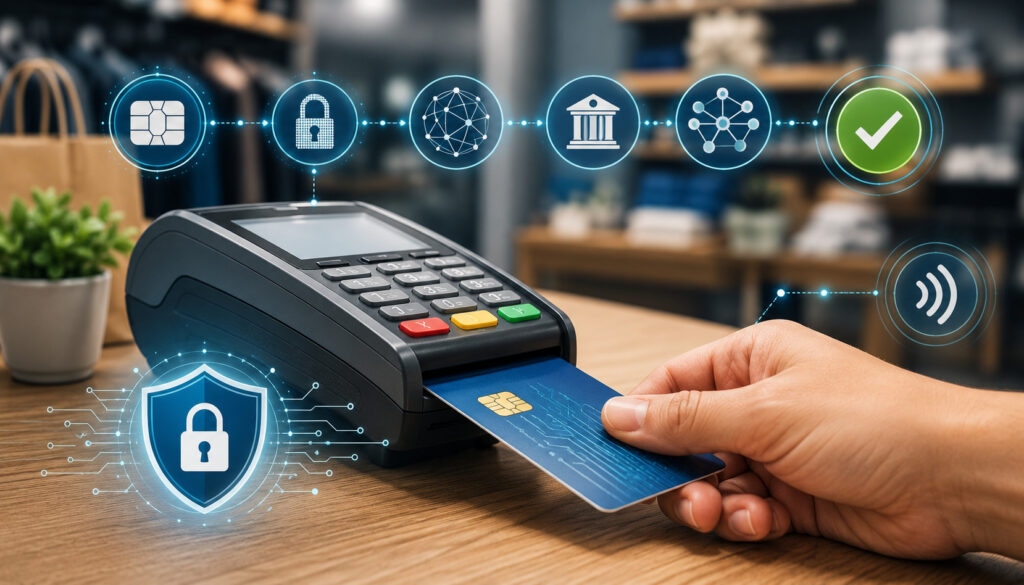
EMV chip card payments work through a structured card-present transaction flow. The customer presents a chip card, contactless card, or mobile wallet at an EMV-capable terminal.
The terminal reads payment credentials, communicates with the card or device, sends the authorization request through the payment system, and returns an approval or decline response.
In a typical in-store gun shop checkout, the cashier enters or scans the items into the POS software. The POS calculates the total and sends the amount to the EMV terminal. The customer inserts the chip card, taps a contactless card, or uses a compatible mobile wallet. The terminal then collects the required transaction data and sends it for authorization.
If the transaction is approved, the POS records the payment, updates reports, and generates a receipt. In an integrated system, the sale may also update inventory, associate the transaction with employee activity, record tax settings where applicable, and include refund reference details.
In a standalone terminal setup, the staff may need to manually enter the approved amount into a separate POS or register system.
For firearm businesses, this flow supports cleaner records. A secure POS system for gun shops can help connect payment approvals with transaction totals, receipts, batch settlement, customer-facing policies, and end-of-day reporting. When disputes or questions arise, organized payment records are easier to review.
Chip Insert, Tap-to-Pay, and Contactless Payments
Chip insert and tap-to-pay are both common EMV transaction methods, but they work differently from the customer’s perspective. With chip insert, the customer places the chip card into the terminal and leaves it there until the transaction is complete. The terminal communicates with the chip during the payment process.
With tap-to-pay, the customer taps a contactless card or mobile wallet-enabled device near the terminal. This uses NFC payment technology and can make checkout faster, especially for smaller accessories, range fees, apparel, cleaning supplies, and other routine retail purchases.
Modern EMV payment terminals may support chip cards, contactless cards, mobile wallet payments, PIN entry where applicable, printed receipts, digital receipts, and integrated POS communication. The exact features depend on the terminal model, POS software, payment processor, and approved merchant setup.
For gun shops, contactless payments can improve checkout speed without sacrificing the need for secure card handling. However, the business should still confirm that its payment processor supports the intended transaction types and that employees understand when customer verification, manager review, or additional documentation may be required.
EMV vs Magnetic Stripe Transactions
EMV chip transactions are generally preferred over magnetic stripe swipes for card-present sales because chip cards provide stronger transaction authentication. Magnetic stripe data is static. If the stripe data is copied, it may be reused in ways that create counterfeit card risk.
EMV chip cards are harder to duplicate because the chip participates in the transaction and produces transaction-specific data. This helps reduce certain counterfeit card fraud scenarios at the physical point of sale.
For gun shop POS systems, the difference matters because payment security and transaction documentation are part of responsible operations. A swipe-only terminal may still process certain cards, but it can expose the business to higher counterfeit card risk and may not meet modern customer expectations.
There may also be fallback situations where a chip card cannot be read and a swipe or manual entry is attempted. These situations should be controlled, documented, and reviewed. Excessive fallback activity may signal damaged cards, terminal issues, staff training problems, or suspicious payment behavior.
Why EMV Compliance Matters for Firearm Retailers
EMV compliance matters for firearm retailers because payment security, fraud prevention, documentation, and account stability are closely connected. A gun shop is not only processing basic retail payments. It may handle higher-ticket purchases, regulated products, deposits, range-related transactions, service invoices, and approved accessory sales.
EMV-compliant POS systems for gun shops help support secure card-present transactions. They reduce reliance on magnetic stripe data and improve checkout consistency. They also help businesses align with current payment expectations, especially when customers are used to chip cards, tap-to-pay, and mobile wallet payments.
Payment security is also part of trust. Customers want to know their card information is handled responsibly. Employees need reliable tools that reduce confusion. Owners need reports that show what was sold, how it was paid, who processed it, when it settled, and whether refunds or disputes occurred.
EMV does not replace PCI compliance, processor underwriting, firearm business documentation, or legal and regulatory review. The payment security standards body explains that PCI DSS provides technical and operational requirements designed to protect payment account data.
Gun shops should use secure systems, avoid unnecessary card data exposure, and seek professional guidance for specific payment security obligations.
When EMV is combined with PCI-aware practices, tokenization, encryption, staff permissions, receipts, refund records, and reconciliation, it becomes a practical foundation for safer firearm payment processing.
Reducing Counterfeit Card Fraud Risk
One of the main reasons to use EMV POS systems for gun shops is to reduce counterfeit card fraud risk in card-present transactions. Counterfeit card fraud occurs when stolen card data is used to create or simulate a payment card. Magnetic stripe transactions are more vulnerable to this type of abuse because the stripe contains static data.
EMV chip card processing helps address this issue by requiring chip-based authentication. The card and terminal exchange transaction information that is harder to duplicate than a simple swipe. This makes chip card payments for gun shops more secure than relying only on magnetic stripe acceptance.
However, EMV is not a complete fraud prevention system. A stolen physical card may still be attempted. A legitimate cardholder may later dispute a transaction. A fraudster may try a card-not-present order through an online checkout or virtual terminal. An employee may process a refund incorrectly.
For that reason, secure firearm payment processing should include both technology and procedures. Staff should know how to identify unusual behavior, follow refund rules, document customer communication, and escalate questionable transactions.
Supporting Better Chargeback Prevention
EMV transactions can support better chargeback prevention by creating stronger card-present payment records. A properly processed chip or tap transaction can show that the card was present and that the payment followed the approved terminal flow.
That said, chargeback prevention depends on more than EMV. Gun shops should keep receipts, authorization records, refund records, signed documents where appropriate, service notes, customer communication, and transaction logs organized. Clear records make it easier to understand what happened if a dispute occurs.
Chargebacks may arise from fraud claims, billing confusion, refund disagreements, non-receipt claims, duplicate charges, or customer misunderstanding. Informational resources on chargeback management commonly emphasize clear communication, evidence, fraud controls, and dispute documentation as important tools for merchants.
For firearm retailers, documentation is especially important because transactions may involve special handling, pickup timing, transfer steps, deposits, or separate compliance workflows. The payment record should not be treated as the only business record. It should fit into a broader operational file.
EMV POS Systems for Gun Shops Compared With Other Payment Setups
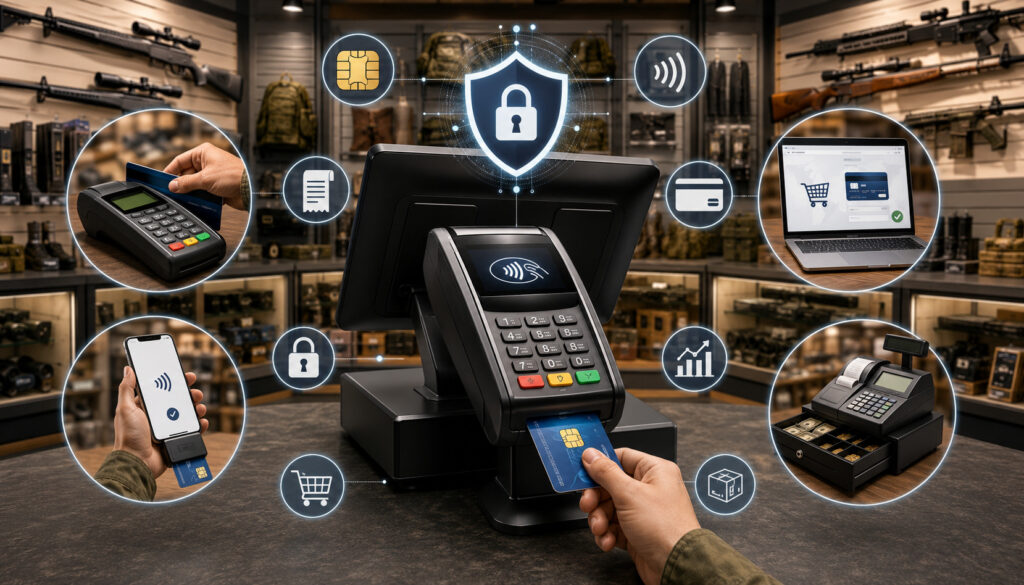
EMV POS systems are only one part of the payment landscape. Gun shops may also use virtual terminals, online checkout, mobile readers, invoices, payment links, recurring billing tools, or ACH options depending on their approved business model. Each setup has different strengths, risks, and documentation requirements.
For in-store card-present transactions, EMV payment terminals are usually the most appropriate tool. They allow the customer to present a chip card or contactless payment method at the counter. This creates a stronger payment record than a manually keyed transaction.
Virtual terminals and online checkout tools are useful for approved remote payments, but they are card-not-present environments. That means the risk profile is different. Card-not-present payments may need additional controls such as address verification, order review, shipping rules, customer verification, gateway settings, and fraud filters.
Mobile readers may work well for approved off-site sales, range events, training counters, or temporary checkout points, but device security and processor approval matter. Payment links can simplify invoice collection, but they should be used with secure confirmation and clear order records.
| Payment Setup | Best For | Benefits | What to Review |
| EMV POS terminal | In-store card-present sales | Secure chip and tap payments | Terminal compatibility, fees, and processor fit |
| Older swipe terminal | Legacy card acceptance | Simple basic use | Higher counterfeit fraud risk and limited payment options |
| Virtual terminal | Approved phone or manual orders | Useful for remote payments | Card-not-present risk and manual entry controls |
| Online checkout | Approved eCommerce firearm-related sales | Supports remote buyers | Website policies, gateway approval, and fraud filters |
| Mobile reader | Events, range counters, off-site sales | Portable payment acceptance | Approved use, device security, and connectivity |
| Payment links | Invoices and custom orders | Easy remote collection | Link security, customer confirmation, and records |
| Integrated POS | Retail sales and inventory | Connects payments with records | Reporting, security, support, and inventory sync |
Businesses researching payment processing for gun stores should compare not only the payment method, but also the account terms, sales channels, products supported, documentation expectations, and risk controls.
When EMV POS Systems Are the Best Fit
EMV POS systems are the best fit when the customer is physically present and can use a chip card, contactless card, or mobile wallet at the counter. This includes in-store firearm accessory purchases, optics, cleaning supplies, apparel, range fees, lane rentals, training payments, retail add-ons, and other approved card-present transactions.
They are also useful at busy counters where speed and consistency matter. Instead of manually keying card numbers or relying on older swipe methods, staff can follow a standard chip or tap process. This reduces confusion and supports better reporting.
Integrated EMV POS systems can be especially useful when a gun shop wants payments connected to inventory, receipts, employee activity, refunds, and end-of-day reports. A well-configured system can reduce duplicate entry and make reconciliation easier.
For many firearm retailers, EMV should be the default card-present payment method. Manual entry and fallback swipes should be exceptions, not everyday habits.
When Other Payment Tools May Still Be Needed
Other payment tools may still be needed when a firearm business operates beyond a simple front-counter retail model. A shop may accept deposits, manage approved online orders, collect training registrations, bill members, send invoices, or process repairs.
In those cases, virtual terminals, payment links, online checkout, ACH options, recurring billing tools, or approved mobile readers may be helpful. Each tool should be reviewed carefully because the risk profile differs from EMV card-present payments.
For example, card-not-present payments may require stronger customer verification, fraud filters, address checks, delivery documentation, and refund rules. Online checkout may require gateway approval and clear website policies. Recurring billing may require authorization records and cancellation procedures.
The key is alignment. The payment tool should match the transaction type, processor approval, business model, and documentation process. A gun shop should not use a remote payment tool casually just because it is convenient.
Key Features to Review in EMV-Compliant POS Systems
When evaluating EMV-compliant POS systems for gun shops, owners should review both payment acceptance and retail operations. A terminal that accepts chip cards is useful, but it may not be enough if the software cannot manage reports, refunds, inventory, employee permissions, and reconciliation.
The POS should support EMV chip card processing, contactless payments, mobile wallet payments, secure receipts, refund controls, batch reporting, transaction history, and payment gateway compatibility.
For firearm retail POS systems, inventory features may also be important, especially where serialized inventory, accessory categories, deposits, service invoices, or range-related items are involved.
Security features deserve close attention. Look for tokenization, encryption, secure user access, role-based permissions, manager approval settings, audit logs, software updates, and PCI-aware workflows. The business should avoid unnecessary storage of sensitive card data and should keep staff access limited to what each role needs.
Reporting matters as much as checkout. Owners and managers should be able to review sales totals, refunds, voids, batch settlement, employee activity, inventory movement, taxes where applicable, chargeback records, and deposit timing. Strong reports make it easier to spot problems early.
Support and processor fit are also critical. A POS system may look attractive, but if the payment processor does not support firearm-related businesses, the setup may not be stable. Gun shops reviewing a firearm merchant account should confirm product categories, sales channels, transaction methods, and documentation expectations before going live.
Payment Terminal and Hardware Features
EMV payment terminals should support chip card acceptance as a core feature. A modern terminal should also support contactless payments, NFC payments, and mobile wallet payments if those options are approved for the business. Customers increasingly expect to tap cards or phones, so contactless capability can improve checkout convenience.
Hardware durability matters in gun shops, ranges, and outdoor retail environments. Terminals should have a clear display, reliable keypad or touchscreen, secure card reader, stable connectivity, and receipt options. Some businesses may need countertop terminals, wireless terminals, customer-facing devices, or mobile readers.
Connectivity should be reviewed carefully. Terminals may use wired internet, Wi-Fi, cellular connectivity, or a combination. A range counter or event setup may require different connectivity than a fixed retail register.
Software updates are also important. Outdated terminals may become less secure, less reliable, or incompatible with newer requirements. Ask how updates are managed, whether the terminal supports future software patches, and how staff will know when updates are required.
POS Software and Reporting Features
POS software should support more than payment acceptance. For gun shop POS systems, reporting and operational records are key. Owners should be able to track sales, refunds, voids, deposits, batches, inventory changes, staff activity, tax settings where applicable, and customer-facing receipts.
Inventory tools should fit the store’s product mix. Firearm businesses may sell accessories, optics, apparel, cleaning products, range items, training services, rentals, and other retail add-ons. Where serialized inventory workflows are required, the POS should support organized item tracking without replacing required business documentation.
Refund tracking is another important feature. A secure POS system should show who processed a refund, when it occurred, which original transaction it relates to, and whether manager approval was required. This helps reduce refund abuse and improves dispute response.
Reporting should also support reconciliation. POS totals should be compared with processor reports, batch records, fees, chargebacks, refunds, and bank deposits. Without good reporting, even a secure terminal can leave the business with accounting confusion.
POS Payment Security for Gun Shops
POS payment security for gun shops involves technology, procedures, and staff behavior. EMV terminals help secure card-present transactions, but payment security also depends on how the business handles card data, user access, device updates, passwords, refunds, reports, and exceptions.
PCI compliance is a major part of payment security. The standards are intended to protect payment account data through technical and operational safeguards. Gun shops should use secure payment systems, follow processor guidance, limit staff access, and avoid collecting or storing sensitive card details outside approved systems.
Tokenization and encryption are also important. Encryption helps protect card data while it is transmitted. Tokenization replaces sensitive card details with a token that can be used for approved payment functions without exposing the actual card number. These tools can reduce the risk of card data exposure when configured correctly.
Access control should not be overlooked. Each staff member should have a unique login. Managers should control refunds, voids, discounts, manual entry, settlement functions, and sensitive reports. Audit logs should show who performed key actions.
Device security matters too. Terminals should be inspected for tampering, kept updated, protected from unauthorized access, and connected through secure networks. Staff should know who to contact if a terminal behaves unusually.
PCI Compliance and Secure Card Handling
PCI compliance refers to payment card data security requirements that apply to organizations that accept, transmit, process, or store cardholder data. For gun shops, PCI-aware practices should be part of daily payment operations, not just a form completed once.
Secure card handling means staff should use approved payment terminals and avoid writing down card numbers, storing card data in spreadsheets, texting card details, or entering card information into unapproved systems. Manual entry should be limited and controlled.
Businesses should also review how receipts are printed or emailed. Receipts should not expose full card numbers. Staff should understand how to handle declined cards, failed chip reads, and customer payment questions without creating unnecessary data risk.
A gun shop should work with payment professionals, security professionals, and legal or compliance advisors when specific obligations are unclear. This article is educational and should not be treated as legal, regulatory, banking, or contract advice.
Tokenization, Encryption, and Access Controls
Tokenization and encryption help protect payment data during and after a transaction. Encryption protects data while it moves through payment systems. Tokenization helps replace sensitive card information with a substitute value that has limited use outside the approved payment environment.
These tools are especially useful when businesses need saved payment references for approved recurring payments, refunds, deposits, or customer profiles. The goal is to reduce exposure of sensitive card data while still allowing necessary payment functions.
Access controls determine who can perform sensitive actions in the POS system. For example, a cashier may process sales but not issue high-value refunds. A manager may approve voids, adjust pricing, view reports, or settle batches.
Unique staff logins, role-based permissions, manager approvals, and audit logs are essential. Shared passwords make it difficult to identify mistakes or misuse. Strong access control supports both security and accountability.
EMV POS Systems and Fraud Prevention
EMV POS systems are a strong fraud prevention tool for in-person payments, but they should be part of a wider risk management strategy. Firearm businesses should combine EMV technology with staff training, customer verification practices where appropriate, refund controls, chargeback monitoring, online fraud tools, and secure reporting.
EMV chip card processing helps reduce counterfeit card risk because chip data is more difficult to duplicate than magnetic stripe data. Contactless EMV payments also use secure transaction methods when processed through compatible terminals.
However, fraud can still happen. A stolen physical card may be used before it is reported. A customer may dispute a legitimate sale. A criminal may try online checkout fraud. A staff member may process a refund incorrectly. A customer may claim confusion about charges, deposits, class fees, membership billing, or service invoices.
That is why secure POS systems for gun shops should include clear workflows. Staff should know how to handle suspicious transactions, declined cards, mismatched information, refund requests, duplicate charges, and manual entry. Managers should review unusual activity, high-value refunds, repeated declines, and excessive fallback transactions.
Fraud prevention also depends on documentation. Transaction logs, receipts, order notes, refund records, customer communication, and delivery or pickup records may all become important if a payment dispute arises.
What EMV Does and Does Not Prevent
EMV helps prevent certain types of counterfeit card fraud in card-present environments. It improves authentication when a chip card or contactless payment is processed through a compatible terminal. This is valuable for gun store payment processing because physical retail transactions are often central to the business.
But EMV does not prevent all payment fraud. It does not stop every stolen card attempt. It does not verify every customer’s intent. It does not prevent all friendly fraud, online fraud, refund abuse, identity misuse, employee mistakes, or account takeover activity.
Card-not-present payments require separate controls. Online checkout, virtual terminals, payment links, and manually keyed transactions should be reviewed with fraud filters, customer verification practices, address checks, order review, and clear policies.
The most effective approach is layered. EMV protects the card-present checkout. PCI-aware practices protect card data. Staff permissions reduce internal risk. Refund controls protect cash flow. Reconciliation detects problems. Customer communication helps prevent confusion.
Staff Training for Secure POS Transactions
Staff training is essential because even the best EMV payment terminals can be weakened by poor procedures. Employees should know how to process chip cards, tap payments, mobile wallet payments, declined cards, refunds, voids, manual entry, and fallback transactions.
Training should include what to do when a chip card fails, when a customer asks staff to key in a card manually, when a receipt does not print, when a duplicate charge is suspected, or when a transaction looks unusual. Staff should also know when to call a manager.
Refund and void procedures deserve special attention. Employees should not improvise refunds, issue cash refunds for card transactions without policy guidance, or process adjustments without documentation. Manager approval can reduce errors and abuse.
Training should be repeated when hardware changes, software updates occur, new employees join, or payment policies change. A written procedure helps maintain consistency across shifts.
EMV POS Systems for In-Store Gun Shop Sales
EMV POS systems for in-store gun shop sales help businesses process retail transactions more securely and efficiently. A firearm retailer may handle firearm accessories, optics, ammunition where applicable, apparel, cleaning supplies, safes, targets, range supplies, repair invoices, deposits, training payments, and membership-related charges.
An EMV terminal gives customers a secure way to pay with chip cards or contactless methods. An integrated POS system can connect those payments with receipts, item records, inventory counts, employee activity, and reports. This reduces double entry and helps keep daily operations organized.
In-store firearm retail can be busy, especially during peak periods. Staff may need to answer product questions, manage customer queues, coordinate paperwork, handle inventory, and process payments quickly. A reliable EMV POS setup can reduce checkout friction.
Receipts are also important. Customers should receive clear payment records showing what was purchased, how payment was made, and what refund or store policies may apply. Business records should match processor reports and bank deposits.
For larger stores, multi-register setups may be needed. For smaller shops, a single integrated terminal may be enough. In either case, the system should support secure firearm payment processing, not just basic card acceptance.
Faster and More Organized Checkout
A well-configured EMV POS system can make checkout faster and more organized. Staff can scan or enter items, send the total to the payment terminal, allow the customer to insert or tap, and generate a receipt without retyping amounts into a separate device.
This reduces manual entry errors. If a cashier enters a total into a standalone terminal incorrectly, the payment record may not match the POS sale. Integrated systems help keep the sale total and payment total aligned.
Speed also matters for customer experience. Customers buying accessories, range time, or training classes may not want a slow checkout process. Chip and tap payments can keep the line moving while maintaining security.
For managers, organized checkout means cleaner reports. Sales by category, payment type, employee, batch, and refund status can be easier to review when the POS and payment system work together.
Connecting Payments With Inventory and Receipts
Connecting payments with inventory and receipts is one of the biggest advantages of integrated gun shop POS systems. When a sale is completed, the POS can update item quantities, record payment details, generate receipts, and include the transaction in daily reports.
For firearm businesses, inventory accuracy is important. While the POS does not replace required records or compliance processes, it can help organize retail inventory, accessories, add-ons, and customer purchases. Serialized inventory workflows should be reviewed carefully to ensure the system supports the business’s needs.
Receipts help customers understand charges and help the business respond to questions. A clear receipt can show item descriptions, payment method, date, refund policy references, and transaction identifiers.
When refunds occur, integrated systems can connect the refund to the original transaction. This improves accountability and helps prevent confusion during chargeback review or accounting reconciliation.
EMV POS Systems for Shooting Ranges and Training Centers
Shooting ranges and training centers may have different POS needs than traditional gun shops. In addition to retail sales, they may collect lane fees, guest fees, memberships, rentals, training class payments, event deposits, safety gear purchases, targets, and other approved add-ons.
EMV-compliant POS systems can help range counters process these payments securely. A customer might tap a card for a range fee, insert a chip card for a membership, or pay for training and retail items in the same transaction. The POS should support these workflows without creating reporting confusion.
Membership payments may require special review. Some businesses collect recurring dues, stored payment authorizations, or scheduled billing. If recurring payments are used, the business should confirm processor approval, authorization requirements, cancellation procedures, and secure card handling.
Ranges also benefit from fast checkout because customers may arrive in groups, attend classes, or move between retail and range areas. A reliable EMV payment terminal can reduce bottlenecks at the counter.
For businesses that combine retail, range operations, and training, FFL merchant services research should include both payment acceptance and operational workflow review. The system should fit the way the business actually sells.
Handling Range Fees and Membership Payments
POS systems can help collect range fees, day passes, guest fees, training payments, and membership dues with clear receipts and payment records. This is especially useful when customers pay for multiple items at once, such as a lane fee, targets, safety gear, and a training session.
Membership payments require clean documentation. Customers should understand billing terms, renewal schedules, cancellation rules, and refund policies before payment is collected. The POS or billing system should maintain authorization records where applicable.
Range operators should also review how the system handles partial payments, deposits, class cancellations, membership upgrades, and refunds. These situations can create disputes if records are unclear.
An EMV terminal supports the card-present part of the transaction, while POS software supports the business record. Both pieces are important.
Managing Add-On Purchases at the Range Counter
Range counters often sell add-on items such as targets, eye protection, ear protection, cleaning supplies, apparel, rentals, and approved accessories. These purchases may happen quickly, especially when customers are preparing for range time.
An organized POS system helps staff ring up add-ons accurately and issue receipts. Inventory tracking can show which items sell frequently, which products need restocking, and which items are tied to range activity.
Add-on purchases can also affect refund and exchange procedures. For example, safety gear, rentals, training fees, and retail items may have different policies. The POS should support clear item categorization and receipt details.
EMV payment terminals make it easier to accept card-present payments for these counter transactions while keeping records organized for reporting and reconciliation.
Integrated EMV POS vs Standalone Payment Terminals
Gun shops can choose between integrated EMV POS systems and standalone payment terminals. A standalone terminal processes the card payment, but it may not automatically connect to inventory, receipts, accounting categories, or detailed POS reports. An integrated system connects payment acceptance with the broader retail workflow.
With a standalone terminal, staff may ring up the sale in a register or POS, then manually enter the total into the payment device. This can work for smaller shops, but it increases the risk of mismatched totals, duplicate entry, missed refunds, and reconciliation challenges.
With an integrated EMV POS, the sale total flows from the POS to the terminal. Once approved, the payment record connects back to the sale. This can simplify receipts, refunds, inventory updates, employee tracking, and batch reports.
The right choice depends on transaction volume, product mix, staffing, inventory needs, reporting expectations, and budget. A very small shop with simple sales may manage with a standalone terminal. A busier firearm retailer, range, or multi-counter operation may benefit from integration.
The key is understanding tradeoffs. Lower upfront complexity may lead to more manual work later. Better integration may cost more, but it can reduce errors and save management time.
Benefits of Integrated EMV POS Systems
Integrated EMV POS systems can reduce manual errors by connecting the checkout amount directly to the payment terminal. This helps prevent incorrect keyed totals and mismatched sale records.
They also improve reporting. Owners can review sales by product type, payment method, employee, refund status, and batch date. This supports better inventory planning, accounting, and dispute review.
Integrated systems can simplify refunds because the POS can locate the original transaction and process the refund through the appropriate payment workflow. Manager approval settings can add another layer of control.
For gun shops with inventory complexity, integration can help connect sales with stock movement. This is useful for accessories, optics, supplies, apparel, range add-ons, and other retail categories.
When Standalone Terminals May Be Enough
Standalone terminals may be enough for smaller businesses with low transaction volume, simple inventory, and basic reporting needs. A shop that only needs to accept occasional card-present payments may not require a fully integrated POS right away.
However, owners should understand the limitations. Standalone terminals often require manual reconciliation between the POS or register and processor reports. Refunds may be harder to connect to original sales. Inventory may need separate updates.
Standalone setups can also make employee accountability more difficult if the terminal does not connect actions to individual staff logins. This can matter when reviewing refunds, voids, mistakes, or suspicious transactions.
A standalone terminal should still be EMV-capable, secure, updated, and approved for the firearm business model. Basic does not mean outdated or insecure.
Payment Processing Fees and Funding Timelines
Payment processing fees and funding timelines should be reviewed before choosing EMV-compliant POS systems for gun shops. A payment setup may include transaction fees, monthly fees, gateway fees, equipment costs, batch fees, chargeback fees, refund handling rules, statement fees, and support charges.
Card-present EMV transactions may be priced differently from card-not-present payments because risk and processing conditions differ. A chip or tap transaction at the counter is not the same as a keyed phone order or online checkout payment.
Gun shop owners should ask how pricing applies to different transaction types. This includes chip cards, contactless payments, mobile wallet payments, keyed transactions, online payments, payment links, refunds, chargebacks, and recurring payments where applicable.
Funding timelines also matter. Businesses should understand when batches settle, when deposits appear, how weekends or holidays affect funding, how refunds are deducted, and how chargebacks or reserves may affect cash flow.
A good review should compare total cost, not just the terminal price. A low-cost device may become expensive if fees are unclear, support is weak, reports are poor, or the processor does not fit firearm payment processing needs.
Card-Present vs Card-Not-Present Costs
Card-present transactions usually involve the customer physically presenting a card or mobile wallet at an EMV terminal. Card-not-present transactions include online checkout, phone orders, payment links, invoices, and manually keyed payments.
The risk level differs because card-not-present payments do not have the same chip or tap authentication flow. As a result, they may have different pricing, fraud exposure, and documentation expectations.
For gun shops, this distinction is important. A customer standing at the counter with a chip card is different from a remote buyer using an online checkout. The POS, gateway, fraud tools, policies, and records should reflect that difference.
Excessive manual entry may also create higher risk. If staff frequently key cards into a terminal, the business should review why. It may indicate training gaps, terminal issues, customer behavior concerns, or misuse of remote payment tools.
Reviewing Batch Reports and Deposits
Batch reports and deposits should be reviewed regularly. A batch report shows the card transactions submitted for settlement. Bank deposits show what actually arrived after processing adjustments, fees, refunds, or other deductions.
Gun shops should compare POS totals, processor reports, refunds, chargebacks, fees, and bank deposits. This helps detect duplicate charges, missing batches, settlement delays, incorrect refund handling, and unexpected fees.
Reconciliation should be scheduled, not occasional. Daily review may be appropriate for busy stores, while smaller shops may use a different rhythm. The important point is consistency.
Managers should also review unusual patterns, such as repeated declined cards, high refund volume, excessive manual entry, or frequent batch mismatches. These patterns can signal training issues, fraud risk, hardware problems, or reporting errors.
EMV-Compliant POS Systems Checklist for Gun Shops
A checklist can help firearm retailers compare EMV POS systems in a practical way. Instead of choosing based only on hardware price or a quick demo, the business can review payment security, processor fit, reporting, staff controls, support, and long-term usability.
The best EMV-compliant POS systems for gun shops should support secure card-present payments, fit firearm retail workflows, and provide enough records for daily management. They should also support staff training and make exceptions easier to control.
Before choosing a system, gather details about the business model. Does the shop sell only in-store? Does it operate a range? Does it take class deposits? Does it sell accessories online? Does it need mobile checkout? Does it require inventory integration? Does it process memberships?
Use the checklist below as an educational starting point, then review specific legal, banking, payment, and contract questions with qualified professionals.
| Review Area | What to Check | Why It Matters |
| EMV support | Chip card acceptance | Supports secure card-present payments |
| Contactless support | Tap cards and mobile wallets | Improves checkout convenience |
| POS integration | Inventory, receipts, reporting | Reduces manual work |
| Payment security | PCI, tokenization, encryption | Helps protect card data |
| Staff permissions | Role-based access and audit logs | Reduces internal risk |
| Refund tools | Clear refund and void workflow | Helps manage disputes |
| Reporting | Sales, batches, fees, deposits | Supports reconciliation |
| Hardware reliability | Terminal updates and connectivity | Keeps checkout running |
| Processor fit | Firearm business acceptance | Supports account stability |
| Support | Help with terminal and payment issues | Reduces downtime |
How to Use the Checklist Before Choosing a POS
Use the checklist to compare each POS option side by side. Start with must-have features such as EMV chip card support, secure payment processing, firearm business acceptance, and reliable reporting.
Then evaluate operational needs. A shop with simple retail sales may need fewer features than a store with range fees, memberships, training classes, inventory categories, and multiple employees. A growing business should consider scalability.
Ask for demonstrations of real workflows. Review a sale, refund, void, manual entry exception, batch report, employee permission setting, and inventory report. Do not rely only on a polished overview.
Finally, compare contract terms, support availability, hardware replacement policies, software update procedures, fees, and funding timelines. A POS system should support daily operations, not create new confusion.
Documentation Gun Shops Should Maintain
Gun shops should maintain organized records related to POS systems, payment processing, refunds, disputes, and procedures. These records can help with accounting, chargeback response, processor reviews, staff training, and internal audits.
Important documents may include POS agreements, processor terms, equipment records, terminal serial numbers, staff procedures, refund policies, void logs, chargeback notices, receipts, transaction reports, batch reports, deposit records, and support communications.
Documentation should also include training materials. Employees should know how to process chip cards, tap payments, manual entry exceptions, refunds, declined cards, and manager escalations.
For firearm businesses, payment records should fit into broader business documentation. POS records do not replace required compliance records, but they can support organized operations.
Best Practices for Using EMV-Compliant POS Systems
Using EMV-compliant POS systems for gun shops effectively requires more than installing a terminal. The business should create consistent procedures, train staff, review reports, and update security settings over time.
Use EMV-capable terminals for card-present payments whenever possible. Enable contactless payments where appropriate and approved. Train staff on chip, tap, fallback, declined cards, refunds, voids, receipts, manual entry rules, and manager approvals.
Avoid manual card entry unless necessary and approved. Keyed transactions can carry different risk and may require additional documentation. If a card cannot be read, staff should follow the business’s fallback policy.
Keep POS software and terminals updated. Use unique staff logins and role-based permissions. Send or print clear receipts. Document refunds, voids, chargebacks, and customer payment questions.
Reconcile POS reports with deposits regularly. Review transaction fees, funding timelines, batch settlement, refunds, chargebacks, and unusual activity. Monitor suspicious behavior and payment disputes.
Keep customer-facing policies clear. Refund rules, deposit terms, training class cancellation policies, membership terms, and pickup-related payment policies should be easy for customers to understand.
Confirm processor support for firearm-related businesses before using a system. A payment solution should align with the business model, sales channels, and transaction types. Businesses researching firearm payment processing should focus on long-term compatibility, not just quick setup.
Training Staff Before Going Live
Before going live with a new POS system, staff should practice common and uncommon checkout scenarios. This includes chip card payments, tap payments, mobile wallet payments, cash transactions where applicable, split payments if supported, refunds, voids, receipts, declined cards, and manual entry rules.
Training should also cover role-based access. Employees should know which actions require manager approval and why. Refunds, high-value voids, discount overrides, batch settlement, and manual card entry should not be casual actions.
Use practice transactions or training mode when available. Staff should be comfortable before customers are at the counter. This reduces mistakes during busy periods.
Managers should observe early use and correct problems quickly. A new system may reveal workflow gaps, unclear policies, or training needs that were not obvious during setup.
Reviewing POS Performance Regularly
POS performance should be reviewed on a regular schedule. Owners and managers should look at transaction volume, failed payments, refunds, chargebacks, employee activity, deposit timing, batch reports, and hardware reliability.
Reviewing performance helps identify small problems before they become expensive. Repeated chip read failures may indicate a terminal issue. Excessive manual entry may indicate poor training or suspicious activity. Refund spikes may indicate policy confusion.
Hardware should also be inspected. Terminals should be clean, secure, connected, and free from signs of tampering. Staff should report unusual prompts, damaged readers, or unexpected error messages.
Regular review also helps with planning. Reports can show which product categories sell well, when staffing should increase, and whether checkout bottlenecks are affecting customer experience.
Common EMV POS Mistakes to Avoid
Common EMV POS mistakes can create security risks, payment confusion, or operational problems. One major mistake is relying on outdated swipe-only terminals. Another is assuming that EMV alone solves all fraud concerns.
Skipping staff training is also risky. Employees who do not understand chip payments, tap payments, fallback procedures, refunds, voids, and manual entry rules may create preventable errors. Those errors can lead to duplicate charges, mismatched reports, customer disputes, or higher risk transactions.
Ignoring software updates can create reliability and security problems. POS systems and terminals should be maintained, patched, and supported. Weak passwords, shared logins, and unrestricted staff permissions can also increase internal risk.
Another mistake is failing to reconcile. If POS reports, batch totals, refunds, chargebacks, fees, and deposits are not reviewed, the business may miss errors or fraud patterns.
Choosing a payment provider without firearm business support can also create serious account stability issues. Firearm retailers should confirm acceptance, underwriting expectations, supported products, approved sales channels, and transaction methods before processing.
Relying on Swipe-Only or Outdated Terminals
Swipe-only terminals are outdated for most modern retail environments. They may still process some cards, but they do not provide the same chip-based authentication as EMV chip card processing.
For gun shops, this can increase counterfeit card fraud risk and limit customer payment options. Many customers expect chip insert, tap-to-pay, and mobile wallet payment acceptance. A swipe-only checkout can appear less secure and less professional.
Outdated terminals may also lack software update support, contactless capability, modern receipt options, and integration features. This can affect both security and operations.
Replacing outdated hardware should be viewed as a risk reduction step, not just a convenience upgrade. A secure terminal supports better payment practices at the point of sale.
Ignoring Manual Entry and Fallback Risks
Manual entry and fallback transactions should be controlled because they may carry higher risk than normal EMV transactions. Manual entry occurs when staff type card details into a terminal or virtual terminal. Fallback may occur when a chip card fails and the transaction is completed another way.
These transactions should not become routine. If staff frequently key in cards, managers should investigate. The cause may be damaged cards, poor terminal maintenance, customer behavior, unclear procedures, or misuse of remote payment tools.
Manual entry should be approved only under defined conditions. Staff should document why it occurred and follow customer verification procedures where appropriate.
Fallback rules should also be written and trained. A failed chip read should not automatically become a swipe without review. The business should protect itself with consistent procedures.
How to Choose the Best EMV-Compliant POS Systems for Gun Shops
Choosing the best EMV-compliant POS systems for gun shops requires a careful review of payment acceptance, firearm business compatibility, POS features, security, inventory needs, fees, hardware, support, and contract terms.
Start with processor fit. The payment provider should understand firearm-related businesses and support the actual transaction types the shop needs. This includes in-store sales, range payments, training fees, approved online payments, mobile use, deposits, or memberships where applicable.
Next, review payment features. The system should support EMV chip cards, contactless payments, mobile wallets, receipts, refunds, batch settlement, reporting, and secure gateway connectivity. If the business uses online checkout or virtual terminals, those tools should be approved and properly configured.
Then review POS features. Gun shop POS systems may need inventory management, serialized inventory support where applicable, customer records, employee permissions, discounts, tax settings where applicable, reporting, and reconciliation tools.
Finally, review total value. A low equipment cost does not guarantee the best outcome. Weak support, poor reports, unclear pricing, limited firearm acceptance, or unreliable hardware can cost more over time.
Questions to Ask Before Choosing a POS System
Before choosing a POS system, gun shop owners should ask practical questions that reveal how the system works in real operations.
Key questions include:
- Does the terminal support EMV chip card processing?
- Does it support contactless cards and mobile wallet payments?
- Is the payment processor comfortable supporting firearm-related businesses?
- Does the merchant account match the business model and sales channels?
- Can the POS integrate inventory, receipts, and payment records?
- Does the system support refunds, voids, manager approvals, and audit logs?
- Are staff permissions role-based?
- What PCI tools or security guidance are provided?
- Does the system support tokenization and encryption?
- How are chargebacks handled and documented?
- What reports are available for sales, batches, deposits, refunds, and fees?
- How long do deposits usually take?
- What hardware costs, software fees, gateway fees, and support fees apply?
- What happens if the terminal fails during business hours?
- Are software updates automatic, assisted, or manual?
These questions help compare real value instead of relying only on marketing claims or device price.
Comparing Total Value, Not Just Equipment Cost
The lowest device price may not be the best choice. A cheap terminal with poor reporting, weak support, limited security features, or no firearm business compatibility can create long-term problems.
Total value includes hardware reliability, software features, payment security, staff controls, reporting, reconciliation, support, processor fit, pricing transparency, and scalability. A system should help the business operate more securely and efficiently.
For example, an integrated POS may cost more than a standalone terminal but save time through inventory sync, cleaner reports, easier refunds, and better employee tracking. A reliable support team may prevent costly downtime. Clear pricing may prevent surprise fees.
Gun shops should review contracts carefully and seek professional guidance for legal, banking, payment, or compliance questions. The right POS setup should support secure payment acceptance and practical daily management.
FAQs
What are EMV-compliant POS systems for gun shops?
EMV-compliant POS systems for gun shops are checkout systems and payment terminals that can process EMV chip card transactions. They allow customers to insert chip cards, tap contactless cards, or use compatible mobile wallet payments depending on the terminal and processor setup.
These systems may be standalone payment terminals or integrated POS systems that connect payments with inventory, receipts, employee activity, reports, refunds, and batch settlement. For firearm retailers, the best setup depends on the business model, transaction types, processor fit, and security needs.
Why do gun shops need EMV-compliant payment processing?
Gun shops need EMV-compliant payment processing because card-present payment security is important for higher-value retail environments. EMV chip card processing helps reduce certain counterfeit card fraud risks compared with magnetic stripe swipes.
It also supports customer confidence and modern checkout expectations. Many customers expect chip card, tap-to-pay, and mobile wallet options. A secure POS setup can also support better transaction records, refund tracking, reporting, and reconciliation.
What is the difference between EMV chip payments and swipe payments?
EMV chip payments use a card’s embedded chip to help authenticate the transaction. The chip produces transaction-specific data that is harder to duplicate than static magnetic stripe data.
Swipe payments rely on magnetic stripe information. That data is easier to copy if compromised, which can increase counterfeit card risk. For card-present gun shop credit card processing, chip or tap transactions are generally preferred over swipe-only methods.
Do EMV POS systems prevent all payment fraud?
No. EMV POS systems help reduce certain counterfeit card fraud risks in card-present transactions, but they do not prevent all fraud. Stolen card use, online fraud, friendly fraud, refund abuse, manual entry risk, internal errors, and chargebacks still require additional controls.
Gun shops should combine EMV technology with PCI-aware practices, staff training, customer verification where appropriate, refund controls, chargeback monitoring, secure passwords, role-based access, and regular reconciliation.
Can EMV POS systems accept contactless and mobile wallet payments?
Many modern EMV payment terminals can accept contactless cards and mobile wallet payments, but support depends on the terminal, POS software, payment gateway, processor, and merchant setup. Businesses should confirm these features before choosing hardware.
Contactless payments can be useful for accessories, range fees, retail add-ons, training payments, and other approved in-store transactions. Staff should still follow store policies for refunds, customer communication, and suspicious transaction review.
What features should gun shops look for in an EMV POS system?
Gun shops should look for EMV chip support, contactless payment acceptance, mobile wallet support, secure receipts, refund controls, reporting, batch settlement, staff permissions, audit logs, tokenization, encryption, PCI-aware tools, and reliable hardware.
They should also review inventory features, serialized inventory support where applicable, payment gateway compatibility, processor fit, funding timelines, chargeback tools, support availability, and contract terms.
How does EMV help with chargeback prevention?
EMV helps by creating stronger evidence that a card-present transaction was processed through a chip or contactless terminal. This can support the merchant’s payment record if a dispute occurs.
However, chargeback prevention also requires clear receipts, refund records, customer communication, authorization records, transaction logs, and organized documentation. EMV is helpful, but it is not the only defense.
How can gun shops choose secure POS systems?
Gun shops can choose secure POS systems by reviewing EMV support, PCI-aware practices, tokenization, encryption, role-based staff permissions, audit logs, refund controls, reporting, hardware reliability, processor compatibility, and support.
They should also confirm that the processor supports firearm-related businesses and the specific transaction types used by the shop. Contract terms, fees, settlement timing, and documentation expectations should be reviewed before going live.
Conclusion
EMV-compliant POS systems for gun shops are an important part of secure card-present payment acceptance. They help firearm retailers, FFL dealers, shooting ranges, training centers, accessory sellers, and outdoor sporting goods stores process chip card and contactless transactions with stronger payment security than swipe-only methods.
The right POS setup can support customer trust, reduce certain counterfeit card fraud risks, organize receipts, improve reporting, simplify refunds, and help staff follow consistent checkout procedures. When integrated with inventory, transaction logs, employee permissions, batch reports, and reconciliation tools, EMV POS systems can also improve daily operations.
Gun shops should review EMV chip support, contactless payments, mobile wallet acceptance, POS integration, payment gateway compatibility, PCI-aware security practices, tokenization, encryption, staff permissions, refund workflows, fraud controls, fees, funding timelines, processor fit, and support before choosing a system.
EMV is not a complete fraud prevention solution by itself. It works best when combined with trained employees, clear policies, organized documentation, secure card handling, strong access control, and regular review of reports and deposits.
For firearm businesses, secure payment acceptance is not only about getting paid. It is about building a stable, organized, and trustworthy checkout process that supports customers, employees, and long-term business operations.
Leave a Reply