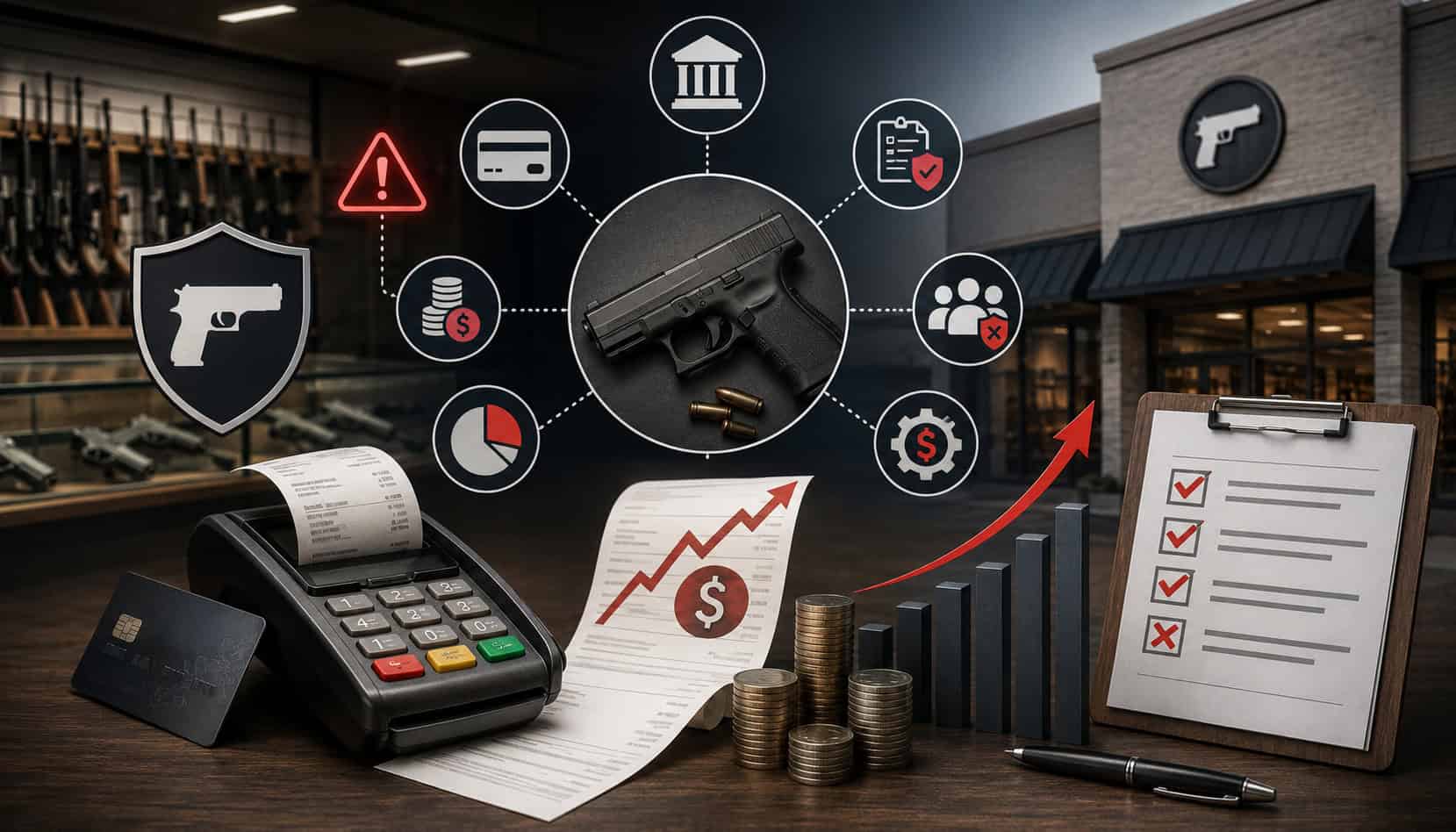
Firearm retailers, FFL dealers, online sellers, ranges, gunsmiths, and related merchants often face a more complex payment environment than standard retail businesses.
Even when a business is fully licensed, well-run, and compliant, processors may classify it as high risk because of regulated products, higher ticket sizes, card-not-present sales, chargeback exposure, underwriting requirements, and processor policy restrictions.
That classification can affect pricing. High-risk processing costs for gun businesses may include higher transaction rates, payment gateway fees, monthly account fees, rolling reserves, chargeback fees, compliance-related costs, and settlement controls. These costs are not always easy to compare because every processor structures pricing differently.
The goal is not simply to find the lowest advertised rate. The better goal is to understand the full cost structure, identify avoidable fees, reduce risk signals, and choose payment tools that support lawful firearm-related commerce without unnecessary disruption.
For a broader overview of account structure, see this guide to high-risk merchant accounts for firearms businesses.
What Are High-Risk Processing Costs for Gun Businesses?
High-risk processing costs are the fees, holds, and account expenses a firearm-related merchant may pay to accept card payments through a provider willing to support the industry.
These costs usually include the basic expense of moving money through the card networks, plus additional pricing tied to underwriting, risk monitoring, compliance review, and chargeback management.
In practical terms, high-risk payment processing costs for firearm businesses can include a percentage of each transaction, a fixed per-transaction fee, a monthly service fee, a payment gateway fee for ecommerce, batch fees, PCI-related fees, statement fees, chargeback fees, and hardware or software costs. Some accounts may also include rolling reserves, where a portion of sales volume is temporarily held as a risk buffer.
A rolling reserve is not the same as a permanent fee. It is usually a withheld percentage of processed volume that may be released later according to the merchant agreement. However, it still affects cash flow, so it should be reviewed carefully before signing.
The most important point is that firearm merchant account fees are rarely just one number. A quote may advertise a transaction rate, but the actual monthly cost depends on sales volume, card mix, refund activity, chargebacks, online sales, gateway use, keyed payments, and account terms.
Why Gun Businesses Pay Higher Processing Fees
Gun businesses often pay higher processing fees because processors evaluate more than whether a merchant is legally allowed to sell. They also review the financial and operational risk attached to the account.
Firearm-related businesses may involve regulated products, higher average ticket sizes, shipping requirements, transfer procedures, special orders, deposits, and stricter documentation expectations.
Processors also consider card-not-present transactions riskier than card-present transactions. Online orders, phone payments, manually keyed transactions, and invoice payments can increase exposure because the card is not physically presented at checkout. That can affect gun store credit card processing fees, especially for ecommerce merchants.
Underwriting is another factor. A processor may review licensing documents, website policies, product categories, refund terms, fulfillment practices, ownership details, bank statements, prior processing history, and chargeback ratios. More review means more administrative work and more risk controls.
Chargeback exposure also matters. Disputes can arise from shipping delays, unclear refund policies, canceled special orders, transfer misunderstandings, duplicate billing concerns, or customer confusion about descriptors. Even a low dispute count can become expensive if the average order value is high.
Firearm-related merchants should also understand that payment providers have their own policies. Some processors do not support firearm sales at all. Others support only certain product categories or sales channels. That is why high-risk merchant services and FFL payment processing often cost more than standard retail processing.
| Cost Type | What It Means | Why It Matters | How to Manage It |
| Transaction fees | Percentage and fixed fee charged per sale | Usually the largest ongoing cost | Compare effective rate, not just advertised rate |
| Interchange costs | Base card-network and card-issuing bank costs | Varies by card type and transaction method | Use secure card-present methods when possible |
| Gateway fees | Cost for online payment gateway access | Common for ecommerce and invoicing | Choose only the gateway features you need |
| Chargeback fees | Fee charged when a transaction is disputed | Can increase account risk and pricing | Use clear policies, tracking, and documentation |
| Rolling reserves | Temporary hold on part of sales volume | Reduces available cash flow | Negotiate terms and ask about release schedule |
| PCI-related fees | Security-related account costs | Helps support safer card handling | Maintain secure workflows and complete requirements |
| Monthly fees | Account, statement, support, or platform fees | Adds fixed cost even in slower months | Review statements regularly |
| Early termination fees | Cost to leave before contract end | Can make switching expensive | Read contract terms before signing |
Transaction and Interchange Costs
Transaction and interchange costs make up the foundation of firearms payment processing costs. Every card sale includes underlying network and issuing-bank costs, plus processor markup. For a gun store, that final price may vary depending on whether the card is debit, rewards credit, corporate, keyed, swiped, dipped, tapped, or used online.
Card-present transactions are often less expensive than card-not-present transactions because the cardholder and card are physically present. Chip and contactless payments may also carry lower risk than manually keyed payments. Keyed transactions usually cost more because they are easier to dispute and harder to verify.
Online firearm payments can cost more because ecommerce checkout requires a gateway, fraud tools, address verification, CVV checks, and secure data handling. Those tools are valuable, but they may add gateway or platform fees.
The best way to evaluate high-risk merchant account pricing for gun stores is to review the effective rate. This means dividing total processing fees by total processed volume. It gives a clearer view than looking only at the quoted percentage.
Rolling Reserves and Risk Holds
Rolling reserves are common in high-risk merchant services because they help protect the processor from future losses tied to chargebacks, refunds, fraud claims, or account closure. A processor may hold a percentage of each batch for a defined period, then release it later if the account remains healthy.
For example, if a processor applies a reserve, the business receives less of each settlement immediately. The withheld portion may be released on a rolling schedule based on the agreement. While this is not the same as a fee, it can still affect inventory purchasing, payroll, advertising, and cash planning.
Rolling reserves are more likely when a business is new, has limited processing history, sells online, has high average tickets, has prior chargebacks, or operates in a category the processor views as sensitive. A reserve may also be reduced or removed after the business establishes consistent volume and low dispute activity.
A helpful overview of how reserves work is available in this merchant account reserves guide.
Chargeback and Dispute Fees
Chargebacks can directly and indirectly increase costs. The direct cost is the chargeback fee itself. The indirect cost is the risk signal it sends to the processor. If disputes rise, the processor may increase pricing, require a reserve, delay settlements, restrict volume, or review the account more closely.
Firearm businesses can face disputes for reasons that are not always related to fraud. A customer may misunderstand transfer steps, shipping timing, cancellation rules, restocking fees, special-order deposits, or refund eligibility. Online orders may also produce disputes when billing descriptors are unclear or tracking information is incomplete.
The best prevention strategy is documentation. Keep receipts, signed invoices, order confirmations, shipping records, transfer communication, refund policy acknowledgments, and customer messages. For ecommerce, use clear checkout disclosures and confirmation emails.
For more prevention tactics, review this guide on how to prevent chargebacks in firearm sales.
Common High-Risk Merchant Account Fees
Common high-risk merchant account fees include transaction fees, monthly account fees, gateway fees, batch fees, PCI-related fees, chargeback fees, statement fees, equipment costs, and possible reserve requirements. Some merchants may also see monthly minimums, annual fees, risk monitoring fees, or early termination fees.
Transaction fees are usually the most visible. These may be structured as flat-rate pricing, tiered pricing, interchange-plus pricing, or another model. Interchange-plus is often easier to audit because it separates base interchange from processor markup, but it still requires careful statement review.
Payment gateway fees are common for online stores. These may include a monthly gateway fee, per-transaction gateway fee, fraud tool fee, tokenization fee, or recurring billing feature fee. For merchants selling through ecommerce, gateway reliability and processor compatibility matter as much as cost.
PCI-related fees may appear as monthly or annual charges. These are tied to card data security responsibilities. Merchants should still avoid storing card information directly and should use secure systems designed to reduce exposure.
Equipment costs may include terminals, mobile readers, POS hardware, software subscriptions, installation, or support. “Free” equipment should be reviewed carefully because it may come with a longer contract, higher processing margin, or return obligations.
Early termination fees deserve special attention. A merchant that signs a long contract with poor support, unexpected reserves, or unclear pricing may face added cost when trying to leave. Always review the term length, cancellation rules, equipment lease terms, and reserve release language.
Factors That Affect FFL Dealer Merchant Account Costs
FFL dealer merchant account costs depend on the merchant’s risk profile, sales model, processing history, and documentation quality. Two gun businesses can receive different pricing even if they sell similar products because underwriting looks at the full account picture.
Sales volume matters. Higher monthly volume can sometimes support better pricing because the processor has more predictable data. However, sudden spikes can trigger review if they exceed approved limits. Merchants should provide realistic volume estimates and update the processor before major growth events.
Average ticket size also affects cost. Higher ticket values increase potential chargeback exposure. If one dispute represents a large dollar amount, the processor may price the account more cautiously or apply reserves.
Ecommerce activity is another major factor. Online sales may require more fraud screening, gateway controls, shipping documentation, and policy review. A business with mostly in-store chip transactions may have a different risk profile than one processing most sales through a website.
Chargeback history is one of the strongest pricing signals. Low dispute activity may help support better terms over time. Repeated disputes, unclear refund policies, or weak documentation can increase costs quickly.
Business age and processing history matter too. New merchants may face more cautious underwriting because there is less data available. Established merchants with stable volume, clean statements, and strong documentation may have more negotiating power.
Documentation quality can also influence approval and pricing. Underwriters may request business formation documents, licensing information, bank statements, processing statements, website URLs, refund policies, shipping policies, product descriptions, and owner identification. The more complete the file, the smoother the review.
How Gun Stores Can Reduce Payment Processing Costs

Gun stores can reduce payment processing costs by lowering risk, improving payment security, reviewing statements, reducing chargebacks, and matching the right pricing model to their sales pattern. The goal is not to avoid all high-risk pricing, but to avoid unnecessary costs.
Start with chargeback prevention. Clear receipts, accurate descriptors, visible refund policies, fast customer communication, and documented shipping or transfer steps can reduce disputes. Customers should understand what they are buying, when it will be available, what cancellation rules apply, and how refunds are handled.
Next, reduce unnecessary keyed payments. When possible, use EMV chip, tap, or secure card-present methods. Keyed payments may cost more and carry higher dispute risk. If phone orders are necessary, use secure invoicing or gateway tools that capture verification data.
Review monthly statements. Look for new fees, downgrades, batch charges, gateway add-ons, PCI fees, non-qualified rates, and chargeback-related costs. Many merchants discover savings simply by understanding what they are already paying.
Compare pricing models carefully. Flat-rate pricing may be simple, but it can be expensive for higher-volume stores. Tiered pricing can be harder to audit. Interchange-plus may offer more transparency, but only if the markup and fees are clearly disclosed.
Use secure checkout for ecommerce. Address verification, CVV checks, tokenization, fraud filters, velocity controls, and order review rules can reduce risky approvals. Learn more in this guide to secure online payments for firearms.
Other cost-control steps include:
- Keep refund, shipping, and cancellation policies easy to find.
- Train staff to avoid manual card entry unless necessary.
- Monitor chargeback ratios monthly.
- Reconcile batches and deposits consistently.
- Keep business documents current.
- Notify the processor before major volume changes.
- Avoid unsupported payment platforms.
Payment Security and Compliance Best Practices
Payment security is central to controlling high-risk processing costs for gun businesses. Secure systems reduce fraud exposure, protect cardholder data, and show processors that the merchant operates responsibly. Strong payment security can also reduce chargebacks, manual reviews, and account interruptions.
Encryption helps protect card data when it moves through the payment system. Tokenization replaces sensitive card data with a secure token, reducing the need for the merchant to handle raw card numbers. Secure gateways and PCI-aware workflows help prevent avoidable exposure.
Staff permissions should be limited by role. Not every employee needs access to refunds, stored customer profiles, settlement tools, or gateway settings. Strong user controls reduce internal mistakes and help protect the account.
Refund controls are also important. Refunds should follow a documented process, require approval when appropriate, and be issued back to the original payment method when possible. Inconsistent refund handling can create accounting problems and customer disputes.
For online sales, fraud monitoring should include address verification, CVV verification, order velocity checks, suspicious IP review, mismatched billing and shipping alerts, and manual review rules for high-value orders. These tools do not guarantee that every risky order will be stopped, but they reduce exposure.
Compliance documentation should remain organized. The ATF notes that federal firearms licensees are subject to compliance responsibilities and inspections, making clean records and operational discipline important for licensed businesses. A useful reference is the ATF’s Federal Firearms Licensee Quick Reference and Best Practices Guide.
Payment compliance and product compliance are not the same thing, but they overlap operationally. A processor may review whether the business has clear policies, secure checkout, proper licensing documentation, and responsible workflows. The easier it is to verify those controls, the stronger the merchant’s position.
Common Mistakes Firearm Businesses Should Avoid
One common mistake is choosing a processor based only on advertised rates. A low rate may look attractive, but it may not include gateway fees, PCI fees, monthly minimums, chargeback fees, reserves, equipment costs, or early termination terms. Total cost matters more than the headline percentage.
Another mistake is ignoring reserves. Some merchants focus only on fees and overlook cash-flow holds. A reserve can make an account more stable, but it should be clearly explained. Merchants should know the percentage, duration, release schedule, review criteria, and whether reserve terms can change.
Weak refund policies can also create problems. If customers do not understand cancellation rules, transfer steps, special-order policies, or restocking terms, disputes become more likely. Clear policies should appear on receipts, checkout pages, invoices, and confirmation emails.
Incomplete documentation is another avoidable issue. Underwriting delays often happen because the merchant cannot quickly provide licensing information, bank statements, processing history, website policies, ownership details, or product descriptions. Keeping these materials ready can improve approval speed and reduce friction.
Using unsupported processors is risky. Some standard platforms may approve an account initially, then later freeze funds or close the account after reviewing the product category. Firearm businesses should work with providers that understand FFL payment processing and clearly support the relevant business model.
Not reviewing statements is another costly habit. Fees can change, downgrades can increase, and chargeback costs can creep upward. Monthly statement review helps identify problems before they become expensive.
For additional cost-saving ideas, see this article on how to lower credit card transaction costs for firearms.
What are high-risk processing costs for gun businesses?
High-risk processing costs for gun businesses are the fees and account expenses tied to accepting card payments in a category processors view as higher risk. These may include transaction fees, monthly fees, gateway fees, PCI-related fees, chargeback fees, reserve requirements, and settlement-related costs.
These costs exist because processors evaluate financial risk, chargeback exposure, product category, compliance documentation, card-not-present sales, and account stability. A firearm business may be responsible and compliant while still receiving high-risk pricing because of industry classification.
Why do firearm businesses pay higher merchant fees?
Firearm businesses often pay higher merchant fees because processors apply stricter underwriting to regulated or sensitive product categories. They may review licensing, product types, websites, refund policies, shipping procedures, chargeback history, and prior processing statements.
Online sales can increase costs further because card-not-present transactions carry more fraud and dispute risk. Higher average ticket sizes, special orders, transfer steps, and policy restrictions can also affect pricing.
What fees should gun stores watch for?
Gun stores should watch for transaction fees, monthly account fees, payment gateway fees, PCI-related fees, statement fees, batch fees, chargeback fees, equipment charges, monthly minimums, early termination fees, and reserve requirements.
The most important step is to compare total monthly cost, not just the quoted rate. A merchant with a low percentage fee may still pay more if the account includes expensive add-ons or unclear contract terms.
What are rolling reserves?
Rolling reserves are temporary holds on a portion of processed sales volume. A processor may use them as a financial buffer against chargebacks, refunds, fraud losses, or sudden account risk.
For example, a processor may hold part of each batch and release it later according to the reserve schedule. The money may eventually return to the merchant, but the hold can affect cash flow while it is in place.
Can FFL dealers reduce processing costs?
Yes. FFL dealers may reduce costs by lowering chargebacks, using secure card-present methods, avoiding unnecessary keyed transactions, reviewing statements, maintaining clean documentation, and choosing pricing that matches their sales pattern.
Cost reduction usually comes from risk reduction. Processors tend to view organized merchants with stable volume, low disputes, and clear policies more favorably than merchants with inconsistent records or frequent disputes.
Why do chargebacks affect pricing?
Chargebacks affect pricing because they create financial exposure for the processor and acquiring bank. A chargeback may involve a refund, a dispute fee, administrative work, and possible loss if the merchant cannot cover the amount.
High chargeback activity may lead to higher fees, reserves, payout delays, account reviews, or termination. Preventing disputes is one of the most effective ways to control firearm merchant account fees.
Are online firearm payments more expensive?
Online firearm payments may be more expensive than in-person payments because they are card-not-present transactions. These transactions typically require a payment gateway, fraud filters, secure checkout tools, address verification, CVV checks, and closer monitoring.
That does not mean ecommerce is impractical. It means the account should be set up properly with supported products, clear policies, secure payment tools, and strong documentation.
How should gun businesses compare processors?
Gun businesses should compare processors by looking at total cost, supported product categories, underwriting standards, gateway compatibility, reserve terms, chargeback support, contract length, settlement timing, and customer service quality.
A good comparison should include the full fee schedule, not only the transaction rate. Merchants should also ask whether the provider supports their exact sales channels, including in-store, ecommerce, phone orders, invoicing, and FFL-related workflows.
Conclusion
High-risk processing costs for gun businesses can feel complicated, but they become easier to manage when each cost is separated and reviewed. Transaction fees, gateway fees, chargeback fees, monthly fees, reserves, and settlement terms all play a role in the true cost of accepting card payments.
The best approach is practical and organized. Maintain strong documentation, use secure payment tools, reduce chargebacks, review statements, clarify reserve terms, and choose a processor that understands firearm-related merchant accounts.
With transparent pricing, secure workflows, clear customer policies, and regular account review, gun businesses can manage high-risk processing costs while maintaining stable and compliant payment acceptance.
Leave a Reply