By gunfriendlypayments March 12, 2026
Running a firearms business means managing more than inventory, customer service, and sales. It also means dealing with a payment environment that can be harder to navigate than many business owners expect. Even well-run stores, licensed dealers, and compliant online sellers can face added scrutiny when they apply for card processing.
That is where a High-Risk Merchant Account for Firearms Businesses becomes important. It is not simply a backup option for businesses that were turned down elsewhere.
In many cases, it is the right starting point for firearm retailers, dealers, manufacturers, parts sellers, training businesses, and accessory merchants that need stable payment acceptance from the beginning.
The challenge is that many business owners hear the phrase “high-risk” and assume it means something is wrong with their company. That is not what it means.
In payment processing, high-risk usually refers to how banks and processors evaluate exposure to chargebacks, compliance issues, reputational concerns, order disputes, higher-ticket transactions, card-not-present sales, and industry-specific underwriting conditions.
A strong high-risk setup can give a firearms business access to secure checkout systems, fraud controls, flexible sales channels, and a processor relationship built for long-term stability.
A weak setup can lead to hidden fees, funding delays, sudden account holds, reserve requirements, or even account termination at the worst possible time.
This guide breaks down how a High-Risk Merchant Account for Firearms Businesses works, why firearms businesses are often placed in high-risk categories, what approval really involves, what fees and reserves to expect, and how to choose a provider that supports your business instead of putting it at constant risk.
Whether you are opening a new shop, growing online sales, or replacing an unreliable processor, the goal is the same: secure, dependable, scalable payment processing that fits your business model.
What Is a High-Risk Merchant Account for Firearms Businesses?
A High-Risk Merchant Account for Firearms Businesses is a payment processing account designed for businesses that operate in an industry processors consider more sensitive or more exposed to financial risk.
It allows firearm-related merchants to accept credit cards, debit cards, and other electronic payments under underwriting rules that match the realities of the business.
Unlike a general merchant account, a high-risk account is built with additional oversight. The processor, acquiring bank, and underwriting team usually look more closely at sales methods, product types, refund practices, website disclosures, business licensing, average ticket size, historical processing trends, chargeback ratios, and fraud exposure.
This does not mean the business is unsafe. It means the processor wants stronger controls in place before approving the account.
For firearms businesses, this structure matters because many standard processors either decline applications outright or approve them under policies that are too fragile for the industry.
A gun shop or dealer may process successfully for a while and then face a sudden review, restrictions on product categories, or account closure when the provider decides the industry no longer fits its risk appetite.
A properly placed high-risk account reduces that mismatch. It creates a processing relationship that is designed for the business from day one. That includes pricing structured for the industry, support for multiple sales channels, clearer underwriting expectations, and risk controls meant to keep the account stable over time.
This type of account can support:
- In-store point-of-sale transactions
- Online gun store payments
- Card-not-present orders
- Phone orders
- Invoice payments
- Special-order deposits
- Recurring billing for approved service models
- Accessory and related product sales
The key benefit is not just approval. It is approved with the right expectations. A strong provider understands firearms payment processing, FFL payment processing needs, processor risk controls, and the compliance pressure that comes with the industry.
What “High-Risk” Really Means in Payment Processing
In payment processing, “high-risk” is a lender and processor classification, not a moral judgment. It reflects the bank’s view of how likely the account is to produce disputes, fraud losses, regulatory issues, policy violations, or sudden financial exposure.
Firearms businesses often trigger this label because processors see several overlapping risks at once. These may include industry sensitivity, card-not-present transactions, special-order sales, larger average order values, scrutiny around product fulfillment, and the need for careful underwriting.
A business can be fully licensed, highly organized, and customer-focused and still be placed in a high-risk category because of how the payment ecosystem measures exposure.
That is why high-risk merchant services exist. They are built to manage accounts that require tighter onboarding, stronger monitoring, and more active relationship management. A good provider is not looking for reasons to shut the business down. It is looking for ways to support the account while keeping risk within acceptable levels.
Which Firearms Businesses May Need One
Many owners assume only online sellers need a high-risk account, but the reality is broader. Different firearms-related business models can face similar processing challenges even when their sales methods differ.
Businesses that commonly need a High-Risk Merchant Account for Gun Dealers or related firearm-focused payment solutions include retail gun stores, licensed dealers, parts and accessory sellers, ammunition-related merchants where permitted by processor policy, custom build businesses, firearm training companies, gunsmith operations, and businesses handling special-order or pre-order transactions. Even stores with mostly in-person sales may still need high-risk approval because of the industry itself.
New businesses are often surprised by this. Established businesses sometimes discover it only after a processor review interrupts operations. In both cases, the lesson is the same: the business model should be matched with the right underwriting path early, not after a problem appears.
Why Firearms Businesses Are Often Classified as High Risk

Firearms businesses are often placed into high-risk payment categories because processors do not look only at sales volume. They look at the full risk picture. That includes compliance exposure, reputation concerns, transaction patterns, product sensitivity, and dispute potential.
One major reason is industry policy. Some banks and processors do not want exposure to certain verticals, even when those businesses are licensed and operate responsibly. Others will accept the industry but only under stricter underwriting.
This makes firearms business compliance and merchant account approval more complex than it is for many ordinary retail categories.
Another reason is transaction behavior. Firearms businesses may handle special orders, deposits, custom requests, larger-ticket items, transfer-related transactions, shipping verification steps, or online orders that require additional validation before fulfillment.
From a processor’s perspective, each extra layer can create more room for disputes, delayed delivery complaints, or fraud attempts if the account is not managed carefully.
Card-not-present transactions can raise risk further. When a customer shops online or places an order over the phone, the merchant cannot physically inspect the card. That is why processors pay close attention to fraud prevention tools, AVS checks, CVV verification, transaction monitoring, and secure checkout systems in firearm-related ecommerce.
Chargeback exposure also matters. A business may have excellent customer service and still face disputes related to order confusion, processing time, refunds, canceled special orders, friendly fraud, or unauthorized-use claims. In high-risk industries, processors often assume that even a moderate level of disputes can become costly if not controlled early.
There is also the issue of processor fit. Some merchants are approved by general providers that do not truly understand the industry. The application slips through, the account starts processing, and then a later review leads to added reserve requirements, payout holds, or closure.
That instability is one reason firearm merchants often seek Gun-Friendly High-Risk Merchant Account options from the beginning.
This classification is not meant to stop the business from growing. It is meant to push the account into a processing structure with stronger underwriting and clearer ongoing controls. When matched correctly, that structure can support steady growth, better fraud defenses, and fewer unpleasant surprises.
Industry Sensitivity and Policy Restrictions
Some industries attract stricter oversight because of how banks, card brands, and processors view reputational or compliance exposure. Firearms fall into that group. Even within the same provider, rules may differ based on product type, sales method, and risk appetite at the acquiring bank level.
This creates a fragmented landscape. One processor may welcome firearm-related merchants with the right underwriting package, while another may reject the same business model entirely.
A third may appear to support it but later add restrictions once deeper reviews begin. That is why many merchants feel confused during the application process.
A firearms business can do everything right and still face policy-based obstacles. The issue is not always the merchant’s quality. It is often the provider’s internal limits. Working with a processor that already understands firearms high-risk payment processing helps reduce the chance of entering a relationship that was never truly built to last.
Transaction Risk, Disputes, and Fraud Exposure
Risk also rises when a business handles transactions that processors see as more dispute-prone or vulnerable to fraud. Firearms merchants may process higher-value orders, special requests, card-not-present transactions, or shipments that require extra validation. Those factors can raise risk scores even before a processor reviews the merchant’s history.
Fraud attempts can be especially damaging in this space. Stolen cards, mismatched billing details, suspicious order velocity, and attempted reshipping schemes can all create losses. On top of that, friendly fraud can affect even legitimate sales when customers claim they did not authorize a purchase or did not understand a transaction.
Because of this, processors want strong controls in place. They may require AVS, CVV checks, device screening, tokenization, encrypted payment data, and active chargeback monitoring. The businesses that treat these tools as part of daily operations, not optional add-ons, are usually better positioned for long-term approval and stability.
Standard Merchant Accounts vs. High-Risk Accounts for Firearm-Related Businesses
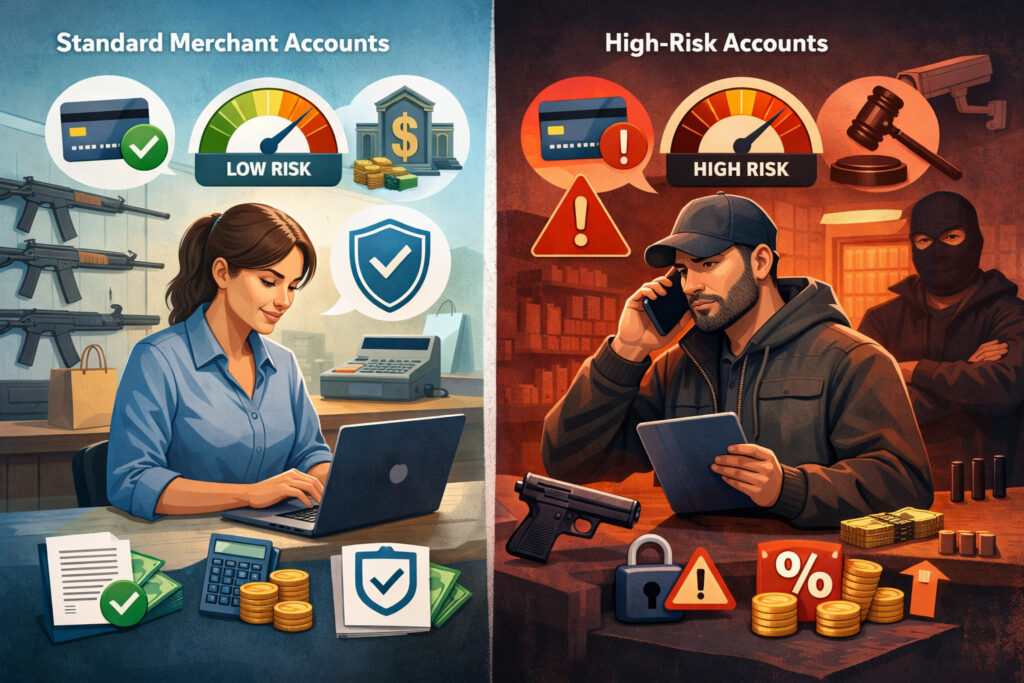
A standard merchant account and a high-risk merchant account both allow a business to accept card payments, but they are not built the same way. The biggest difference is how the processor expects the account to behave and how much risk management is built into the relationship from the beginning.
A standard merchant account is usually designed for industries with lower expected dispute rates, fewer policy concerns, and more predictable transaction patterns. Approval is often faster. Pricing may appear lower at first. Reserve requirements are less common. Ongoing monitoring may be lighter. For ordinary low-risk retail, that structure can work well.
For firearms businesses, it often does not. The provider may not fully support the business model, may not understand firearms business compliance requirements, or may react quickly when the account is reviewed by a risk department later. That is where merchants run into frozen funds, extra documentation requests, or abrupt termination.
A High-Risk Merchant Account for Firearms Businesses is structured differently. Underwriting is more detailed.
The processor is more likely to review licensing, sales model, website content, refund policy, shipping procedures, prior processing history, expected monthly volume, and transaction sizes. Pricing may be higher, but the account is also better aligned with the real risk profile of the business.
High-risk accounts are more likely to involve rolling reserves, stricter monitoring, documented risk controls, and ongoing reviews.
That can sound like a disadvantage, but it often provides more stability because expectations are clear. The processor is not surprised by the industry. It approved the account knowing exactly what it was taking on.
Another key difference is channel flexibility. A strong high-risk setup can support online gun store payments, in-store payment solutions, manually keyed phone orders, gateway integrations, and secure payment processing across multiple environments.
Standard providers may offer some of those features, but not always with reliable long-term support for the firearms space.
In practical terms, a standard account may look cheaper and easier, while a high-risk account may look more demanding. For firearms merchants, the second option is often safer because it is built for reality, not just for a quick approval.
Where Standard Accounts Often Fall Short
Standard processors usually focus on smooth, fast onboarding for industries they view as predictable. That system can fail when the business falls outside those assumptions. Firearms merchants may get approved through a general application path, only to discover later that the provider is uncomfortable with actual transaction activity.
This can show up in several ways. The processor may question certain product pages, place limits on monthly volume, delay funding while reviewing orders, or terminate the account after internal policy checks. In some cases, merchants are told the account was approved in error. That puts the business in a difficult position, especially if sales are already active and customer payments are flowing through the account.
A processor relationship should not feel fragile. If the provider does not specialize in high-risk industry payment solutions, the account may always be one review away from disruption. That is why firearms businesses often do better with providers that underwrite the industry intentionally rather than tolerating it temporarily.
Why High-Risk Accounts Are Often the Better Fit
A high-risk account is usually the better fit because it is designed around the actual business model. The processor expects closer review, higher scrutiny, and more active monitoring from the start. That means fewer surprises later.
Instead of hiding the nature of the business or hoping the processor never asks deeper questions, the merchant presents the business clearly during underwriting. Product types, sales channels, order flow, chargeback controls, and compliance practices are all part of the approval conversation. That honesty helps build a more durable relationship.
The right provider can also offer better tools for high-risk credit card processing, transaction monitoring, fraud screening, dispute alerts, and reserve management. These features are not just defensive. They help support smoother operations, better approval odds for future reviews, and greater confidence as the business grows.
How Firearms High-Risk Payment Processing Works
Firearms High-Risk Payment Processing works through a layered system involving the merchant, payment gateway, processor, acquiring bank, underwriting team, card networks, and risk management controls. The business may only see the front-end payment experience, but a great deal happens behind the scenes to keep the account active and compliant.
The process starts with underwriting. Before the account goes live, the provider reviews the business in detail. That usually includes ownership information, business formation documents, license details where applicable, estimated monthly processing volume, average transaction size, processing history, bank statements, website review, refund and shipping policies, and any prior merchant account issues.
The underwriter is trying to answer a simple question: can this business process safely and predictably within the provider’s risk standards?
Once approved, the payment setup usually includes a gateway or point-of-sale system, secure payment processing tools, and fraud filters.
For online transactions, the gateway transmits payment data securely between the customer, the merchant’s site, and the processor. Encryption, tokenization, AVS, CVV checks, and fraud scoring may all be involved before a transaction is authorized.
After approval, ongoing monitoring begins. The processor tracks chargeback ratios, refund activity, unusual transaction spikes, suspicious order patterns, declines, account volume shifts, and settlement behavior. If something unusual appears, the processor may ask for more information or temporarily review payouts. This can feel frustrating, but it is part of high-risk account management.
Funding timelines can also differ from standard accounts. Some providers deposit funds quickly after settlement, while others maintain reserve balances or apply temporary holds when risk increases.
A rolling reserve is common in high-risk merchant services. This means a small percentage of sales may be held for a fixed period before release to protect the processor against future disputes.
Pricing is usually higher than standard retail processing because the provider is taking on more exposure. Rates, transaction fees, chargeback fees, gateway costs, compliance fees, and reserve terms should all be reviewed carefully before signing.
Periodic account reviews are also normal. If a business changes product mix, adds a major online channel, increases volume sharply, or experiences more chargebacks, the processor may reassess the account terms.
That is why communication matters. A merchant that keeps the processor informed is often in a stronger position than one that creates surprises.
Underwriting, Approval, and Risk Review
Merchant account underwriting is the foundation of high-risk processing. Underwriters are not just checking whether your application is complete. They are evaluating how your business operates, how customers are charged, how orders are fulfilled, and what type of exposure the processor may face if things go wrong.
For firearms merchants, underwriting may include a close review of website disclosures, contact information, return and refund terms, order workflow, product descriptions, secure checkout systems, prior processing statements, and proof that the business is structured and documented properly. If something looks unclear, inconsistent, or incomplete, approval may be delayed.
Even after approval, risk review does not stop. High-risk accounts are often monitored continuously. Sudden changes in volume, ticket size, customer complaints, or dispute trends can trigger attention.
That is not a sign the account is failing. It is part of how high-risk payment environments operate. Businesses that plan for this and keep organized records are better prepared for smoother reviews.
Reserves, Pricing, Monitoring, and Account Reviews
High-risk processors often use reserve structures and closer monitoring to balance exposure. A rolling reserve is one of the most common tools.
The processor withholds a percentage of each batch for a set period, then releases those funds on a rolling basis. This protects against future chargebacks and losses, especially in industries where disputes or fraud may arise after the sale.
Pricing also tends to reflect the added risk. Firearms businesses may see higher discount rates, per-transaction fees, monthly gateway fees, PCI-related costs, and chargeback fees than a low-risk retail merchant.
The important question is not whether the fees are higher. It is whether they are clearly disclosed and backed by a processor relationship that is stable and supportive.
Monitoring is another major part of the picture. Processors track refund ratios, fraud indicators, account velocity, batch behavior, and unusual sales patterns.
Regular account reviews may happen after major volume changes, product line updates, or changes in ownership or business model. Strong documentation and proactive communication can make these reviews far less stressful.
How a High-Risk Merchant Account Supports In-Store, Online, Phone, and Special-Order Sales
A major advantage of the right high-risk setup is flexibility. Firearms businesses do not all sell the same way. Some depend heavily on in-store traffic.
Others operate online, take deposits for hard-to-find inventory, accept card payments by phone, or combine retail and special-order models. A High-Risk Merchant Account for Gun Dealers should support these real-world sales patterns instead of forcing the business into a narrow system.
For in-store sales, the account can be connected to a point-of-sale environment with EMV-enabled terminals, receipt tracking, inventory-friendly integrations, and secure in-person authorization.
In-store payment solutions are often the easiest from a fraud standpoint because the card is physically present, but processors still care about refund practices, transaction patterns, and ticket size.
For ecommerce, the account works through a payment gateway for firearms businesses. This allows the merchant to accept online payments using secure checkout systems, tokenization, encryption, AVS, CVV checks, and other fraud controls.
The gateway becomes especially important when a business offers online browsing, invoicing, deposits, accessory purchases, or other card-not-present transactions.
Phone orders and manually keyed transactions can also be supported, though they usually carry higher risk. Since the card is not physically present, the processor may require stronger internal procedures for identity verification, order confirmation, and customer communication. Too many keyed sales without proper controls can increase underwriting concern.
Special-order transactions are common in this industry and require careful handling. Deposits, delayed fulfillment, custom builds, and product sourcing can all create misunderstanding if policies are unclear.
The merchant account should support these transactions, but the business must make timelines, cancellation terms, and refund expectations visible before payment is taken.
The best providers do more than approve the account. They help match the right tools to each sales channel. That could include virtual terminals, hosted payment pages, ecommerce integrations, POS hardware, invoicing tools, and transaction monitoring customized to the business model.
This matters because a sales channel is not just a checkout method. It is a risk profile. In-store, online, phone, and special-order payments each create different processor concerns. The right high-risk setup accounts for all of them.
In-Store and Card-Present Sales
In-store transactions are often viewed more favorably because card-present sales reduce certain fraud risks. EMV chip acceptance, signed receipts where applicable, and in-person customer interaction provide stronger evidence if a dispute occurs later.
For firearms retailers, this can make in-store volume a stabilizing factor within the overall account profile.
Still, card-present does not mean risk-free. Refund confusion, sales staff errors, special-order misunderstandings, and poor receipt detail can still lead to disputes. The processor may also review how deposits are handled and whether certain transactions are completed at the time of order or later at pickup.
A solid in-store setup should include secure terminals, clear receipts, consistent refund documentation, and trained staff. When those basics are handled well, in-store processing can strengthen the business’s overall risk profile and support long-term processor confidence.
Online, Phone, and Special-Order Transactions
Online and phone sales require more attention because they fall under card-not-present rules. That means the merchant carries more fraud exposure and may face higher scrutiny from the processor. Every step of the order process matters, from product page clarity to billing verification to post-sale communication.
Online gun store payments should be processed through a secure gateway with fraud filters, AVS, CVV validation, velocity controls, tokenization, and encrypted checkout. Phone orders should follow documented procedures, especially for verifying billing details, recording customer consent, and confirming order terms.
Special orders deserve even more care. Deposits, delayed fulfillment, customized products, and nonstandard timelines can all generate chargebacks if expectations are not documented clearly.
Businesses that explain policies before payment, confirm details in writing, and maintain transparent communication usually have fewer disputes and stronger long-term payment stability.
The Role of Payment Gateways, Fraud Tools, PCI Compliance, and Secure Checkout
The technology behind the transaction matters just as much as the account itself. A processor may approve a firearms business, but the account will still be vulnerable if the payment environment is weak.
That is why a strong High-Risk Payment Processing for Gun Stores setup usually includes a reliable gateway, layered fraud prevention tools, PCI compliance support, and a secure checkout experience.
A payment gateway for firearms businesses acts as the bridge between the merchant’s checkout system and the processor. It securely transmits transaction details, helps authorize payments, and often provides risk filters that screen orders before they are approved. For online sales, the gateway is one of the most important parts of the payment stack.
Fraud prevention tools add another protective layer. AVS compares the billing address submitted by the customer with the address on file at the card issuer. CVV checks confirm the card security code. Device analysis, velocity rules, geolocation checks, and manual review flags can help stop suspicious orders before they turn into losses or chargebacks.
Tokenization and encryption are also essential. Encryption protects payment data while it moves through the system. Tokenization replaces stored card data with a secure token so the business can process repeat interactions without storing sensitive information directly. Together, these tools strengthen secure payment processing and reduce exposure.
PCI compliance is another critical requirement. It is not just a form to fill out once a year. It is a set of security standards that applies to businesses handling card data.
Even when a gateway or hosted payment page reduces the merchant’s direct exposure, the business still needs to follow secure practices, maintain approved systems, and understand its compliance responsibilities.
Chargeback monitoring tools also play a major role. Alerts, dispute notifications, reason-code tracking, and early-response programs can help a firearms merchant spot trouble quickly. In high-risk industries, fast action matters. A growing dispute problem is easier to contain when it is identified early.
The goal is not just fraud reduction. It is account protection. Processors look more favorably on merchants that use strong controls, maintain secure checkout systems, and show they understand how fraud and compliance affect long-term account stability.
Why Gateways and Security Features Matter
A payment gateway does more than accept card numbers. It shapes the security, reliability, and risk profile of your transactions. For firearm-related merchants, that matters because online and manually entered transactions often face more processor scrutiny than in-store sales.
A good gateway can support hosted payment pages, shopping cart integrations, tokenized repeat billing where appropriate, fraud rules, and secure data transmission. It can also reduce manual work by screening obvious risk signals automatically. When integrated well, it improves both customer experience and internal risk control.
Weak gateways create friction and exposure. They may lack fraud filters, produce unclear transaction records, or make it harder to track order-level details during disputes. That can hurt both approvals and account stability. Choosing the right gateway is not a technical side decision. It is a core processing decision.
PCI Compliance, AVS, CVV, Tokenization, and Encryption
PCI compliance helps businesses handle payment data more safely. Even if a merchant never sees full card details because the gateway hosts the checkout form, the business still has responsibilities around system security, access controls, device use, and policy awareness. A processor wants to see that the merchant takes this seriously.
AVS and CVV are frontline fraud filters. They help detect mismatches before a transaction is finalized. Tokenization reduces the need to store sensitive data directly, while encryption protects it during transmission. These tools work best together, not in isolation.
For high-risk merchants, they also send a message to underwriters and risk teams: this business is serious about secure operations. That can improve approval outcomes, strengthen processor trust, and reduce the chance that fraud-related issues grow into a broader account problem.
Benefits and Trade-Offs of a Gun-Friendly High-Risk Merchant Account
A Gun-Friendly High-Risk Merchant Account offers clear advantages for firearms businesses, but it also comes with trade-offs. Business owners should understand both sides before applying. The goal is not to find a perfect account with no limits. The goal is to find a stable account with terms that make sense for the business.
The biggest benefit is industry alignment. A processor that is genuinely gun-friendly is not treating the merchant as a temporary exception. It understands firearms payment processing, knows how to underwrite the business, and is more likely to support the account consistently as volume grows or sales channels expand.
Another major benefit is better long-term stability. When the processor already expects the industry’s risk profile, the merchant is less likely to face sudden surprises caused by internal policy shifts.
That does not eliminate reviews or reserve structures, but it reduces the chance of operating under a provider that never fully supported the business in the first place.
These accounts can also offer broader sales support. Many firearm merchants need a mix of in-store payment solutions, online acceptance, keyed transactions, invoicing, and secure gateway tools. A provider specializing in high-risk industry payment solutions is often more prepared to support this mix.
The trade-offs are real, though. Pricing may be higher. Approval may take longer. Reserve requirements may apply. Chargeback thresholds may be monitored closely. Contracts may include rolling reserves, early termination language, gateway fees, or enhanced due diligence requirements.
Some business owners see these terms and assume they are automatically bad. That is not always true. The real danger is not higher fees by themselves. It is unclear fees, misleading promises, or contract terms the merchant does not understand before signing.
In other words, the best high-risk account is not the one with the lowest advertised rate. It is the one that combines fair pricing, strong tools, transparent policies, and a processor relationship built to last.
Key Benefits for Firearms Businesses
The strongest benefit is reliable access to card processing in an industry where many businesses struggle to find durable support. A good high-risk provider makes it easier to accept payments across channels without constantly worrying about sudden shutdowns from a processor that does not understand the business.
There are also operational advantages. Better fraud tools, stronger chargeback support, more realistic underwriting, and tailored gateway options can improve both security and customer experience. For established businesses, that can support growth. For new merchants, it can prevent costly problems early.
Perhaps most importantly, the right account creates room for planning. When the processor relationship is stable, the business can focus on sales, service, and compliance instead of worrying that payment acceptance will disappear unexpectedly.
Common Trade-Offs to Expect
Higher rates and fees are the most common trade-off. High-risk processors price for additional exposure, monitoring, and reserve risk. Merchants may also see longer approval timelines because underwriting is more thorough.
Reserves are another trade-off. Not every account has one, but many do. This can affect cash flow, especially for newer businesses. Ongoing reviews, requests for updated documents, and stricter risk controls are also common.
None of these are deal-breakers by themselves. Problems arise when merchants do not expect them, do not read contract terms carefully, or choose a provider based only on front-end sales promises. A well-informed merchant can manage these trade-offs successfully.
Common Fees, Reserve Structures, Contract Terms, Approval Timelines, and Risk Factors
Understanding the numbers behind the account is essential. Many business owners focus on approval first and pricing second, but hidden fee traps often show up after the account goes live. A firearms merchant should know what costs, reserve terms, and contract conditions apply before signing anything.
Merchant account fees can include a discount rate or markup, per-transaction fees, monthly account fees, gateway fees, statement fees, PCI-related fees, chargeback fees, retrieval fees, batch fees, virtual terminal fees, and early termination costs. Some providers bundle these together clearly. Others bury them in long agreements or vague pricing language.
Reserve structures are especially important in high-risk merchant services. A rolling reserve is the most common. The processor withholds a percentage of each day’s or month’s volume and releases it later after a set hold period. Some providers may also require upfront reserves or establish trigger-based reserves if the account shows rising risk.
Approval timelines vary based on the business profile. A well-prepared merchant with complete documents, a compliant website, clean processing history, and realistic volume estimates may move through underwriting fairly smoothly.
Businesses with missing documents, unclear policies, prior account issues, or inconsistent application details may experience delays.
Risk factors that affect pricing and approval include:
- Business age
- Processing history
- Average ticket size
- Monthly volume
- Chargeback history
- Refund trends
- Card-not-present exposure
- Product mix
- Website quality and disclosures
- Prior account terminations
- Special-order or delayed-fulfillment sales
- Financial stability
For new businesses, the lack of processing history can make approval harder, even when everything else looks good. For established businesses, sudden growth or prior issues with another processor can raise questions.
In both cases, honesty matters. Underwriters are often more comfortable with a higher-risk file that is clearly documented than a smoother-looking file with missing details.
A good provider should explain pricing and reserve terms in plain contract language, not just on a sales call. If a fee sounds unusual or vague, ask for it in writing. If reserve conditions can change after approval, ask under what circumstances. If the provider cannot explain those terms clearly, that is a serious concern.
Fees and Reserve Structures to Watch Closely
Not all fees are equal. Some are routine and expected in high-risk credit card processing. Others are signs of poor transparency. Chargeback fees, gateway costs, and monthly account fees are common. Vague “risk” fees, unclear annual charges, or surprise compliance add-ons deserve closer review.
Reserves require the same attention. Ask what percentage is held, how long funds are retained, whether the reserve is rolling or fixed, and what could cause the reserve percentage to increase. Cash flow planning becomes much easier when the merchant understands reserve mechanics ahead of time.
Businesses that ignore these details often feel blindsided later. Businesses that ask direct questions upfront are more likely to choose providers that fit their operations and working capital needs.
Approval Timelines and What Slows Them Down
Approval can move quickly when the file is complete and the business model is presented clearly. Delays usually happen when underwriters need to chase missing details, resolve inconsistencies, or review unclear website content.
Common slowdowns include missing licenses or formation documents, weak website disclosures, unrealistic volume estimates, incomplete bank statements, and confusion around what products are actually being sold. Prior account issues can also extend the timeline because underwriters want more context.
The easiest way to speed up approval is preparation. When documents are organized, the website is ready for review, and the business explains its operations clearly, underwriting becomes easier for everyone involved.
How to Choose the Right High-Risk Payment Processing for Gun Stores
Choosing the right High-Risk Payment Processing for Gun Stores is one of the most important decisions a firearms business can make. The wrong provider can create constant instability. The right one can support growth, reduce payment friction, and protect the business from avoidable account problems.
Start with industry fit. Ask whether the provider actively supports firearms merchants or only reviews them case by case. Those are very different answers. A processor that already handles gun store payment solutions and FFL payment processing is more likely to understand your real needs and underwrite the account properly.
Next, evaluate transparency. You should understand rates, transaction fees, reserve terms, chargeback fees, contract length, gateway costs, and any conditions that allow the processor to change terms. If the sales rep is vague or avoids giving written detail, move carefully.
Technology matters too. The account should support your actual sales model. That may include POS hardware, ecommerce integration, virtual terminal access, invoice tools, secure checkout systems, fraud screening, tokenization, and reporting. Do not assume every provider offers the same capabilities.
Support quality is another major factor. When a funding delay, chargeback spike, or account review happens, responsive support matters. Ask how risk reviews are handled, what happens when payouts are held, and whether you will have a real contact who understands the account.
Look at long-term scalability as well. Can the provider support higher monthly volume, broader product lines, added online channels, or multi-location operations? A processor that fits today but not six months from now may create another painful transition later.
Most importantly, pay attention to red flags. Be cautious if a provider guarantees approval without reviewing your business, avoids discussing reserves, refuses to explain fee changes, or encourages you to describe your products in a misleading way. That kind of shortcut can damage the account later.
The best processor relationship is built on clear expectations. A provider that understands the industry, explains terms honestly, and offers secure payment processing tools is usually worth more than one that only wins on headline pricing.
Questions to Ask Before You Sign
A strong provider should be able to answer practical questions directly. Ask what industries they currently support, whether they have experience with firearms high-risk payment processing, and how they handle reserve reviews, chargeback thresholds, and funding holds.
Also ask about gateway compatibility, ecommerce support, virtual terminal access, POS options, and fraud tools. If your business uses special orders or deposits, make sure those transaction types are disclosed and approved in advance. Hidden assumptions cause avoidable account problems.
Good providers do not fear informed questions. In fact, the quality of their answers often tells you more than the pricing sheet does.
Red Flags That Suggest a Bad Fit
Watch for overpromising. Guaranteed approval, ultra-low rates with no discussion of risk, or claims that the business does not need to disclose certain products are major warning signs. So are vague contracts and reluctance to share full fee details in writing.
Another red flag is poor understanding of your sales model. If the provider cannot explain how they support online sales, phone orders, or special-order deposits, they may not actually be equipped for your business. Fast approval is not helpful if the account is unstable from the start.
A processor should make the business feel more secure, not more uncertain. If the sales process already feels slippery, the long-term relationship is unlikely to improve.
Why Accounts Get Denied, Delayed, Frozen, or Terminated
Merchant account problems rarely happen for no reason. In most cases, a denial, delay, freeze, or termination can be traced back to underwriting concerns, risk events, documentation gaps, or processor mismatch. Understanding these triggers helps firearms businesses avoid common mistakes and respond more effectively when issues arise.
Denials often happen during the application stage. Common reasons include incomplete paperwork, unclear ownership structure, poor or missing website disclosures, unsupported product categories, weak financial history, unrealistic volume estimates, or prior processing problems.
New businesses may also be denied simply because they lack enough operating history unless the rest of the file is especially strong.
Delays usually happen when the processor needs more information. That might include updated bank statements, clearer website language, proof of business operations, better refund disclosures, or explanations of prior chargebacks. Many delays are fixable, but they can slow launch plans if the merchant is unprepared.
Frozen funds are usually tied to risk review. The processor may hold settlements when chargebacks rise, sales spike unexpectedly, ticket sizes increase, fraud indicators appear, or the account processes transactions outside the approved business model. Even a healthy business can trigger a review if its activity changes sharply without notice.
Terminations are the most serious outcome. They may happen when the processor believes the merchant misrepresented the business, violated policy, exceeded risk limits, ignored documentation requests, or created a level of exposure the provider no longer wants to support.
Sometimes the problem is not misconduct. It is that the account was approved by the wrong type of processor in the first place.
The best defense is transparency and account discipline. Merchants should disclose products honestly, keep their website accurate, stay responsive to document requests, monitor chargebacks closely, and notify the processor before making major changes to sales channels or volume.
Most Common Approval and Review Problems
Approval problems often start with preventable issues. Missing terms and conditions, unclear refund language, incomplete contact information, or product pages that do not match the application can all create underwriter concern. Prior terminated accounts and poor processing history make review even tougher.
Review problems after approval often come from account changes. A merchant may start accepting higher-ticket orders, add a new online sales channel, or shift into more keyed transactions without telling the processor. Even legitimate growth can create concern when it appears suddenly.
Consistency matters. The application, the website, the processing behavior, and the business model should all align. When they do, processors are more likely to trust the account.
What Merchants Can Do When Problems Happen
If an account is delayed or under review, speed and organization matter. Provide requested documents quickly, explain the business model clearly, and avoid emotional or vague responses. Processors want evidence, not frustration.
If funds are frozen, gather order records, customer communication, refund logs, and fraud-screening data. If chargebacks are rising, identify the root cause immediately. If the provider relationship is breaking down, prepare for a transition carefully rather than waiting until processing stops completely.
The businesses that recover best are usually the ones with strong records, clear policies, and a habit of treating payment processing as a managed system rather than an afterthought.
How New and Established Firearms Businesses Can Improve Approval Odds and Maintain Long-Term Stability
New and established merchants both need strong payment foundations, but their challenges are different. New businesses often struggle with limited history. Established businesses may face more scrutiny around past processing patterns, volume changes, or prior account issues. In both cases, preparation improves approval odds and long-term stability.
For new businesses, documentation is everything. The processor wants to see a real business, not just a good idea.
That means complete formation documents, a professional website, clear contact information, visible policies, secure checkout flow, realistic revenue expectations, and a business bank account that matches the application. If the business lacks processing history, the rest of the file should be especially clean.
For established businesses, processing history becomes a major factor. Prior merchant statements, chargeback ratios, refund activity, average ticket size, and monthly volume trends help underwriters measure risk. If there were past account holds or closures, it is usually better to explain them honestly than to hope they never come up.
A compliant website helps both groups. Merchants should display refund policies, shipping or fulfillment terms, customer service contact details, privacy practices, and any order conditions that affect timing or final sale expectations. Clear disclosures reduce customer confusion and help underwriters trust the account.
Operational transparency also matters. Businesses should avoid processing outside their approved model, hiding product categories, or making sudden changes without notifying the provider. Long-term processor stability depends on predictability. The more stable and transparent the account appears, the less likely it is to face disruptive reviews.
Ongoing account maintenance is just as important as approval. That includes monitoring chargebacks, reviewing suspicious transactions, updating fraud rules, keeping PCI responsibilities current, training staff on payment procedures, and staying in communication with the processor when business conditions change.
The goal is not simply to get approved. It is to become the kind of merchant a processor wants to keep. That means organized records, low dispute rates, strong fraud prevention, realistic transaction behavior, and a business model that matches what was disclosed during underwriting.
Approval Tips for New Businesses
New merchants should focus on credibility. A polished website, visible terms, secure checkout, accurate product descriptions, and consistent business details all help reduce underwriter hesitation. Be realistic about projected monthly volume and average ticket size. Overstated numbers can make the file look less trustworthy.
It also helps to prepare documents before applying. Formation records, ownership details, bank statements, licenses where relevant, and a clear explanation of the sales model can save time. New businesses may not have a long processing history, but they can still present a low-chaos, well-organized profile.
Underwriters do not expect perfection from a new business. They do expect clarity. The easier it is to understand how your business works, the easier it is to review.
Stability Best Practices for Established Businesses
Established merchants should treat their processing history as an asset. Clean statements, low dispute ratios, organized records, and a stable transaction pattern all strengthen future reviews. If your business is expanding into new sales channels or higher volume, tell the processor before the shift happens.
Regular internal reviews also help. Check for rising refunds, recurring customer complaints, suspicious order patterns, and policy gaps that may lead to disputes. Update website disclosures as the business evolves.
Long-term processor stability is usually earned through consistency. The merchants that last are the ones that manage risk actively, not only when a problem appears.
Step-by-Step Checklist for Selecting, Applying for, and Managing a High-Risk Merchant Account
A good merchant account process should be systematic. When firearms businesses rush through provider selection or treat the application as basic paperwork, they often create avoidable issues later. The checklist below can help reduce that risk and support better long-term payment stability.
Step 1: Define Your Real Processing Needs
Start by listing how your business actually takes payments. Include in-store sales, online orders, phone transactions, deposits, invoices, special orders, and expected monthly volume. Be realistic about average ticket size and seasonal spikes.
This helps you choose a processor that fits your true business model rather than a simplified version of it. It also gives underwriters a clearer, more accurate picture from the start.
Step 2: Prepare Your Website and Business Documents
Before applying, make sure your website reflects a professional, transparent business. Include contact details, refund and return terms, order policies, privacy language, and any customer disclosures that affect payment expectations.
Gather key documents in advance:
- Business formation documents
- Ownership details
- Bank statements
- Processing statements if available
- License-related documentation where applicable
- Voided business check or bank letter
- Product and sales model summary
A strong file can speed up merchant account approval and reduce follow-up delays.
Step 3: Compare Providers Carefully
Do not compare providers on rate alone. Compare their fit for firearms payment processing, fraud tools, reserve terms, gateway options, contract language, and support structure. Ask direct questions about your specific sales model.
Review the full merchant agreement, not just the application summary. Hidden fee traps often appear in the contract, including reserve adjustment rights, early termination language, and extra compliance charges.
Step 4: Apply With Full Transparency
Disclose your products, channels, and transaction types honestly. Trying to look lower-risk than you can backfire later during account review. A provider that approves the real business is far better than one that approves a partial version of it.
Answer follow-up questions quickly and consistently. Underwriters appreciate merchants who are responsive and organized.
Step 5: Set Up Security and Fraud Controls
Once approved, implement secure payment processing controls immediately. Use AVS, CVV checks, tokenization, encryption, transaction monitoring, and chargeback alerts where available. Train staff on payment policies and review suspicious orders carefully.
This is where technology and operations come together. Your tools matter, but so do your internal habits.
Step 6: Monitor the Account Like a Core Business System
Track chargebacks, refunds, decline rates, suspicious transactions, and funding patterns. Review statements regularly. If your business is growing quickly or changing sales channels, communicate that to the processor before it shows up in the data.
A merchant account is not something to set and forget. It is a relationship that needs active management.
FAQ
Q.1: What is a High-Risk Merchant Account for Firearms Businesses?
Answer: A High-Risk Merchant Account for Firearms Businesses is a processing account built for firearm-related merchants that need card acceptance under stricter underwriting and risk controls. It is designed to support businesses that standard processors may decline or handle inconsistently.
Q.2: Why are firearms businesses considered high risk by processors?
Answer: Processors often classify firearms businesses as high risk because of industry sensitivity, compliance concerns, higher fraud scrutiny, chargeback exposure, and the complexity of certain sales models such as online orders, special orders, or larger-ticket transactions.
Q.3: Is a high-risk account always more expensive?
Answer: Usually, yes. Rates and fees are often higher than standard retail processing because the provider is taking on more risk. However, higher pricing can still be worthwhile if it comes with better stability, stronger tools, and a processor that actually supports the industry long term.
Q.4: Can a High-Risk Merchant Account for Gun Dealers support both in-store and online sales?
Answer: Yes. A strong High-Risk Merchant Account for Gun Dealers can support in-store transactions, online payments, phone orders, virtual terminal use, and special-order deposits as long as those channels are disclosed and approved during underwriting.
Q.5: What is a rolling reserve?
Answer: A rolling reserve is a portion of sales that the processor holds for a set period before releasing it. It helps protect the processor against future chargebacks or losses and is common in high-risk merchant services.
Q.6: What documents help improve merchant account approval?
Answer: Helpful documents include business formation records, bank statements, processing statements, ownership information, a compliant website, refund and shipping policies, and a clear explanation of your sales model. Organized documentation can speed up underwriting.
Q.7: What can cause a firearms merchant account to be frozen or terminated?
Answer: Common causes include sudden volume spikes, higher chargebacks, suspicious transactions, processing outside the approved business model, incomplete responses to risk reviews, or using a provider that is not truly built for firearms high-risk payment processing.
Q.8: What should I look for in High-Risk Payment Processing for Gun Stores?
Answer: Look for industry experience, transparent pricing, clear reserve terms, fraud tools, gateway support, strong customer service, and a provider that understands secure checkout systems, chargeback prevention, and long-term processor stability.
Q.9: Do new firearms businesses have a harder time getting approved?
Answer: They can, mainly because they lack processing history. Still, a new business can improve approval odds with strong documentation, a professional website, realistic volume projections, clear policies, and a transparent application.
Q.10: How can I reduce chargebacks and fraud over time?
Use AVS, CVV checks, tokenization, encryption, chargeback monitoring, and transaction screening tools. Also make sure your refund policy, order terms, and customer communication are clear. Strong internal processes are just as important as fraud software.
Conclusion
A High-Risk Merchant Account for Firearms Businesses is not just a payment tool. It is a stability tool. For firearm retailers, dealers, and related merchants, the right account can mean the difference between smooth daily operations and constant uncertainty around funding, approvals, and processor support.
The firearms space comes with added underwriting scrutiny, stronger risk controls, and a need for careful account management. That is why standard merchant accounts often fall short.
They may look easier at first, but they are frequently not built for the long-term realities of firearms payment processing. A properly structured high-risk account is usually the more practical and more secure choice.
The best results come from choosing a processor that understands the industry, presenting the business clearly during underwriting, using strong fraud prevention tools, maintaining PCI and security standards, and managing chargebacks before they become account threats.
It also means reviewing fees carefully, understanding reserve structures, and building a processor relationship on transparency instead of shortcuts.
Whether you are launching a new business or replacing an unstable provider, the goal is not simply to get approved. The goal is to create long-term payment stability.
When the account matches the business model, the technology supports secure transactions, and the processor relationship is built for the industry, your payment system becomes a growth asset instead of a recurring risk.
Leave a Reply