By gunfriendlypayments January 30, 2026
Running a firearms retail operation is not like running a standard specialty store. You’re dealing with serialized inventory, tightly controlled acquisition and disposition records, time-sensitive transfers, and compliance workflows that must stand up to inspection.
That’s why gun-friendly POS systems exist as a category of their own: they’re designed to support FFL transactions without forcing you into awkward workarounds, risky spreadsheets, or disconnected compliance tools.
A true gun-friendly POS system should do more than ring up sales. It should help your staff move a firearm from receiving to disposition with fewer errors, enforce required fields, and keep your inventory and customer data organized so you can operate confidently.
Modern gun-friendly POS systems are also evolving into unified platforms, combining point of sale, eCommerce, distributor catalog connections, and digital compliance capabilities in one place—because fragmented systems create gaps, and gaps create problems.
This guide focuses on gun-friendly POS systems that are positioned for real-world FFL workflows in 2026: serialized inventory, transfers, digital 4473 workflows (where supported), bound book management (direct or integrated), and operational tools like reporting, purchasing, and multi-location management.
Regulatory requirements are still your responsibility, but the right platform can make doing the right thing easier—every shift, every sale, every transfer.
What “Gun-Friendly POS” Really Means for FFL Operations
Many businesses learn the hard way that “POS” and “payments” are not the same thing, and in this industry the difference matters. A platform can be technically capable as a retail POS while still being a poor fit for FFL transactions if it can’t handle serial numbers properly, can’t support transfers, or forces compliance data into external systems.
The best gun-friendly POS systems are built around firearm-specific realities: ATF-facing recordkeeping, controlled dispositions, and the need to trace inventory quickly.
At a high level, your POS must support a clean workflow from acquisition to disposition, with accurate records that reflect how items move through your store. Federal recordkeeping rules require licensees to maintain acquisition and disposition records (commonly called the “A&D” or “bound book”).
The relevant regulation for dealer records is in 27 CFR 478.125, which outlines required acquisition and disposition information. Your POS may not be your bound book, but for a smooth operation it should connect to it tightly—either through native features or proven integrations.
Also important: retention and accessibility of transaction records and forms. ATF guidance emphasizes retention requirements for Form 4473, including that licensees retain the forms until they discontinue licensed activity, with additional details referenced in the CFR and ATF Q&A guidance.
If your team is still printing everything, scanning later, and filing manually, you’re spending labor on tasks that modern gun-friendly POS systems can streamline—often with better audit-readiness.
A practical way to define “gun-friendly” is this: the POS should support the firearm workflow without friction. It should not force employees to “skip fields,” store serials in notes, or split a single customer transaction into multiple systems. Those workarounds might seem small, but they scale into lost time, higher error rates, and messy inspections.
Core Features Every Gun-Friendly POS System Should Have in 2026
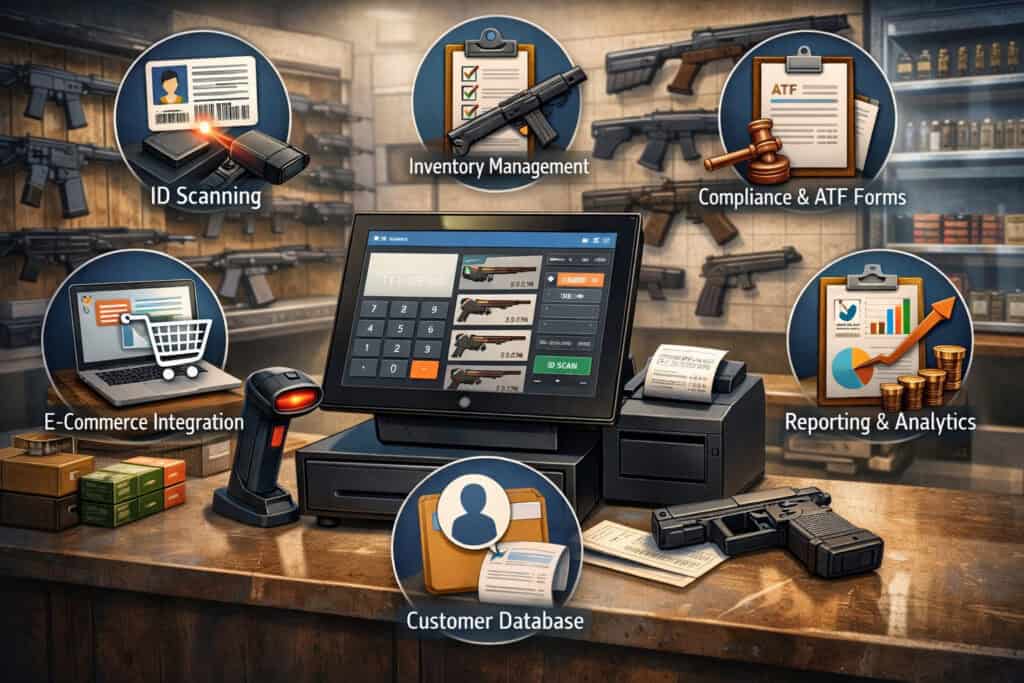
If you want to shortlist gun-friendly POS systems quickly, start by validating the features below. These aren’t “nice to haves.” They are the operational backbone of a modern FFL retail environment.
First, serialized inventory tracking must be native and consistent. Every firearm should be tracked by serial number throughout receiving, transfers, sales, and returns.
Systems marketed for gun stores frequently highlight serial-number tracking because it is foundational to compliance-grade inventory control. Without reliable serialization, you’ll eventually face mismatched records, phantom inventory, or time-consuming manual reconciliation.
Second, you need FFL transaction workflows: transfers, consignments, holds, layaways, and order deposits that match how firearm sales work in real life. Firearm transfers are not the same as selling a t-shirt.
A POS that can manage transfer intake, track the firearm as it enters inventory, and guide staff through disposition reduces friction and improves accuracy.
Third, evaluate the bound book and 4473 support. Some gun-friendly POS systems include built-in A&D and digital 4473 tools; others integrate with dedicated compliance software.
ATF has issued rulings and guidance around electronic recordkeeping and electronic storage of 4473s, including requirements for audit access and conditions for electronic retention. You don’t need your POS to do everything, but you do need the total system (POS + compliance tooling) to meet operational and inspection needs.
Fourth, confirm eCommerce and catalog connectivity if online sales matter. Many firearms retailers rely on distributor feeds, product catalogs, and online inventory visibility. Platforms like Gearfire market a unified retail management approach that ties in-store transactions, compliance automation, and broader commerce functionality.
The more your POS can unify store + web + inventory, the fewer mismatches you’ll have between “what the site says” and “what’s actually on the shelf.”
Finally, don’t ignore reporting and audit readiness. A serious gun store POS should help you answer questions like: “Which serial number was received on this date?” “Who touched this transaction?” “Where is the receiving discrepancy?” The best gun-friendly POS systems make those answers quick, not a scavenger hunt.
Orchid POS: All-in-One Gun-Friendly POS Built for FFLs
Orchid POS is positioned as a purpose-built, cloud-based gun-friendly POS system that combines retail operations and compliance tooling in a single platform. Its core value proposition is reducing risky integrations by keeping POS, bound book, and digital 4473 workflows under one roof.
Orchid markets integrated FFL bound book, 4473 workflows, and even direct NICS integration as part of its ecosystem, aiming to reduce the operational friction created by stitched-together systems.
From a day-to-day standpoint, the benefit of an all-in-one approach is consistency: the inventory object your cashier sells is the same object tracked for acquisition/disposition. That can reduce duplicate entry and eliminate the “POS says sold, bound book says still here” problem.
Orchid also emphasizes compliance guidance and automatic updates aligned with ATF form revisions and rulings—important because when forms and rulings update, manual processes often lag behind.
Orchid’s positioning also includes payments aligned with the firearms retail niche. In practice, “gun-friendly” often means the vendor and processor are comfortable supporting legal firearm sales without surprise policy changes that freeze processing.
Orchid explicitly includes firearms-friendly payments in its pricing and packaging language, which is a meaningful detail for store owners who have experienced sudden interruptions.
A notable recent development is Orchid’s launch of a lower-cost plan aimed at small gun stores, marketed as Orchid POS Spark. That matters because cost is often the blocker for first-time modernization, especially for smaller storefronts or low-volume FFLs.
If you’re looking for gun-friendly POS systems that minimize third-party complexity, Orchid is one of the clearest “single-vendor” paths.
Best fit scenarios for Orchid POS
Orchid is strongest when you want a unified stack and don’t want to coordinate multiple vendors for POS + compliance + storage + eCommerce.
If your store has been piecing together a generic POS, a spreadsheet inventory list, and a separate compliance tool, the all-in-one model can reduce training time and remove process gaps. It’s also a strong fit when you want your team living in one interface, with fewer “switch screens, re-enter data” steps.
This approach is especially attractive for multi-employee environments where turnover happens and consistent workflows matter. When the POS itself enforces required data capture, you’re less dependent on “tribal knowledge” and more dependent on system guardrails.
For gun-friendly POS systems, those guardrails often translate into fewer compliance mistakes and faster onboarding.
What to verify before you buy
Even with an all-in-one vendor, you should validate how the system handles edge cases: returns after paperwork started, canceled transactions, multiple firearms on one transaction, transfers that convert to sales, and inventory corrections. Ask how audit exports work and how your store can retrieve records quickly during an inspection.
Also validate how the platform supports your eCommerce goals—especially if you use distributor catalogs, want to synchronize inventory across channels, or need special handling for restricted items.
The “all-in-one” promise is only valuable if it actually covers your workflows. In the category of gun-friendly POS systems, the right match is the system that fits your day-to-day reality, not just the demo script.
Bravo Store Systems: Gun-Friendly POS with Integrated Compliance Workflows
Bravo Store Systems is widely marketed as a firearm-ready retail platform that combines point of sale, digital compliance tooling, and operational features in one system.
Bravo highlights integrated digital 4473 functionality, A&D book support, related forms (like 3310s), and eNICS support as part of its gun shop offering. For stores that want a unified operational and compliance workflow, Bravo is firmly in the “built for the job” category of gun-friendly POS systems.
A major advantage of Bravo’s positioning is that it treats compliance steps as part of the retail flow rather than a separate back-office function. When compliance is integrated, staff are less likely to “forget” steps, and managers have better visibility into where a transaction stands.
Bravo also actively publishes compliance-related materials, including references to digital storage questions tied to ATF Ruling 2022-1, which governs conditions for electronic storage of completed 4473s.
Bravo also stresses that it supports FFL operations beyond straightforward firearm sales, including transfers and the operational needs of stores that blend categories (pawn + firearms, or retail + firearms).
That matters because many firearm retailers are not “only” gun shops; they have hybrid business models that require a flexible POS that still respects serialized inventory requirements.
If your store is trying to reduce manual paperwork, reduce duplicate entry, and keep compliance data close to the transaction, Bravo is commonly shortlisted among gun-friendly POS systems for exactly that reason.
Best fit scenarios for Bravo
Bravo tends to be a strong fit for busy retail environments where multiple staff members touch a transaction, and managers need visibility into workflows. It’s also compelling for hybrid stores that want one platform for multiple business functions without sacrificing firearm-specific compliance tooling.
If you are scaling—more locations, more staff, more volume—integrated platforms often outperform “POS + separate compliance system + manual bridges,” simply because fewer moving pieces means fewer breakpoints.
In the gun-friendly POS systems landscape, that integration is often what separates “works on paper” from “works under pressure.”
What to verify before you buy
Ask detailed questions about data portability and exports. In an industry that requires long retention windows, you need confidence you can retrieve and present records reliably. Also ask how the platform handles exceptions: corrected forms, voids, and transactions that start but don’t complete.
ATF guidance and rulings emphasize conditions around electronic record retention and audit access. Your platform should support those practical needs cleanly.
Finally, validate how Bravo fits your ecosystem: ecommerce plans, distributor feeds, accounting integrations, and multi-location inventory. For gun-friendly POS systems, the “best” one is often the one that keeps your store consistent from receiving to reconciliation.
Gearfire AXIS: Retail Management + Compliance Automation for Firearms Retailers
Gearfire’s AXIS is marketed as a complete retail management system designed for firearms retailers, going beyond basic POS by tying together compliance automation, inventory, and broader operational features.
Gearfire describes AXIS as an RMS built to automate compliance, streamline in-store transactions, and support range management and distributor connectivity.
In other words, it targets the same core need that drives modern gun-friendly POS systems: unify the transaction, the inventory, and the compliance steps so they’re not scattered across tools.
For retailers that rely heavily on distributor catalog access and the ability to manage in-store and online inventory in a coordinated way, the “RMS” framing can be attractive. POS is only one layer of the operational stack.
The deeper value comes when the system standardizes how products enter your inventory, how they’re sold, and how the associated records flow through your business. In firearm retail, that standardization also reduces errors, especially when serials and dispositions are handled consistently.
AXIS also emphasizes scalability. As stores grow, the cost of manual checks grows too: more receiving, more transfers, more inventory movement, and more opportunities for a mistake. A system built around firearm workflows is meant to reduce those operational costs.
That’s one reason retailers consider AXIS among top gun-friendly POS systems when they plan to expand across locations or launch more complex sales channels.
Best fit scenarios for AXIS
AXIS can make sense when your store has operational complexity: multi-location inventory, distributor-driven purchasing, a range component, or an integrated sales ecosystem where customers interact across channels. If you’re trying to standardize processes across staff and locations, an RMS-style platform can reduce variability and training friction.
It can also be a fit for retailers who want their POS to be “part of the machine” rather than “the cash register.” Many gun-friendly POS systems ring up transactions; fewer aim to orchestrate inventory, compliance automation, and retail operations as a connected system.
What to verify before you buy
Verify exactly how compliance workflows are supported in practice. The details matter: how serial numbers are captured, how returns are handled, what reports are available, and how audit exports work. Also confirm integration pathways with your accounting, ecommerce, and distributor partners.
Finally, validate long-term data access and storage workflows. This isn’t optional in the firearms category. Federal rules and ATF guidance emphasize record retention and inspection access requirements for licensees. A platform can be powerful operationally, but it must be reliable in recordkeeping realities too.
Rapid Gun Systems / Rapid POS: Strong Gun Store + Range Support with Serialized Inventory
Rapid markets a comprehensive firearm retail and range POS built for compliance-driven workflows, including serial number tracking, bound book management, and 4473-related processes.
This is the category where gun-friendly POS systems are often judged on usability: can your staff execute a compliant transaction quickly, consistently, and without “POS gymnastics”?
Rapid emphasizes serial number tracking built into transactions, a point worth focusing on because serialization is where generic POS systems routinely fail.
If your store runs a range, classes, memberships, or rentals, the range and service management layer becomes as important as the firearm retail layer. Rapid explicitly targets those range-driven operational needs while still framing the platform as firearm-compliance oriented.
Another factor is integration with ecommerce platforms. Rapid’s materials reference connections to mainstream ecommerce systems (such as Magento, BigCommerce, and WooCommerce).
In practice, a gun store’s online strategy often relies on careful inventory visibility and product management across channels. The more your gun-friendly POS system can bridge that gap, the less time your team spends reconciling “online vs in-store” mismatches.
Rapid is often considered when a retailer wants one platform that supports retail + range + compliance workflows, without having to stitch a range management tool onto a separate POS.
Best fit scenarios for Rapid
Rapid can be a strong fit for stores where the range is a major revenue driver. When memberships, lane rentals, classes, and retail sales all happen in the same environment, a system that supports both sides reduces friction for staff and improves customer experience.
It’s also a good fit when you want a firearm-focused POS that highlights inventory discipline and compliance-driven transaction structure. Among gun-friendly POS systems, Rapid is positioned toward operators who want practical tools to run the entire storefront.
What to verify before you buy
Verify whether the compliance and recordkeeping features you need are native or rely on integrations. Also test real workflows: receiving a serialized firearm, transferring, placing holds, canceling or correcting transactions, and producing audit-ready reports.
Finally, confirm how the system handles multi-location inventory and how ecommerce updates flow. In a compliance-heavy environment, you don’t want “sync issues” becoming “record issues.” A gun-friendly POS system should reduce error surface area, not create new failure points.
Celerant Sportsman POS: Enterprise Retail System Positioned for Compliance-Driven Outdoor Retail
Celerant’s Sportsman POS is marketed as a retail system designed to help gun shops operate more efficiently across POS, ecommerce, and marketing, with messaging that includes compliance-oriented operations.
In the universe of gun-friendly POS systems, Celerant often comes up when operators want an “enterprise retail platform” feel—something that can power larger stores, complex catalogs, and multi-channel sales.
One reason retailers consider Celerant is the broader retail stack: POS + ecommerce + digital marketing functions under one brand umbrella.
Many firearm retailers are also selling apparel, optics, accessories, and outdoor goods, and they want robust retail features without sacrificing firearm workflow support. A POS built only for “gun transactions” may sometimes feel limited when the broader retail category mix becomes complex.
Celerant is also listed as a partner by compliance software providers like FastBound, which highlights a pattern you’ll see often: some stores choose a strong retail POS and then pair it with a dedicated compliance tool via integration.
FastBound describes its goal as connecting sales, inventory, ecommerce, and compliance, and lists Celerant as a partner solution. That “best of both worlds” approach—retail platform + compliance platform—can work well if integration quality is high and workflows are clean.
In short, Celerant can fit operators who want gun-friendly POS systems that behave like modern retail engines while still supporting firearm retail realities through compliance alignment and integrations.
Best fit scenarios for Celerant
Celerant tends to fit larger or growth-oriented retailers who care deeply about omnichannel retail: ecommerce, marketing workflows, promotional controls, and inventory visibility across categories.
If your store is a hybrid outdoor retailer where firearms are important but not the entire business, an enterprise-style POS can reduce compromise. In the gun-friendly POS systems category, that hybrid reality is common—and it’s a major driver of “we need more than just a gun shop register software.”
What to verify before you buy
Confirm the depth of firearm-specific workflows (serial capture, transfer handling, controlled dispositions) and how those workflows interact with the compliance solution you choose. If you’re relying on an integration partner for bound book/4473 workflows, validate how data flows and where staff actually works.
Also validate inspection readiness: exports, transaction logs, correction processes, and data access. Federal recordkeeping rules outline required A&D record practices. Your overall stack must make those obligations manageable, not burdensome.
MicroBiz + Compliance Integration: Affordable Gun-Friendly POS Strategy for Many Retailers
MicroBiz positions itself as a gun store and shooting sports POS that supports firearm retail needs like tight inventory tracking and customer capture for compliance entry, and it explicitly mentions integration with popular electronic bound book systems like FastBound.
For many stores, this “affordable POS + proven compliance integration” route is a practical way to get modern workflows without paying for a full all-in-one suite.
The reason this approach works is that firearm retail has two distinct layers:
- Retail operations (checkout, reporting, purchasing, inventory, promotions)
- Compliance recordkeeping (A&D, 4473, transfer documentation, inspection readiness)
Some gun-friendly POS systems combine both layers natively. Others do layer 1 very well and integrate into a dedicated compliance platform for layer 2. FastBound, for example, emphasizes POS integrations across many systems so dealers can streamline A&D and 4473-related processes through connected workflows.
MicroBiz is relevant in this model because it markets firearm-aware inventory control and reporting while acknowledging that compliance tools may be a separate system.
If your operation doesn’t need a single-vendor stack, this can be a balanced way to modernize: your staff uses MicroBiz for daily retail, while compliance flows into your bound book/4473 system reliably.
This combination can be attractive for lower-volume stores, new retailers, or operators who want to modernize in phases—starting with the POS, then tightening compliance workflows through integration.
Best fit scenarios for MicroBiz + integration
This approach can work well for smaller shops that want affordability and flexibility. It’s also a fit for retailers who already trust a compliance platform and don’t want to switch compliance vendors just to get a POS upgrade.
Among gun-friendly POS systems, this is the “modular strategy.” It can be the most practical path when you want control over each component of your stack and you’re willing to validate integrations carefully.
What to verify before you buy
Integration quality is everything. Ask whether inventory entries sync in real time, how serial numbers are handled, and what happens when a transaction is voided or corrected. Confirm whether transfers and dispositions flow cleanly into the compliance system, and whether staff can complete tasks without duplicating steps.
Also confirm your record retention plan. ATF guidance addresses retention of Form 4473 and the ability to store electronically under specific conditions. Your POS and compliance system together should support retrieval, export, and audit access smoothly.
Windward and “Industry-Configured” Retail POS: When You Want a Full Store System with Firearm Features
Windward markets a “Gun Shop” business configuration that includes POS, inventory, serial number tracking, bound book support, gunsmithing workflows, customer relationships, and accounting back office capabilities.
This is a different path within gun-friendly POS systems: rather than starting with a firearms-only vendor, you choose a broad retail platform that has firearm-ready modules or configurations.
The appeal here is scope. Some stores want a single system that handles not only checkout and compliance workflows, but also deeper back-office operations—accounting, purchasing, service work orders, and customer account history. When the system is designed to cover the entire business process, fewer things fall through the cracks.
For shops that do gunsmithing, service tickets and work orders are not optional. A POS that tracks a service intake, parts usage, labor, and final disposition with customer history can improve both customer experience and internal accountability.
In the firearms industry, that also intersects with strict inventory discipline. The more your gun-friendly POS system can keep service workflows connected to inventory and serialized items, the less chaos you’ll have in the back room.
This category can also be a good fit when your store sells large volumes of non-firearm inventory (apparel, outdoors, tools) and still needs firearm-specific handling. It’s a “whole store first” mindset that still respects firearm workflows.
Best fit scenarios for Windward-style systems
This works when you want a broad business system and you value back-office coverage as much as firearm transaction handling. It can also fit retailers who have long-established processes and want software that adapts to them, rather than changing everything to match a firearms-only platform’s workflow.
In the gun-friendly POS systems landscape, this is the “configured enterprise” approach: not purely firearms-exclusive, but strong when configured correctly.
What to verify before you buy
Validate firearm-specific workflows in detail: serial capture, transfers, controlled dispositions, inventory corrections, and audit export. The phrase “gun shop software” can mean many things, so you want to test your real workflows, not generic demos.
Also confirm whether bound book and 4473 features are native, supported via integrations, or require additional modules. And confirm how updates are delivered when forms or regulatory expectations shift. For compliance-heavy operations, ongoing vendor responsiveness matters.
Compliance and Recordkeeping: How Your POS Should Support Federal Requirements

Even the best gun-friendly POS systems don’t replace your responsibility as an FFL. But the right system can make compliance practical and repeatable.
At a baseline, licensees are required to maintain records of receipt and disposition, with the core dealer recordkeeping requirements defined in the CFR. That means your operations must be able to show what came in, what went out, and when—accurately.
Many modern systems support electronic recordkeeping pathways that align with ATF rulings authorizing electronic methods under specific conditions. ATF Ruling 2016-1 (and related rulings) addresses requirements for keeping firearms records electronically.
More recently, ATF Ruling 2022-1 addresses electronic storage of Forms 4473 under defined conditions, including audit access. These rulings matter because they shape what “paperless” can legally mean in practice. Your POS should support compliance by enforcing structured data capture.
For example, serialized inventory must be handled consistently and tied to transactions. POS platforms aimed at firearm retailers frequently highlight serial tracking and compliance-aware workflows as core features, precisely because generic retail systems often treat serials as optional metadata.
Also, keep in mind that ATF’s regulatory updates can affect how items are defined and marked in records. The “frame or receiver” final rule (2021R-05F) changed definitions and recordkeeping expectations for certain items and configurations, emphasizing traceability and proper recordkeeping.
Your store’s system should be able to adapt to such shifts—especially if you handle a wide range of firearm-related products.
A good way to evaluate gun-friendly POS systems is to ask: “Does the system reduce compliance risk day-to-day?” If it helps prevent missing serials, flags incomplete workflows, and supports quick retrieval of records, it’s doing its job. If it pushes compliance into staff memory and manual checklists, it’s not.
How to Choose the Right Gun-Friendly POS System for Your Store
Selecting among gun-friendly POS systems should be a process, not a guess. Start with a mapping exercise: write down your transaction types (standard firearm sales, transfers, consignments, gunsmithing, range memberships, layaway, ecommerce fulfillment) and your operational needs (multi-location inventory, purchasing, distributor catalogs, employee permissions, reporting). Then evaluate platforms based on workflow fit.
Next, decide whether you want:
- All-in-one (POS + bound book + 4473 + storage in one platform)
- Best-of-breed (retail POS + dedicated compliance tool via integration)
All-in-one options like Orchid and Bravo emphasize unified stacks that reduce integration risk. Integration-first models—like using a POS with FastBound connectivity—can work well if integration quality is proven and the staff experience is smooth.
Then, pressure-test demos. Don’t demo “ringing up an accessory.” Demo what stresses your store:
- Receive a serialized firearm into inventory
- Initiate a transfer workflow
- Hold inventory pending paperwork completion
- Correct a mistake cleanly
- Run an audit report quickly
- Reconcile inventory against what’s physically on-hand
Also ask vendors directly about inspection support: exports, retrieval speed, logging, and long-term access. ATF emphasizes inspection accessibility and retention obligations for key records like Form 4473. Your vendor doesn’t have to be your legal advisor, but your system must not trap you.
Finally, confirm your payment strategy. A “gun-friendly POS system” that works operationally but can’t support stable processing is not a complete solution. Many retailers prioritize vendors that openly support lawful firearm commerce, reducing the chance of sudden disruptions.
Future Predictions: Where Gun-Friendly POS Systems Are Headed Next
The next wave of gun-friendly POS systems is moving toward deeper automation, fewer disconnected tools, and stronger audit-readiness by default. The trend is clear in how vendors present their platforms: integrated compliance workflows, unified ecommerce + inventory, and digital storage aligned with ATF rulings.
Expect more emphasis on real-time validation and guardrails. Instead of relying on employee memory, systems will increasingly prevent incomplete steps—especially around serialized inventory and required record fields.
This isn’t just a convenience feature. It’s a business risk feature. Better software guardrails reduce costly mistakes and reduce training time when staff changes.
Also expect continued growth in cloud-first compliance storage. ATF has addressed electronic storage of Forms 4473 under specific conditions, and vendors are building offerings that align to those conditions.
As more stores embrace paperless operations, the competitive advantage will shift toward platforms that make retrieval, export, and inspection support painless.
On the retail side, expect stronger distributor connectivity and pricing automation. Many firearm retailers rely on distributor feeds and catalogs, and platforms like Gearfire emphasize ecosystem connectivity as a core advantage. The systems that help stores replenish inventory intelligently, reduce stockouts, and control margins will keep winning.
Finally, anticipate ongoing regulatory-driven change. ATF’s frame/receiver rule highlights how definitions and recordkeeping expectations can shift, impacting how items are categorized and recorded.
The “future-proof” gun-friendly POS systems will be the ones that update quickly, communicate changes clearly, and reduce the burden on store owners to interpret every operational impact alone.
FAQs
Q.1: What makes a POS “gun-friendly” for FFL transactions?
Answer: A POS becomes “gun-friendly” when it supports firearm retail workflows instead of forcing you into generic retail patterns. That includes serialized inventory tracking, transfer workflows, customer identity capture tied to transactions, and compatibility with compliance recordkeeping.
Many gun-friendly POS systems also include or integrate with A&D (bound book) and 4473 workflows to reduce duplicate entry and mistakes.
From a compliance standpoint, FFLs must maintain acquisition and disposition records and be able to present them during inspections, as outlined in federal regulations. Your POS doesn’t have to be your compliance record system, but it should support compliance by ensuring inventory and transactions are structured correctly and consistently.
In practice, “gun-friendly” also includes vendor willingness to serve the industry consistently. Retailers often prioritize platforms that openly support lawful firearms commerce, reducing the risk of sudden policy-driven service interruptions.
Q.2: Do gun-friendly POS systems run NICS checks or replace compliance responsibility?
Answer: In most cases, the POS supports workflow and recordkeeping but does not replace legal responsibilities. Some specialized platforms market direct integrations or eNICS-related workflow support, but the core principle remains: the FFL is responsible for compliance and correct execution of required steps.
Platforms like Orchid and Bravo market integrated workflows involving 4473 and NICS-related features as part of their firearm-focused approach.
Separately, ATF rulings address electronic recordkeeping and electronic storage of 4473s, but they also include conditions that must be met—especially for audit access and retention. So even if your system supports electronic workflows, your store must ensure policies, access controls, and procedures align with requirements.
Think of gun-friendly POS systems as risk-reduction tools: they can reduce mistakes and streamline execution, but they don’t absolve responsibility.
Q.3: Is an all-in-one POS better than a POS integrated with a bound book system?
Answer: It depends on your store’s complexity and preferences. All-in-one gun-friendly POS systems (like those that combine POS + bound book + 4473 tools) can reduce integration risk and improve staff usability because everything lives in one interface. That can be valuable for training and consistency.
However, integration-first stacks can work well if you already trust a compliance platform and want a retail POS that fits your broader category mix. FastBound, for example, emphasizes POS integrations so stores can connect retail operations with compliance tooling.
The real decision point is workflow smoothness. If staff must enter serial numbers twice, reconcile mismatched item IDs, or manually correct “sync lag,” integrations may create more work. If the integration is clean and stable, a best-of-breed stack can be flexible and cost-effective.
Q.4: What record retention and digital storage rules should POS buyers care about?
Answer: Any POS buyer in this category should understand record retention and electronic storage expectations because your software choice influences your ability to comply. ATF guidance explains that licensees must retain Form 4473 until they discontinue licensed activity and references CFR requirements for record retention.
For digital storage, ATF Ruling 2022-1 addresses conditions under which electronic storage of completed Forms 4473 is authorized, including requirements related to audit access and how records are maintained.
This is why gun-friendly POS systems that include storage and compliance features must be evaluated beyond marketing. Ask about exports, audit mode, access logs, and how quickly records can be produced on request.
Q.5: Can a generic retail POS be made “gun-friendly” with the right processor?
Answer: A processor alone cannot make a POS truly gun-friendly. Payments may be “firearm-friendly,” but you still need serialized inventory workflows, transfer handling, and compliance-aware processes.
A generic retail POS might ring up transactions, but it often lacks guardrails and structure for firearm-specific operations, which creates manual work and potential errors.
That said, some stores do pair a general retail POS with a dedicated compliance system via integration. This can work if the POS supports strong inventory controls and the integration is reliable.
The success of this approach depends on how well serial numbers, receiving, and dispositions flow through the system without duplication or gaps.
For most retailers who want fewer moving parts, purpose-built gun-friendly POS systems are often the safer long-term path.
Conclusion
The best gun-friendly POS systems are not just registers. They are operational control centers that help firearm retailers run fast, stay organized, and reduce compliance risk through consistent workflows.
Whether you choose an all-in-one platform like Orchid or Bravo, a retail management ecosystem like Gearfire AXIS, a range-focused solution like Rapid, or an integration-first approach with tools like FastBound, your goal is the same: fewer errors, fewer disconnected systems, and better visibility from receiving to disposition.
As you shortlist options, keep your selection grounded in real workflows: serialized inventory, transfers, compliance documentation, and audit-readiness. Federal rules and ATF guidance on recordkeeping and electronic storage shape what your system must support, especially over long retention windows.
Looking ahead, gun-friendly POS systems will keep moving toward deeper automation, tighter compliance guardrails, and unified commerce experiences.
The stores that win will be the ones that choose software built for their reality—then train, document, and standardize around it. When your POS fits the way FFL transactions actually happen, your team moves faster, your records stay cleaner, and your business becomes easier to scale.
Leave a Reply