By gunfriendlypayments January 30, 2026
Digital wallets have become one of the fastest, most convenient ways for customers to pay—online and in-store. But if you sell firearms, ammo, or regulated parts, “turning on Apple Pay” is not as simple as it sounds.
The firearms category is commonly treated as high-risk by acquiring banks, payment facilitators, and many consumer wallet or P2P apps. That creates two big realities:
- You can absolutely accept digital wallet payments for firearms—but usually through a proper merchant account + gateway that supports your product category.
- You should not rely on person-to-person apps (and many mainstream “easy button” processors) because prohibited-use rules can lead to frozen funds or account termination.
This guide explains, step-by-step, how to accept digital wallet payments for firearms safely, keep approvals stable, reduce chargebacks, and build a checkout experience that converts—without triggering compliance shutdowns.
What “Digital Wallet Payments for Firearms” Really Means

When most merchants say “digital wallet,” they usually mean card-based wallets such as Apple Pay, Google Pay, or Samsung Wallet—where a customer pays using a card credential stored in a phone, browser, or wearable.
In most cases, these transactions still ride the card networks (card present via NFC in-store or card-not-present online), but they use tokenization and device authentication (Face ID, fingerprint, passcode) that can reduce fraud.
A second group—often confused with wallets—includes P2P money transfer apps (like “send money to a friend”). These frequently have their own rules that restrict firearms-related purchases, and they are not designed for regulated commerce, customer disputes, or business-grade risk controls.
For firearms sellers, the safest path is usually card-based digital wallet acceptance through a firearms-friendly processing setup:
- In-store wallet acceptance: NFC tap-to-pay (phone/watch) through an EMV-enabled terminal
- Online wallet acceptance: Apple Pay / Google Pay buttons via a compatible gateway and merchant account
- Invoice / pay-by-link wallets: Digital wallet checkout links that still route through compliant card rails
The goal is to provide modern checkout options while staying aligned with risk, underwriting, and regulatory expectations for firearms commerce—especially around age, jurisdiction, and documentation.
Why Many Popular Wallet-Like Options Don’t Work for Firearms
A common mistake is trying to accept “quick wallet payments” using consumer platforms or all-in-one aggregators that are not built for high-risk categories. Firearms merchants run into problems because many providers prohibit firearms-related transactions in their acceptable use rules.
For example, PayPal’s acceptable use policy explicitly restricts transactions involving ammunition, firearms, and certain parts/accessories.
Google’s payments policies list firearms and ammunition as examples of restricted content.
Square’s payment terms also list firearms, firearm parts/hardware, and ammunition among prohibited sales categories.
Even when a platform doesn’t loudly advertise “no firearms,” its risk team may still interpret your activity as prohibited, especially if your website content, product metadata, shipping policies, or descriptors suggest regulated items. That can lead to:
- sudden shutdowns and withheld funds
- chargeback vulnerability (no firearms-tailored evidence flow)
- inability to pass underwriting for stable limits
- operational chaos during peak sales periods
This is why a firearms merchant usually needs a purpose-fit acquiring relationship (or a high-risk program) that supports firearms, plus a gateway that can present Apple Pay/Google Pay in a compliant way.
The Compliance Foundation: What You Must Have Before You Enable Digital Wallet Checkout

To accept digital wallet payments for firearms reliably, you need your operational compliance in place first. Wallet buttons increase conversion, but they also increase scrutiny because faster checkout means less friction—and regulators, networks, and banks expect you to control risk elsewhere.
Build your foundation around these essentials:
1) Clear product classification: Be explicit about what you sell: complete firearms, ammo, magazines, accessories, optics, safes, apparel, training, etc. Underwriting depends on accurate classification and correct merchant category coding and descriptors. Misclassification can cause forced closure later.
2) Customer eligibility checks: Have a documented process to prevent sales to restricted buyers and destinations. This includes age gating where relevant, address validation, and jurisdiction logic for items with shipping restrictions.
3) Documentable transfer workflow: If your model involves regulated transfers, ensure your site and policies clearly describe how orders are fulfilled (e.g., shipment to a licensed transfer location) and what documentation is required before release.
4) Transparent policies: Post strong shipping, returns, cancellations, and refund timelines. Wallet buyers expect clarity, and disputes often hinge on whether policies were visible at purchase.
5) Data security and PCI alignment: Digital wallets reduce exposure by using tokenization, but you still need secure handling for the rest of your environment (website, plugins, staff access, logs). A stable processing relationship depends on security maturity.
This foundation isn’t “extra paperwork.” It’s what allows your processor to approve you for digital wallet payments for firearms without fearing surprise risk.
The Right Setup: Merchant Account + Gateway That Supports Firearms and Digital Wallets
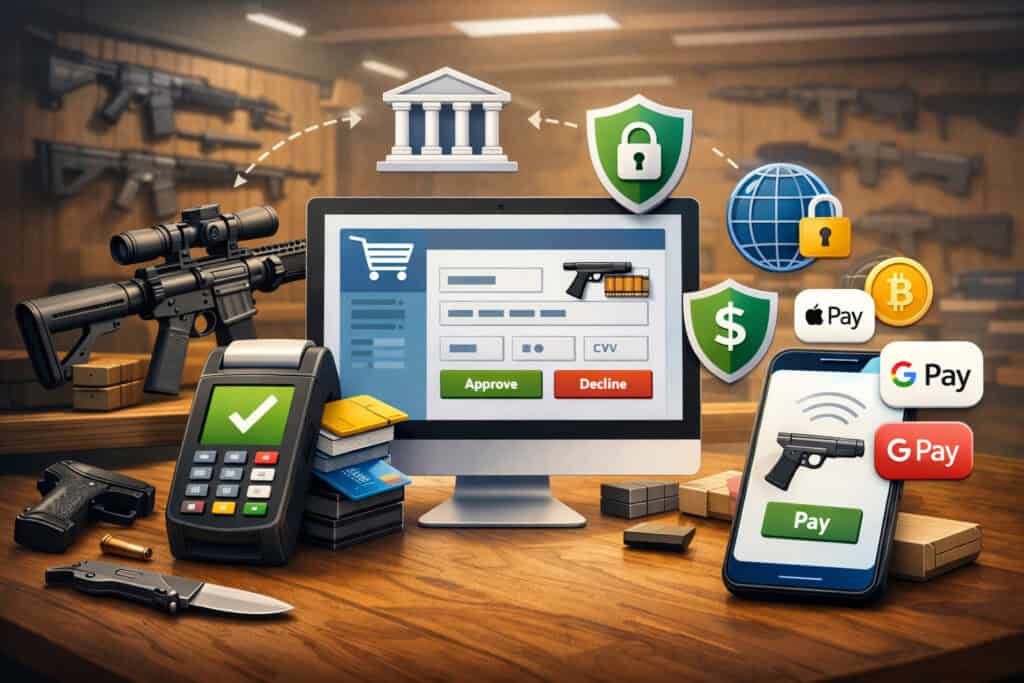
If you want to accept Apple Pay and Google Pay for firearms, think in terms of three layers:
- Merchant account (acquiring): The bank relationship that settles funds to you
- Payment gateway: The technology layer that routes transactions, manages tokens, and connects checkout to your acquirer
- Front-end integration: Your website, shopping cart, POS, or invoicing tool
For firearms sellers, the merchant account is the make-or-break layer. Many “instant approval” services operate as payment facilitators, and their prohibited categories can override your intent, even if your sales are lawful.
A firearms-supportive underwriting path reduces surprise shutdowns because your account was approved with your category fully disclosed.
Then comes the gateway: to enable wallet buttons, your gateway must support wallet token flows and domain verification (especially for Apple Pay on the web). Apple’s web Apple Pay guidelines require you to implement Apple Pay properly and follow their requirements for offering Apple Pay consistently where other third-party methods exist.
A strong firearms-ready stack typically supports:
- Apple Pay / Google Pay online and in-app
- NFC wallet acceptance in-store
- AVS/CVV rules, fraud scoring, velocity checks
- 3D Secure where appropriate for card-not-present risk
- granular descriptors and evidence packages for disputes
This combination is what turns “we want digital wallets” into “we can accept digital wallet payments for firearms year-round without random freezes.”
In-Store: Accepting Tap-to-Pay Wallet Transactions the Safe Way
In-store is often the easiest place to start with digital wallet payments for firearms, because NFC tap-to-pay transactions behave like modern EMV card-present sales. Apple Pay and similar wallets use device authentication and tokenization, which can lower counterfeit fraud compared to magstripe-style risk.
Here’s how to set it up correctly:
- Choose the right terminal: Use an EMV-capable terminal with NFC enabled. Look for support for contactless, chip, and fallback controls. Your processor should provision it to your approved firearms merchant account—not a generic “starter” account.
- Configure receipts and descriptors: Cardholders often recognize wallet transactions by the receipt descriptor. Make sure your business name and support contact are clear to reduce friendly fraud disputes.
- Train staff on compliance flow: Digital wallet checkout is fast, so staff training matters more—especially for age checks, local policy, and handling declined taps. Have a script for “try chip” vs “try another card,” and rules for when to request alternative payment.
- Use the right refund and cancellation flow: Wallet refunds usually go back to the original tokenized credential. A clean, prompt refund process reduces disputes and protects your processing standing.
- Know what wallet security changes: Wallet payments can reduce certain fraud types, but they don’t eliminate disputes. A buyer can still claim “item not received,” “not as described,” or “unauthorized.” Your job is to maintain proof of fulfillment and policy acceptance—especially if you sell accessories alongside regulated items.
When done right, in-store wallets become a low-friction way to accept digital wallet payments for firearms while keeping risk manageable.
Online: Enabling Apple Pay and Google Pay for Firearms Without Triggering Shutdowns
Online acceptance is where most firearms merchants struggle, because underwriting teams and automated scanners review your website content, SKU details, and policies. You can enable wallet buttons safely, but it must be done through a compliant path.
Key steps:
Build a firearms-clear checkout architecture
Use a cart and gateway that can pass item metadata cleanly and present wallet buttons only on eligible pages. Keep your policies visible at checkout, not buried.
Use domain verification and secure hosting
Apple Pay on the web requires domain verification and proper implementation. Your gateway or processor typically guides this. Follow Apple’s official implementation guidelines to avoid integration issues and failed wallet eligibility checks.
Apply strong fraud controls without wrecking conversion
Wallet buttons can increase conversion, but you still need layered controls:
- velocity limits (attempts per IP, device, email)
- address checks and shipping restriction logic
- risk scoring rules for high-value orders
- step-up verification for suspicious patterns
Use 3D Secure strategically
3D Secure can shift certain fraud liability and can be useful for high-risk card-not-present categories. The tradeoff is added friction on some transactions. Use it as a targeted tool, not a blanket hammer.
Maintain a clean “evidence trail”
For chargebacks, you want: policy acceptance proof, confirmation email, shipping status, delivery confirmation, and customer support logs. Even if a transaction was tokenized via a wallet, disputes still require documentation.
This is the practical reality: you can accept digital wallet payments for firearms online, but it must be paired with underwriting transparency and a risk stack designed for your category.
Why “P2P Wallet Payments” Are a Bad Idea for Firearms Businesses
Many merchants ask if they can accept payments through P2P apps because customers request it. The problem is that P2P systems are usually meant for personal transfers, not regulated commerce.
Several platforms’ policies restrict firearms-related usage, and marketplaces often explicitly ban using them for firearm transactions because it violates terms. For example, PayPal’s restrictions include firearms and ammunition.
Even if a transaction “works” today, the risk is operational:
- funds can be frozen during review
- your account can be permanently limited
- your customers have weak purchase protections and you have weak seller protections
- you lose professional dispute tooling and structured payment records
From a business standpoint, a P2P workaround is not a strategy. If you want fast checkout, the better answer is to expand legitimate acceptance methods: card-based wallets online, NFC in-store, invoices, and possibly ACH-based options where appropriate—through business-compliant tools.
If your goal is stable, scalable digital wallet payments for firearms, avoid P2P improvisation.
Chargebacks, Fraud, and Disputes: Protecting Digital Wallet Payments for Firearms
Digital wallets can reduce some fraud types, but firearms merchants still face elevated dispute scrutiny due to category risk and shipping/transfer complexity. The way you sell matters as much as what you sell.
Here’s how to protect yourself:
Set expectations early
Disputes often start with misunderstanding. Use clear checkout messaging about:
- fulfillment timeline
- transfer steps (if applicable)
- cancellation windows
- restocking or return limitations for certain products
Use layered verification
Wallet device authentication is helpful, but it’s not the whole story. Pair wallets with:
- address validation rules
- phone/email verification for high-value carts
- suspicious order review queues
- repeat buyer recognition and allowlists
Keep proof of fulfillment tight
Your evidence should be easy to understand, timestamped, and consistent. Store:
- invoice and confirmation email
- tracking and delivery confirmation
- support ticket history
- policy acceptance logs
Optimize descriptors and support response times
Many “friendly fraud” chargebacks happen because the buyer doesn’t recognize the descriptor or can’t reach the merchant. Make it easy to contact you and respond quickly to confusion.
Track dispute ratios and fix root causes
High dispute ratios can lead to monitoring programs, reserve increases, or termination. Use analytics to isolate spikes by SKU type, shipping region, marketing channel, or fraud pattern.
A professional risk posture is what keeps digital wallet payments for firearms stable long-term—because it signals to banks and processors that you run a controlled operation.
Website and Checkout Optimization for Higher Conversion and Lower Risk
Search engines and processors both “read” your website in different ways. For ranking and for underwriting stability, you want a site that is clear, structured, and trustworthy.
Focus on:
- Product page clarity: Use detailed descriptions and compliant terminology. Clearly indicate what is and is not included. Add compatibility notes for accessories. Avoid vague language that increases returns.
- Shipping restriction logic: If certain items cannot ship to certain locations, enforce it at checkout. Don’t rely on “we’ll email you later.” That triggers disputes.
- Age and eligibility gating: Use appropriate gating tools where relevant. Do not create “fake friction,” but do show that you take eligibility seriously.
- Policy UX: Keep policies readable, with short paragraphs and scannable formatting. Make sure the buyer sees key policy terms before paying.
- Wallet button placement: Place Apple Pay/Google Pay buttons on cart and checkout pages (and optionally product pages) only if you can keep the experience consistent and compliant. Apple’s web guidelines emphasize correct implementation and presentation expectations for Apple Pay.
A well-structured site improves both SEO and payment stability. That combination is essential if you want to grow digital wallet payments for firearms without constant processor headaches.
Common Mistakes That Get Firearms Merchants Flagged
A firearms merchant can do everything “legally” and still get shut down by a payment provider if the provider’s rules, onboarding, or risk signals are tripped. The most common mistakes include:
- Using a prohibited platform “until it breaks”: PayPal and Square both publish restrictions involving firearms/ammunition in their policies/terms. Using them anyway creates sudden failure risk.
- Hiding the category during underwriting: If you try to appear as “sporting goods” while selling regulated products, your account is more likely to be terminated later when risk review discovers the mismatch.
- Poor website transparency: Missing contact info, unclear shipping steps, vague policies, or hidden fees all raise risk. Risk teams often evaluate legitimacy by how clearly the business explains fulfillment and customer support.
- Weak operational controls: No documented process for restricted destinations, no consistent proof of delivery, or slow support response times can push dispute rates up—leading to reserves or termination.
- Overreliance on a single payment rail: If all revenue depends on one fragile method, one disruption can halt operations. A resilient setup includes card-based wallets, chip/tap in-store, invoices, and a backup plan.
Avoiding these mistakes is the difference between “we tried wallets” and “we sustainably accept digital wallet payments for firearms.”
The Future of Digital Wallet Payments for Firearms: What to Expect Next
The next few years will likely bring changes that affect how firearms merchants accept digital wallet payments—mostly driven by tokenization, identity signals, and alternative rails.
More tokenization and network-level identity signals
Card networks and wallet ecosystems continue to invest in tokenization and risk signals that can reduce fraud. That’s good for merchants, but it also increases surveillance of prohibited categories—so transparency and correct underwriting will matter even more.
Greater use of bank-to-bank instant payments for certain use cases
Instant bank transfer systems and “pay by bank” options are expanding. Firearms merchants may increasingly use bank transfer rails for deposits, training, memberships, or certain accessory purchases—especially when card acceptance is volatile. The challenge will be building consumer-friendly UX and managing refunds cleanly.
Processor specialization will continue
High-risk categories are unlikely to become “plug-and-play” overnight. Instead, expect more specialized processors and gateways tailored for regulated commerce, with better tools for documentation, restricted shipping logic, and dispute packages.
Policy shifts can happen quickly
Industry rules are not static. For example, Stripe publicly indicates it may support some restricted businesses with explicit prior approval, and industry reporting noted a shift of firearms-related businesses from prohibited to restricted with additional review steps. Even when this is positive, it reinforces the need for documented compliance and transparent onboarding.
The practical prediction: firearms merchants who invest now in compliant merchant accounts, modern gateways, and strong operational controls will have the easiest time expanding digital wallet payments for firearms as wallet ecosystems evolve.
FAQs
Q.1: Can I use PayPal to accept digital wallet payments for firearms?
Answer: For firearms and ammunition sales, PayPal is commonly not a safe choice because its acceptable use policy restricts transactions involving firearms, ammunition, and certain parts/accessories.
Even if a payment appears to go through, policy enforcement can happen after the fact—during a review triggered by a dispute, keyword detection, buyer notes, or a website scan.
If your business depends on consistent cash flow, the risk isn’t just “will the payment work today,” but “will funds settle reliably and remain available.” A sudden limitation can freeze funds and disrupt operations at the worst possible time.
If you want wallet-like speed, the safer approach is to accept Apple Pay/Google Pay through a firearms-friendly merchant account and gateway that explicitly supports your category. That way, your underwriting is aligned upfront, and you’re building on a stable foundation for digital wallet payments for firearms rather than hoping a prohibited platform doesn’t notice.
Q.2: Does Google Pay allow firearms transactions?
Answer: Google’s payments policies list firearms and ammunition among examples of restricted items/content. That matters because “Google Pay” can refer to different contexts: consumer transfers, merchant checkout, and payments functionality inside wallet experiences.
In practice, firearms merchants should assume that attempting to process regulated firearm sales through a platform that flags firearms as restricted can create enforcement risk.
What usually works better is using Google Pay as a card-based wallet button via a gateway that supports your firearms-appropriate merchant account—where the acquiring bank relationship is designed for regulated commerce.
In other words, don’t treat Google Pay like a standalone permission slip. Treat it as a wallet interface layered on top of a compliant payments stack.
If your goal is stable digital wallet payments for firearms, always start with “Is my merchant account approved for my category?” and then add wallet buttons through that approved channel.
Q.3: Is Square a good option for accepting digital wallet payments for firearms in-store?
Answer: Square’s published payment terms list firearms, firearm parts/hardware, and ammunition among prohibited sales categories. That means Square is generally not considered a stable choice for firearms merchants, even if you like the simplicity of its hardware and POS experience.
If you want tap-to-pay wallets in-store, the better path is an EMV/NFC terminal provisioned under a firearms-supportive merchant account. You can still deliver the same customer experience—tap with a phone or watch—without building your business on a provider whose terms prohibit your category.
In-store wallet acceptance is one of the best ways to expand digital wallet payments for firearms because the risk profile often resembles modern card-present EMV. The key is matching the hardware to an acquiring relationship that actually supports your product category.
Q.4: Can firearms merchants use Stripe for digital wallet payments?
Answer: Stripe states that it may be able to support some businesses on its prohibited and restricted list with explicit prior approval, depending on review outcomes. Additionally, industry reporting indicated Stripe moved firearms and related businesses from prohibited to restricted, implying possible support with extra review and paperwork.
The important takeaway is that “maybe” is not the same as “approved.” If you pursue Stripe, do it transparently: disclose your exact products, fulfillment method, and compliance controls, and get written confirmation of approval for your specific use case.
Don’t assume that because Stripe supports wallet buttons, it will automatically support digital wallet payments for firearms.
For many firearms sellers, a dedicated high-risk or firearms-specialized merchant account and gateway remains the more predictable option—especially for long-term stability, higher ticket sizes, and fewer surprise policy swings.
Q.5: What is the safest way to accept digital wallet payments for firearms online?
Answer: The safest approach is a compliant, end-to-end setup:
- Get a merchant account approved for firearms (no misclassification)
- Use a gateway that supports Apple Pay / Google Pay on top of that account
- Implement strong website policies and restricted shipping logic
- Add fraud controls and maintain chargeback-ready evidence
This structure reduces the chance of sudden account closure because your processing partner already knows what you sell and how you fulfill orders. It also improves your ability to fight disputes, because your checkout and documentation are designed for regulated commerce.
If you’re trying to rank and convert, remember: the winning formula is trust + clarity + speed. Digital wallets deliver speed, but you must supply trust and clarity—especially in regulated product categories. That’s how you build durable digital wallet payments for firearms instead of short-lived workarounds.
Conclusion
Accepting digital wallet payments for firearms is absolutely achievable—and it can dramatically improve conversion, especially on mobile. The path that works long-term is not a loophole or a consumer P2P shortcut. It’s a professional payments stack built around:
- a firearms-supportive merchant account
- a gateway that enables Apple Pay / Google Pay correctly
- secure, transparent checkout and fulfillment policies
- strong fraud and chargeback controls
Many mainstream consumer payment platforms publish restrictions involving firearms, ammunition, or parts, and that policy risk can be just as dangerous as fraud risk. The merchants who win are the ones who disclose their category upfront, implement compliance clearly, and create a checkout flow that balances speed with control.
Leave a Reply