
By gunfriendlypayments March 12, 2026
Selling firearms and related products comes with more scrutiny than many other retail categories. That affects everything from underwriting and fraud controls to checkout design and long-term account stability.
If you want to Set Up a Secure Firearms Merchant Account, you need more than a basic payment application. You need a setup that protects customer data, supports your sales model, and gives processors confidence that your business is legitimate, well-managed, and prepared for risk.
That is why firearms payment processing is often treated differently from standard retail processing. Many traditional providers do not fully understand the operational realities of gun stores, FFL businesses, special orders, compliance checks, and mixed in-store and online sales.
A firearms business may need stronger fraud filters, more detailed underwriting, better chargeback procedures, and a payment partner that is comfortable supporting the industry over time.
The good news is that a secure and reliable setup is possible. Whether you run a storefront, accept phone orders, process online accessories sales, or manage special orders, the right structure can help you reduce payment risk and improve approval odds.
A strong setup also creates a better customer experience by making checkout smoother, faster, and more trustworthy.
This guide explains how to set up a secure firearms merchant account online and in-store, what documents you will need, how underwriting works, what security tools matter most, and how to choose a provider that actually fits your business.
It is written for both new and established dealers who want dependable, secure transaction processing without unnecessary surprises.
What It Means to Set Up a Secure Firearms Merchant Account
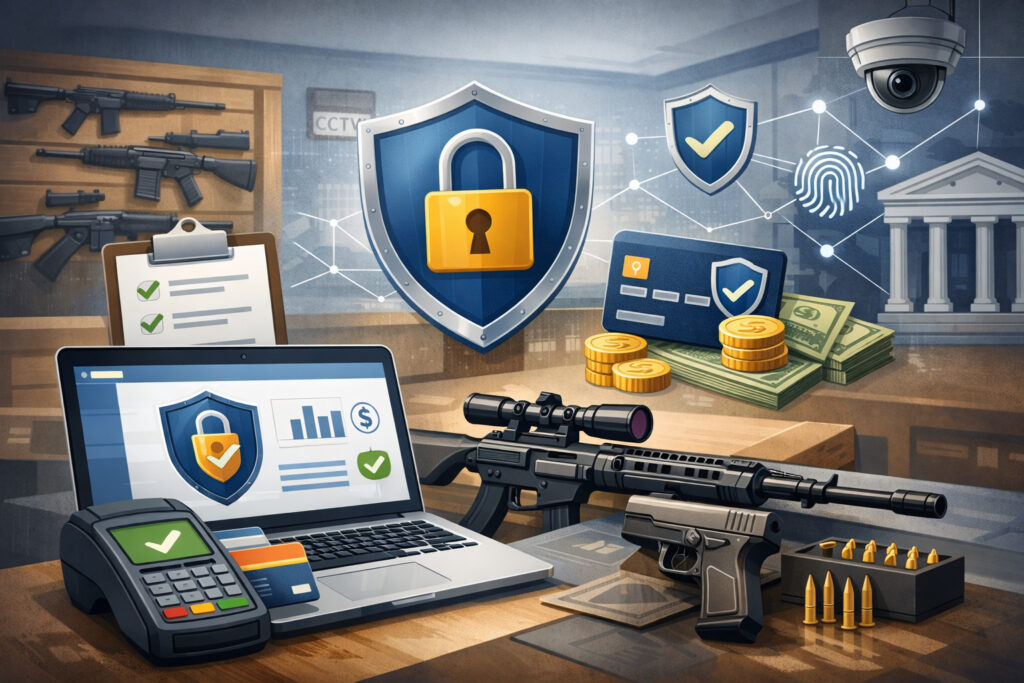
When people talk about opening a merchant account, they often think it is just a way to accept cards. In reality, a merchant account is part of a larger payment ecosystem.
It connects your business, your payment processor, card networks, acquiring partners, and fraud and compliance systems. In the firearms space, that setup has to be built with extra care.
To Set Up a Secure Firearms Merchant Account, you need a processing arrangement that is designed for a firearms-related business and backed by security controls that reduce fraud, protect customer data, and lower the risk of account shutdowns.
This includes proper underwriting, a secure payment gateway for firearms businesses, PCI compliance, encryption, tokenization, fraud screening, and clear operational policies.
A secure setup also means matching the account to how you actually sell. Some businesses only process in-store firearms payments through a terminal or POS system.
Others accept online gun store payments for accessories, memberships, training, or permitted product categories. Some handle card-not-present special orders by phone. Each channel carries different risks, and your account needs the right controls for each one.
Security is not just about technology. It is also about business readiness. Providers want to see that your licenses are in order, your website is professional and compliant, your refund policies are visible, and your team understands how to handle disputes and suspicious transactions. These details matter because underwriting for high-risk merchants focuses heavily on operational quality.
A secure merchant account should help you do five things well:
- Accept payments reliably across your sales channels
- Protect cardholder data from exposure
- Reduce fraud and unauthorized transactions
- Manage disputes before they become costly
- Maintain processor confidence through consistent compliance
A weak setup can create the opposite outcome. You may deal with delayed funding, excessive reserves, frozen processing, or repeated fraud issues. That is why firearms businesses should not treat payment acceptance as an afterthought. It is a core part of risk management and customer trust.
Why Security Matters More in Firearms Payment Processing
Firearms businesses face a level of processor scrutiny that many standard merchants never see. Even when a business is fully licensed and professionally run, processors may still view it as higher risk because of chargeback exposure, fraud concerns, brand sensitivity, or policy restrictions at certain institutions. That makes payment security a business stability issue, not just a technical feature.
A secure setup reduces the chance that your account gets flagged for avoidable problems. For example, poorly configured fraud settings can allow unauthorized online transactions. Weak website disclosures can create customer confusion and increase disputes.
Incomplete application information can lead to underwriting delays or approval on less favorable terms. When these issues pile up, processors may increase reserves, limit volume, or terminate the relationship.
Security also affects the customer experience. Buyers want a checkout flow that feels professional and trustworthy. They want secure credit card processing, clear billing descriptors, fast receipts, and confidence that their information is protected.
If your site looks unfinished or your terminal setup feels outdated, customers may hesitate, abandon the purchase, or later dispute the charge because they do not recognize it.
For firearm retailers, the goal is to combine strong controls with a smooth payment experience. That means using tools like encryption, tokenization, AVS, CVV checks, and chargeback monitoring without making checkout feel broken or overly difficult.
The best systems prevent bad transactions while still allowing legitimate customers to pay with confidence.
Why Many Businesses Need a Specialized Merchant Account for Gun Dealers
A general retail processor may not understand the needs of a firearms business. That creates problems from the first conversation. You may receive vague answers about allowed products, unclear onboarding requirements, or approval terms that change after underwriting reviews your business type more closely.
In some cases, a provider may approve the account at first and later decide the risk is outside its comfort zone.
A specialized Merchant Account for Gun Dealers is designed to avoid that mismatch. These providers typically have more experience with firearms business compliance, FFL payment processing, processor documentation, and the operating realities of the industry.
They know the difference between a basic storefront account and a setup that needs e-commerce filters, virtual terminal protections, recurring billing controls, or layered fraud tools for online gun store payments.
Specialized providers also tend to ask better questions. Instead of treating the business category as a problem to avoid, they want to understand your products, order flow, sales channels, average ticket size, refund patterns, and past processing history. That leads to a more accurate underwriting outcome and a better chance of long-term account stability.
This matters because the cheapest option is not always the safest option. A provider that lacks firearms industry experience may offer low teaser pricing but weak support, limited fraud tools, hidden reserve language, or poor communication when risk issues appear.
A gun-friendly setup is not just about getting approved. It is about staying approved and operating without constant uncertainty.
Why Firearms Businesses Often Need Specialized Payment Support
Firearms businesses do not always fit neatly into the assumptions built into standard payment processing. Many providers are set up for low-risk retail models with simple products, low dispute exposure, and predictable approval patterns.
Firearms merchants often operate differently. They may sell high-ticket items, accept deposits, process special orders, or combine storefront and online transactions. That complexity changes how processors evaluate risk.
This is why many businesses need specialized support rather than a generic sales pitch. A provider with real firearms experience can help structure the account correctly from the start.
That includes assigning the right merchant category, understanding which products are being sold, reviewing website compliance details, and aligning the gateway and fraud tools with your actual order flow. These steps reduce the chance of underwriting friction and future account problems.
Specialized support also matters when business models evolve. A retailer might begin with in-store sales and later add e-commerce for accessories, gift cards, training, memberships, or approved online transactions.
A processor that already understands your industry can help expand the account without forcing you to start over or create new compliance gaps. That kind of continuity is valuable.
Another reason specialized support matters is that firearms businesses often need better communication. When a provider is unfamiliar with the industry, account reviews can become confusing and inconsistent.
One team member says the business is fine, another asks for more documents, and a risk analyst later flags something that should have been addressed earlier. Experienced merchant services for gun shops reduce that back-and-forth by setting better expectations from the beginning.
The right provider acts less like a basic sales channel and more like a risk-aware payments partner. That does not mean every step will be effortless. It means the process is clearer, more realistic, and more likely to lead to a stable result.
Common Risk Factors Processors Look at During Approval
When a processor reviews a firearms business, it is not only looking at your industry type. It is looking at the total risk picture. That includes what you sell, how you sell it, how customers pay, and how likely the processor believes it is to face losses from disputes, fraud, or regulatory issues. Understanding this helps you present your business more effectively.
Some of the most common factors include average transaction size, monthly processing volume, sales methods, processing history, refund frequency, and whether the business accepts card-not-present payments.
A store with consistent in-person sales and a strong transaction record may appear more stable than a new online-heavy business with no prior history. That does not mean new businesses cannot get approved. It means they should prepare stronger documentation and a cleaner operational profile.
Processors also look closely at business transparency. They want to see a professional website, visible policies, matching business information across documents, and clear product descriptions.
If your site is incomplete, your billing practices are unclear, or your documentation does not match your application, underwriters may assume there are deeper issues. Small inconsistencies can create unnecessary delays.
Risk teams may also evaluate how well you handle payment security for dealers. Do you use a secure checkout system? Are AVS and CVV enabled? Do you store card data improperly? Are you PCI compliant? Do you have chargeback prevention procedures? These questions matter because processors want to know whether your business actively reduces avoidable loss.
Why a Gun-Friendly Merchant Account Is Different From a Generic Retail Setup
A Gun-Friendly Merchant Account is different because it is built with industry realities in mind. That does not mean every provider is identical. It means the provider is willing to support firearms-related businesses and has infrastructure, policies, and underwriting relationships that make approval more practical. A generic retail setup may never get that far.
One major difference is product understanding. Generic processors may lump all firearms-related businesses together without recognizing differences in sales channels, item categories, or operational controls.
A gun-friendly provider is more likely to ask specific questions that lead to a fairer review. That improves your chances of approval on workable terms.
Another difference is risk tolerance. A provider that actively supports the industry is usually better prepared for underwriting nuances, fraud concerns, and ongoing account monitoring.
It may still require reserves, additional documents, or custom fraud settings, but those requirements are often based on experience rather than discomfort. That creates a more predictable onboarding process.
Support quality is also different. When issues arise, such as a chargeback spike, suspicious order pattern, or website update request, experienced support teams can give guidance that fits your business.
A generic support team may simply repeat policy language or escalate the issue without real direction. That can leave you scrambling during time-sensitive account reviews.
Finally, gun-friendly providers usually do a better job of matching merchants with appropriate tools. That includes gateways, POS systems, virtual terminals, secure checkout systems, fraud filters, and reporting tools that support both in-store firearms payments and online gun store payment needs. The result is not just approval. It is a more secure and durable payment setup.
Standard Merchant Account vs. High-Risk Merchant Account for Firearms
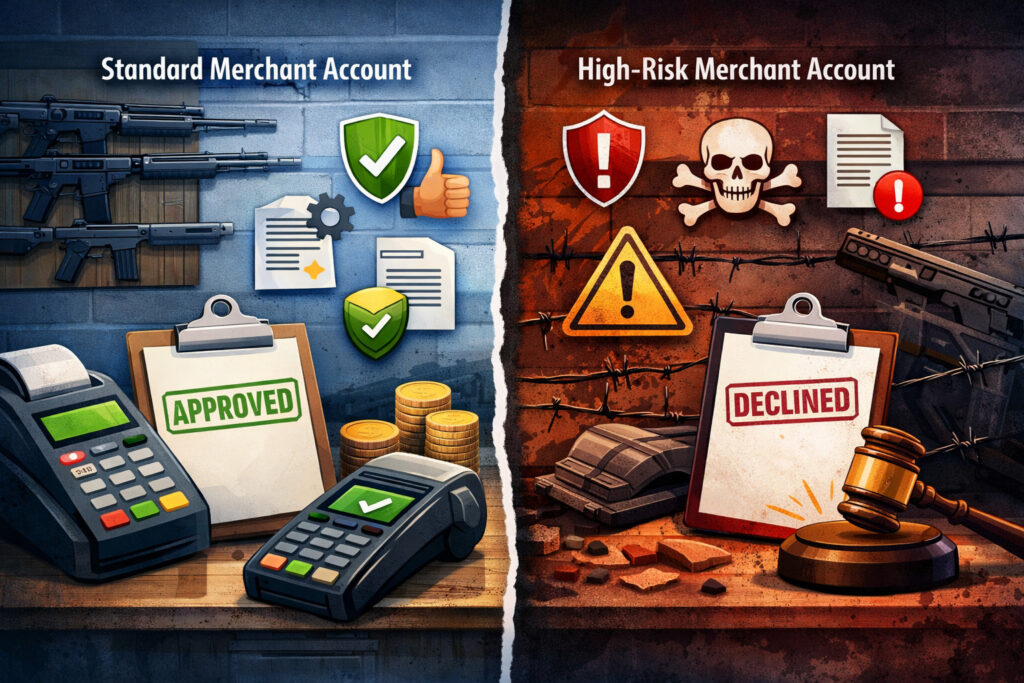
Many firearm retailers ask whether they really need a High-Risk Merchant Account for Firearms or whether a standard merchant account will be enough.
The answer depends on the processor, your business model, and how your activity is classified during underwriting. In many cases, firearms-related businesses are placed into a high-risk category even when they are well-run and fully compliant.
A standard merchant account is usually intended for lower-risk businesses with predictable sales patterns, low fraud exposure, lower dispute rates, and fewer underwriting concerns. Approval may be faster, pricing may look lower, and reserve requirements may be limited or absent. For the right type of merchant, that model works well.
A high-risk account is different. It is built for businesses that processors believe have a higher potential for chargebacks, fraud, reputational risk, or policy sensitivity.
Firearms businesses often fall into this category because of the products sold, the possibility of larger ticket sizes, and the caution many financial institutions apply to the industry. This does not mean the business is unsafe or badly managed. It means the processor sees more exposure and prices or structures the account accordingly.
That structure can include higher processing rates, rolling reserves, more documentation, ongoing monitoring, or additional fraud controls. For many firearms merchants, that is still the correct path because it creates a more honest match between the business and the provider’s risk framework.
A standard account that is not truly comfortable with firearms activity can be more dangerous than a high-risk account with transparent expectations.
The best way to think about it is this: the right account is not the one with the lowest advertised price. It is the one that gives your business stable, secure, and supportable processing over time.
When a Firearms Business Is Likely to Be Placed in a High-Risk Category
A firearms business is more likely to be placed in a high-risk category when it combines industry exposure with sales patterns that processors consider harder to control.
That may include online transactions, mail or phone orders, high average tickets, rapid volume growth, previous processing problems, or limited operating history. The more uncertainty a processor sees, the more likely it is to use a high-risk structure.
New businesses are often viewed more cautiously because they have not yet built a processing record. That does not mean a new dealer cannot get approved. It means underwriters rely more heavily on documentation, owner background, website quality, business plans, licenses, and projected volumes.
Established merchants with stable statements may receive better terms because they can demonstrate real-world performance. Online activity also plays a major role. Card-not-present payments carry more fraud risk than in-store swiped or dipped transactions.
A merchant that takes online payments for accessories, deposits, training, or approved product categories may need stronger fraud protection tools and chargeback controls. Processors often price that additional risk into the account.
Past issues matter too. If a previous provider terminated your account, froze funds, or flagged excessive chargebacks, the next processor will want to understand why. Transparent explanations and documented corrective actions can help, but the account may still fall into a high-risk program with reserves or closer monitoring.
A high-risk classification is not a failure. It is often simply the framework that makes approval possible for firearms businesses while protecting the processor from unexpected losses.
The Trade-Offs: Higher Scrutiny, Better Fit, More Stability
A High-Risk Merchant Account for Firearms usually involves trade-offs. You may face more scrutiny during application, more underwriting questions, stricter website requirements, and less flexibility around incomplete documentation.
Pricing can also be higher than what you see in generic retail ads. That can feel frustrating at first, especially for business owners who know they run a compliant operation.
But the benefit is fit. A processor that knowingly supports high-risk firearms activity is often more reliable than a low-cost provider that approved you by mistake or without fully understanding your model.
Higher-risk programs are built to absorb the realities of these businesses. That means the account may be structured more conservatively, but it is also more likely to remain functional when normal issues appear.
This stability matters in daily operations. Payment interruptions can create serious business problems, especially for stores that depend on deposits, special orders, or steady retail volume.
A provider that understands underwriting for high-risk merchants will usually monitor the account more actively, but it also has a framework for keeping the relationship in place when issues are handled properly.
The right question is not whether you can avoid a high-risk label entirely. The better question is whether the provider gives you a secure, transparent, and sustainable setup. In many cases, a well-structured high-risk account gives firearm retailers exactly that.
What You Need Before You Apply
A strong application starts before you speak with a processor. Many delays happen because merchants submit incomplete information, inconsistent documents, or a website that is not ready for review.
If you want to Set Up a Secure Firearms Merchant Account efficiently, preparation matters almost as much as the provider you choose.
Underwriters want a clear, complete picture of your business. That includes how the company is structured, what it sells, how it takes payments, and whether it appears capable of managing fraud, disputes, and compliance responsibilities.
When your documents are organized and your public-facing business information is polished, the approval process usually moves faster.
At a minimum, most providers will want core business formation documents, identification for owners, banking details, processing statements if available, and any required business licenses or operating documentation.
Firearms businesses often face deeper review, so additional materials may be requested depending on your model. This may include supplier information, fulfillment explanations, product mix details, or a short summary of how transactions are handled in-store and online.
Website readiness is another major part of preparation. Even if your business is mostly in-store, your site often serves as part of the underwriter’s risk review. A weak site raises questions.
A strong site builds confidence. It should reflect a real business with accurate contact details, product information where appropriate, visible policies, and a professional presentation.
Getting these basics in place before you apply helps in three ways. First, it improves approval speed. Second, it may improve your pricing and reserve outcome because the risk review feels cleaner. Third, it sets the foundation for more secure operations after approval.
Business Documents, Licenses, and Processing History
The first layer of approval is documentation. Providers typically ask for standard business paperwork, but firearms businesses should expect a more careful review.
You will likely need formation documents, tax or registration records, bank information, ownership identification, and supporting materials that prove the business is real, active, and aligned with the application.
If you are already processing elsewhere, recent merchant statements are especially valuable. They show actual volume, average ticket, chargeback levels, refund patterns, and funding behavior.
This history gives underwriters something concrete to evaluate. A stable processing record can improve your credibility and help offset some perceived risk tied to the industry category.
Licensing and operational legitimacy also matter. Any required business and firearms-related documentation should be current and consistent with the business name, address, and ownership details listed on the application.
Mismatches between your website, bank records, licenses, and application can trigger delays or extra review. Accuracy matters more than many merchants realize.
For new businesses, the lack of processing history is not fatal, but it means other pieces of your application need to work harder. Underwriters may rely more heavily on owner experience, business plans, expected monthly volume, projected average tickets, and website readiness.
If you are a startup, be prepared to explain your model clearly and provide realistic numbers rather than inflated projections.
Website Readiness and Underwriting Expectations
Your website is often one of the first things an underwriter checks. It helps verify whether your business looks legitimate, transparent, and capable of handling customer expectations. A site does not need to be flashy, but it does need to look complete, accurate, and professionally maintained. Many merchants underestimate how much this affects approval.
A review-ready site should include your business name, contact information, and a clear description of what you sell. If you take online payments, your policies should be easy to find.
This often includes refund terms, shipping details where applicable, privacy language, terms and conditions, and customer support information. If the processor sees missing pages, broken links, vague descriptions, or unclear order terms, it may assume customers will be more likely to dispute transactions.
Secure checkout systems matter too. If you are applying for online payment capability, underwriters want to see a stable e-commerce environment with SSL protection and a professional checkout process.
They may also look for signs that your products, order flow, and security tools align with the provider’s policies. A rushed website can lead to a longer review, higher reserves, or outright denial.
Underwriting expectations are not just about the site itself. They also include how honestly you describe your sales model. If you say you only sell in-store but your website suggests online ordering, that inconsistency can cause problems.
The strongest applications are transparent. They explain the exact role of the website, what transactions will occur there, and which controls are in place to support secure transaction processing.
How a Merchant Account for Gun Dealers Supports Different Sales Channels
A good Merchant Account for Gun Dealers should do more than accept payments. It should support the actual way your business operates. Some dealers process almost everything at the counter.
Others combine point-of-sale payments with online transactions, over-the-phone orders, layaway-style deposits, or special order invoicing. If the account is not aligned with those channels, security and approval issues can appear quickly.
Sales channels matter because risk is not the same across every transaction type. In-store payments made with chip-enabled terminals are generally lower risk than manually keyed transactions or online orders.
Phone payments may require different controls than a secure checkout page. Special orders may introduce timing issues that affect authorization, fulfillment, and customer expectations. Your provider should help map these channels to the right tools.
This is one reason gun store payment solutions should never be treated as one-size-fits-all. The right setup often includes a combination of POS hardware, gateway services, virtual terminal access, invoicing tools, and fraud settings tailored to your workflow.
A merchant that runs a retail counter, attends events, and accepts special orders may need several payment methods under one coordinated account.
The more closely your account fits your real sales process, the easier it is to maintain security and reduce operational mistakes. It also creates a better customer experience.
Customers expect the same level of professionalism whether they are paying at the counter, through an invoice, or on a website. A stable account structure helps you deliver that consistency.
In-Store Firearms Payments, POS Systems, and Secure Terminals
For brick-and-mortar businesses, in-store firearms payments are often the foundation of the account. This is usually where risk is easiest to manage because chip cards, contactless payments, and secure terminals reduce the likelihood of certain types of fraud. A modern POS setup can also improve reporting, inventory coordination, and transaction accuracy.
The key is using hardware and software designed for secure credit card processing. That means EMV-capable terminals, encrypted data transmission, limited card data exposure, and controlled user permissions.
If your team can process payments, issue refunds, and access transaction data, those roles should be properly managed. Too much uncontrolled access creates both fraud and compliance problems.
POS integration also matters. Some gun store payment solutions connect directly with point-of-sale systems, making it easier to reconcile transactions, issue receipts, and track payment events without manual workarounds.
That saves time and reduces human error. It also helps when disputes arise because cleaner records make it easier to prove what happened during a sale.
For stores that take occasional keyed transactions at the counter, security procedures should be tighter. Card-present transactions are safer than manually entered ones, and processors know that. If your business relies on keying cards, you may need stronger review processes and staff training to reduce unnecessary exposure.
Online Gun Store Payments, Phone Orders, and Special Order Processing
Online gun store payments introduce a different level of risk because the card is not physically present. That makes fraud prevention tools essential.
A payment gateway for firearms businesses should support secure checkout systems, AVS, CVV checks, velocity controls, device or behavioral analysis where available, and strong reporting so suspicious patterns can be reviewed quickly.
If your website accepts payments for accessories, training, approved orders, or special deposits, the checkout flow should be clearly structured. Customers need visible pricing, contact details, order policies, and a secure payment page. Ambiguity causes disputes. A professional checkout experience reduces confusion and supports trust.
Phone orders and virtual terminal payments also require care. These transactions can be legitimate and important, especially for special orders or repeat customers, but they are more exposed than in-person chip transactions.
Staff should verify order details carefully, document customer communications, and use the processor’s virtual terminal securely. Payment data should never be written down casually or stored in unsafe ways.
Special orders deserve extra attention because the time gap between payment and fulfillment can increase dispute risk. Customers may forget the timing, misunderstand the process, or become impatient.
Clear written terms, accurate receipts, and proactive communication help reduce those problems. Processors want to see that your business handles these orders in a controlled and well-documented way.
Security Tools Every Firearms Merchant Account Should Include
A secure account is not just an approval outcome. It is a system of layers that work together to protect transactions, customer data, and processor trust. Firearms merchants benefit from strong security because the cost of fraud, disputes, or account instability can be high. The right tools make a measurable difference.
At the core are the tools that protect payment data itself. This includes encryption, tokenization, secure gateways, and PCI-compliant environments.
These tools reduce the chance that cardholder information is exposed during checkout, storage, or transmission. They also help reduce the burden on your business by shifting some sensitive handling away from your internal systems.
The next layer focuses on fraud prevention. AVS, CVV checks, transaction velocity limits, geolocation mismatch alerts, and manual review queues help screen suspicious activity before it turns into chargebacks. These are especially important for online and phone transactions, where fraud risk is higher than at a physical terminal.
Then there is dispute and monitoring infrastructure. Chargeback alerts, reporting dashboards, suspicious transaction reviews, and clear recordkeeping processes help you respond faster when issues arise. A secure firearms merchant account should not just process payments. It should help you see risk early and act on it.
The best providers make these tools accessible without making the system overly complicated. Security should be strong, but it should also be practical for daily use by business owners and staff.
PCI Compliance, Encryption, and Tokenization
PCI compliance is one of the most important building blocks in secure transaction processing. It refers to the security standards businesses are expected to follow when handling cardholder data.
For firearms retailers, this is not optional background paperwork. It is part of how you demonstrate that your operation takes payment security seriously.
Encryption protects card data while it is moving through the payment process. Instead of transmitting readable information, the system converts sensitive data into a protected format. This reduces the risk of exposure during payment acceptance.
Tokenization takes protection further by replacing stored card data with a non-sensitive token that can be used for future transactions or internal references without exposing the original card number.
Together, these tools reduce the amount of sensitive data your business directly touches. That matters because the less card information you handle, the less you have to protect, and the lower your internal exposure becomes. It also helps with customer trust. People want to know that their information is not being stored loosely or passed through weak systems.
PCI compliance should be supported by practical habits. Use approved payment devices, restrict access to payment systems, update software, train staff, and avoid storing payment details outside secure systems.
A compliant environment is not just about passing a questionnaire. It is about building a culture of payment security for dealers and staff alike.
AVS, CVV Checks, Fraud Filters, and Chargeback Monitoring
Fraud tools are especially important for card-not-present transactions. AVS compares the billing address entered by the customer with the address on file at the card issuer. CVV checks confirm the security code on the card. These tools are not perfect, but they are effective first-line defenses against certain unauthorized transactions.
Additional fraud protection tools may include transaction velocity rules, country or region filters, IP and address mismatch alerts, email risk scoring, and manual review thresholds.
For example, if multiple high-ticket orders are placed within minutes using different cards but similar contact information, the system should flag that pattern before it is approved automatically.
Chargeback monitoring is just as important as fraud filtering. Some disputes are caused by true fraud, but many come from confusion, poor communication, delayed fulfillment, or billing recognition issues.
Your processor or gateway may offer alerts that let you respond before a dispute becomes a full chargeback. This can save revenue and protect your account standing.
Good monitoring also helps you improve over time. If you notice that certain order types, sales channels, or customer misunderstandings create repeated issues, you can adjust your checkout process, policies, or documentation. Chargeback prevention is not a one-time setting. It is an ongoing business discipline.
How to Choose a Gun-Friendly Merchant Account Provider
Choosing the right provider is one of the most important decisions in the process. The wrong processor can create delays, unstable approval, poor support, hidden costs, or account disruption when your business needs reliability most. The right one can help you Set Up a Secure Firearms Merchant Account with fewer surprises and stronger long-term support.
A true Gun-Friendly Merchant Account provider should be comfortable discussing firearms payment processing directly. If a sales rep seems evasive, vague, or unwilling to confirm support for your business model, that is a warning sign.
You want clarity early. The provider should be able to explain what kinds of transactions it supports, how underwriting works, what documents it needs, and what security tools are recommended.
Industry experience matters. Providers that work with merchant services for gun shops usually understand the approval challenges, website requirements, sales channel differences, and fraud concerns specific to the industry.
That does not guarantee perfect service, but it usually leads to more realistic onboarding and better support when issues arise.
Transparency matters just as much. You need to understand pricing, monthly fees, gateway costs, reserve terms, contract length, equipment terms, and support access. Hidden fees and unclear cancellation language are common pain points in high-risk processing. Ask detailed questions and get answers in writing whenever possible.
Strong providers also treat support as part of risk management. When fraud issues, disputes, or underwriting reviews happen, you need a real response from someone who understands the account. That support can save you time, money, and frustration.
Questions to Ask Before You Sign
Before signing any agreement, ask questions that go beyond rate quotes. Pricing matters, but it is only one part of the relationship. A provider may advertise attractive processing rates while burying reserve language, gateway add-ons, annual fees, or long cancellation obligations in the fine print. A detailed review helps you avoid expensive surprises later.
Ask whether the provider actively supports firearm retailers and what types of businesses it currently works with in the space. Ask how it handles online payments, phone orders, and in-store processing.
Ask what fraud protection tools are included and whether PCI support is built into the offering. You should also ask how funding works, how long holds can last, and what triggers reserve changes or additional document requests.
It is also worth asking about risk communication. If your account shows unusual activity, who contacts you? How fast can you respond? Is there a dedicated risk or support team? Do you get chargeback alerts or help with dispute response? These practical questions often reveal more about the provider than a basic sales presentation.
Finally, ask for a full fee breakdown. That includes transaction costs, monthly minimums, statement fees, gateway charges, PCI fees, equipment costs, batch fees, annual fees, and early termination terms. A provider that resists transparency before you sign is unlikely to become more transparent afterward.
Red Flags That Signal a Poor Processor Fit
Some warning signs appear early. Others show up only after you start reading the agreement carefully. Either way, it is better to catch them before your business is locked into a poor arrangement.
One major red flag is lack of clarity around firearms support. If the provider cannot explain its position clearly, your approval may not be stable even if the account opens.
Another red flag is unrealistic promises. Be cautious of anyone guaranteeing instant approval, ultra-low rates regardless of business model, or no-risk processing for all online sales.
Firearms businesses often require deeper underwriting. Honest providers acknowledge that. Overpromising is usually a sign that the sales process is disconnected from actual risk review.
Weak support is another issue. If it is hard to get answers during the sales process, imagine how difficult it may be during a funding delay or chargeback spike. You want responsive communication, not generic scripts. Poor contract transparency, especially around reserves and cancellation terms, is also a serious concern.
A final red flag is inadequate security guidance. If the provider is not asking about your website, checkout setup, fraud tools, or payment security for dealers, it may not be thinking proactively about your risk profile. In a high-risk category, that lack of depth can cause problems later.
How to Set Up a Secure Firearms Merchant Account Online Step by Step
If you want to set up a secure firearms merchant account online, it helps to follow a structured process rather than rushing straight into an application. A step-by-step approach reduces errors, improves underwriting confidence, and closes the common gaps that lead to fraud issues or account delays later.
Start by reviewing your business model honestly. Determine which products and services you will process payments for, which channels you will use, and how customers move from order to fulfillment.
Once that is clear, prepare your documents, review your website, and identify the security tools your business needs. Then compare providers with a focus on fit, not just price.
After you apply, respond quickly to underwriting requests and be transparent about your operations. Once approved, configure your gateway, terminals, virtual terminal access, user permissions, and fraud settings carefully.
Run tests. Review your billing descriptor. Confirm receipts, refund procedures, and reporting access. Make sure your staff understands how to use the system properly before live processing begins.
A secure setup is not complete the day your account is approved. The launch phase matters. Many merchants create unnecessary risk by going live before policies, fraud rules, and internal procedures are fully in place. A better approach is to treat onboarding as part of your risk strategy.
Step 1 Through Step 4: Prepare, Compare, Apply, and Configure
Step one is preparation. Gather your business formation documents, licenses, ownership identification, bank information, and processing statements if you have them. Review your website for contact details, policies, secure checkout elements, and overall professionalism. Make sure the story your documents tell matches the story your website tells.
Step two is provider comparison. Look for a high-risk payment processor or gun-friendly provider with proven firearms industry experience. Ask about support, security tools, contract terms, reserves, and the exact payment methods supported. Compare real value, not just rate quotes.
Step three is the application. Fill it out carefully and avoid optimistic guesswork. Use realistic volume estimates and be transparent about online, in-store, phone, or special-order payments. Respond quickly if underwriting asks follow-up questions. Delayed or incomplete replies can slow the process and weaken confidence.
Step four is configuration. Once approved, set up your gateway, terminal, or POS environment properly. Enable AVS and CVV where appropriate. Review chargeback notifications, reporting access, funding schedules, and user permissions.
If you process online payments, test the full customer experience from cart to receipt and verify that fraud settings are working as expected.
Step 5 Through Step 7: Train, Monitor, and Maintain
Step five is staff training. Even the best merchant account can create risk if employees use it inconsistently. Train your team on secure card handling, refund procedures, suspicious order escalation, virtual terminal rules, and customer communication standards. One employee taking shortcuts with card data can create serious problems.
Step six is monitoring. Watch transaction patterns, failed AVS responses, refund activity, chargeback notices, and unusual spikes in volume. Set a regular schedule for checking your dashboard and gateway alerts. Early detection is one of the best forms of firearm retailer risk management.
Step seven is maintenance. Keep your website updated, renew compliance items on time, review fraud settings regularly, and stay in communication with your processor if your business changes.
If you add a new sales channel, begin a major promotion, or expect a large volume increase, notify your provider in advance. Surprises create risk flags. Clear communication supports trust and account stability.
This final stage is what keeps the account secure over time. Many businesses focus heavily on approval and then ignore the operational habits that preserve it. A secure firearms merchant account is strongest when maintenance becomes part of normal business practice.
Common Mistakes That Create Security or Approval Problems
Many merchant account problems are avoidable. They happen not because the business is unsafe, but because the setup was rushed, incomplete, or based on the wrong provider. If you understand the common mistakes ahead of time, you can avoid the issues that lead to delays, higher costs, fraud losses, or even account termination.
One of the most common mistakes is choosing a processor based only on price. A low advertised rate may look appealing, but if the provider does not truly support firearms merchants, the relationship may not last.
Another frequent issue is weak website readiness. Missing policies, poor checkout design, inconsistent business information, and unclear order terms all create underwriting and chargeback risk.
Some businesses also underestimate fraud prevention. They assume a payment gateway alone is enough, but without proper filters, monitoring, and staff procedures, suspicious transactions slip through. Others ignore the contract details, especially reserve language and termination terms, until a problem appears.
Poor communication is another mistake. If your volume changes sharply, your website changes, or your sales channels expand, your processor should know. Surprises are one of the fastest ways to trigger risk reviews.
The strongest merchants treat the processor relationship as something to manage actively, not just a background utility.
Weak Website Compliance, Hidden Fees, and Poor Fraud Settings
A weak website can damage your approval odds even before you process a single transaction. Underwriters expect a professional digital presence.
If your website lacks policies, has broken pages, uses unclear product language, or does not match your application details, it may signal poor operational control. That can lead to delays, reserve requirements, or denial.
Hidden fees are another common trap. Some merchants focus on the discount rate but overlook monthly minimums, annual fees, gateway charges, PCI fees, equipment leases, statement fees, or early termination penalties.
In high-risk payment processing, the cost structure can be complex, so every line item matters. Ask for full transparency and review the agreement carefully.
Poor fraud settings are equally dangerous. A merchant may launch an online checkout with weak AVS settings, no CVV requirement, and no transaction review thresholds. That can invite unauthorized activity and chargebacks quickly.
On the other hand, overly aggressive filters can reject good customers and hurt conversion. The goal is balance, built through testing and review.
Ignoring Contract Terms and Processor Communication
Contract terms affect more than pricing. They can shape your cash flow, flexibility, and risk exposure. Reserve terms, funding delays, account review rights, volume thresholds, and cancellation language all matter. Some merchants do not read these sections closely because they are eager to get approved. That can become expensive later.
Processor communication is another overlooked issue. If you expect a major seasonal rush, start selling in a new way, or launch online payments after years of being store-only, tell your provider first.
Sudden changes in volume or transaction type can trigger automatic reviews. When the processor hears about changes in advance, those reviews are often easier to manage.
Good communication also helps when issues arise. If you see suspicious activity, a dispute trend, or operational error, address it early. Waiting for the processor to discover the issue on its own often creates a more defensive response. Trust is easier to maintain when communication is proactive and documented.
Best Practices for Ongoing Security, Account Health, and Risk Management
Getting approved is only the beginning. Long-term success depends on how well you manage the account after launch. Firearms businesses that maintain strong controls, clear documentation, and consistent communication tend to enjoy better account stability than merchants who treat processing as a set-it-and-forget-it function.
Ongoing security starts with routine system reviews. Check your gateway settings, POS permissions, fraud filters, billing descriptors, and reporting tools regularly.
Look for patterns that signal trouble, such as rising refunds, repeated AVS failures, or unusual transaction timing. These indicators often appear before a serious fraud or chargeback issue develops.
Documentation is another important habit. Save order records, customer communications, signed receipts where relevant, tracking details, and policy acknowledgments.
These details strengthen your chargeback responses and show the processor that your business operates with discipline. Good records also make it easier to investigate suspicious transactions internally.
Regular staff training matters too. Employees forget procedures, shortcuts emerge, and turnover introduces new risk. Review secure card handling, refund approval rules, manual entry standards, and escalation processes for suspicious orders. Security works best when the whole team understands it, not just the owner or manager.
Strong merchants also keep the processor informed. Growth is good, but sudden unexplained growth may look risky to a provider. If your volume, product mix, or sales channels change, communicate early. That simple step can prevent reserve increases or funding interruptions.
Dispute Management, Fraud Reviews, and Internal Controls
Dispute management should be proactive, not reactive. Do not wait until chargebacks become frequent. Review every dispute for cause. Was the customer confused by the billing descriptor? Was there a shipping delay, a communication gap, or a preventable fraud pattern? Each answer helps you improve the business.
Fraud reviews should happen on a set schedule, especially if you accept online or phone transactions. Look at flagged orders, mismatched AVS results, unusually large transactions, repeat attempts from the same data points, and refund anomalies. Even a small business can benefit from disciplined fraud review if it processes card-not-present transactions.
Internal controls create accountability. Limit who can issue refunds, change gateway settings, access reporting, or use virtual terminal functions. Strong access controls reduce internal misuse and create cleaner audit trails. This is especially important in growing businesses where multiple employees touch the payment system.
Building Long-Term Processor Confidence
Processors like predictability. They want to see consistent volume, manageable chargebacks, timely responses, and honest communication. When your business looks organized and transparent, the processor is more likely to work with you when normal issues arise. That is valuable in any high-risk environment.
Building confidence means avoiding surprises where possible. Let your provider know about major promotions, seasonal spikes, website changes, or new transaction channels. Keep your documents current. Respond quickly to requests. Show that you understand your own fraud trends and have a plan to manage them.
Over time, a well-run account may gain more flexibility. Reserve terms may improve, reviews may become easier, and support interactions may become smoother because the processor sees your business as disciplined and low-drama within its category. That kind of trust is earned through consistent operational quality.
Secure Firearms Merchant Account Checklist
A practical checklist can help you move from planning to execution without missing key details. Use this before applying and again after approval to make sure your setup stays strong.
Pre-Approval Checklist
- Confirm your business structure, ownership details, and banking information are accurate
- Gather formation documents, identification, licenses, and prior processing statements
- Review your website for contact information, policy pages, and professional presentation
- Make sure your application matches your actual sales model
- Clarify whether you need in-store, online, phone, or special-order payment capability
- Compare providers based on firearms experience, fraud tools, pricing transparency, and support
Post-Approval Checklist
- Configure POS, gateway, and virtual terminal access securely
- Enable AVS, CVV checks, and other relevant fraud protection tools
- Verify PCI compliance tasks are completed
- Test checkout, receipts, refunds, and billing descriptors
- Train staff on card handling, refunds, and suspicious order procedures
- Set a schedule for fraud review, chargeback monitoring, and processor communication
- Update your provider before major business changes or volume spikes
FAQ
Q.1: How long does it take to set up a secure firearms merchant account?
Answer: The timeline depends on the provider, your business readiness, and how quickly you respond to underwriting requests.
Businesses with organized documents, a professional website, and clear processing history often move faster than those applying with incomplete information. Firearms-related accounts may take longer than standard retail setups because risk review is usually more detailed.
Q.2: Do all firearms businesses need a high-risk merchant account?
Answer: Not every business will be labeled the same way, but many firearms merchants are placed into a high-risk category because of processor policies and perceived industry exposure.
That does not mean the business is unsafe. It usually means the account is being structured for a category that requires closer underwriting and stronger risk controls.
Q.3: What makes a gun-friendly merchant account provider different?
Answer: A gun-friendly provider is willing to support firearms-related businesses and usually has more experience with the underwriting, fraud, compliance, and operational needs involved.
These providers are often better at matching merchants with suitable gateways, POS tools, and security controls rather than trying to force the business into a generic retail setup.
Q.4: Can I set up a secure firearms merchant account online if I also sell in-store?
Answer: Yes. Many businesses use a combined setup that supports both in-store firearms payments and online transactions. The key is making sure your processor understands all sales channels involved and that your security controls match each one. In-store, online, and phone payments do not carry the same risk, so they should not be treated exactly the same.
Q.5: What documents do underwriters usually ask for?
Answer: Most providers ask for standard business documents, owner identification, banking information, and processing statements if you already accept cards. Firearms businesses may also face additional review based on licenses, website readiness, order flow, projected sales volume, and overall business transparency.
Q.6: Why is website readiness so important for approval?
Answer: Your website helps underwriters verify that your business is legitimate, transparent, and prepared to serve customers clearly.
Missing policies, broken pages, unclear order terms, or inconsistent business information can raise concerns about future disputes and operational risk. Even businesses focused on storefront sales benefit from having a polished and complete website.
Q.7: Which security tools matter most for firearms payment processing?
Answer: The most important tools usually include PCI compliance, encryption, tokenization, AVS, CVV checks, chargeback monitoring, and fraud filters within your payment gateway for firearms businesses. The right combination depends on how you sell, but every firearms merchant should prioritize secure data handling and strong transaction screening.
Q.8: How can I reduce chargebacks in a firearms business?
Answer: Use clear billing descriptors, visible policies, accurate receipts, and proactive customer communication. Pair that with strong fraud tools, careful documentation, and regular dispute review. Many chargebacks can be reduced by improving order clarity and responding quickly when customer confusion appears.
Q.9: Are reserves always required for a high-risk merchant account for firearms?
Answer: Not always, but they are common. A processor may require a reserve based on your business type, sales channels, operating history, or perceived exposure. Reserves are meant to protect the processor against potential losses. A stronger application and stable account history may improve your terms over time.
Q.10: What is the biggest mistake to avoid when setting up a firearms merchant account?
Answer: The biggest mistake is choosing the wrong processor. A provider that lacks firearms industry experience may approve the account without truly supporting the business, which can lead to holds, poor support, hidden fees, or account instability. The best results usually come from choosing fit, transparency, and security over the lowest advertised rate.
Conclusion
To Set Up a Secure Firearms Merchant Account, you need more than approval. You need the right provider, the right tools, and the right operational habits. Firearms businesses face more scrutiny than many standard merchants, which makes secure setup and long-term account management especially important.
A strong account supports your real sales channels, protects customer data, reduces fraud risk, and gives processors confidence in your business. That means preparing documents carefully, building a review-ready website, understanding underwriting expectations, and choosing a provider with real firearms industry experience.
It also means using security tools like PCI compliance, encryption, tokenization, AVS, CVV checks, and chargeback monitoring as part of everyday operations.
Whether you are a new dealer or an established retailer, the goal is the same: stable, secure, and reliable payment processing that fits your business. A thoughtful setup today can prevent costly disruptions tomorrow.
When your merchant account is built correctly, it becomes more than a payment tool. It becomes part of your business foundation.
Leave a Reply